Identify the moisture mechanism before choosing equipment
Condensation is water vapor becoming liquid at a cold surface. Seepage is commonly used to describe moisture arriving through the foundation or its joints. Minnesota Extension distinguishes liquid flow, capillary suction, vapor diffusion, and air movement. A basement can have more than one pathway, so the choice is not always 'condensation or a leaking crack.' Plumbing and appliance leaks are additional possibilities.
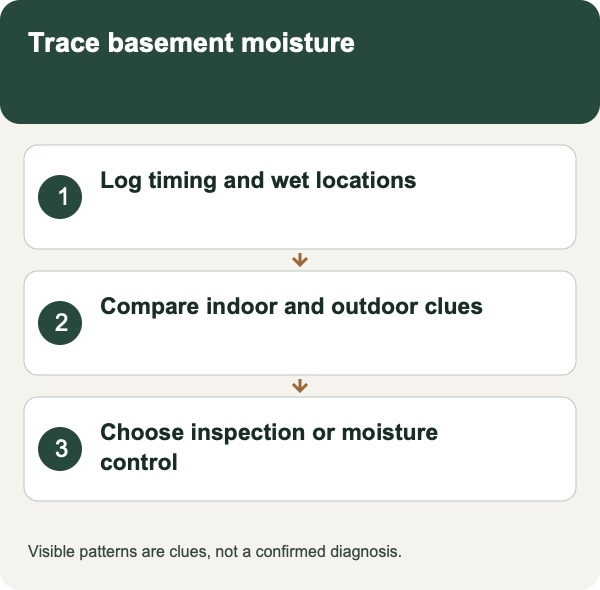
Start by describing the visible problem without naming its cause. 'Beads on the cold-water pipe' and 'water appearing at the wall-floor joint after rain' are useful observations. 'Bad waterproofing' is a conclusion that needs support. This guide helps organize those observations before a service call or purchase. It does not certify a foundation, exclude hidden mold, or provide a destructive inspection procedure. Existing humidity guidance remains useful once the moisture source is understood.[1][3]
Apply the safety screen before inspecting
Standing water near electrical equipment changes the task immediately. CDC warns never to operate electrical switches or equipment while standing in water; if reaching the disconnect requires entering water, call an electrician. Flood-affected electrical systems need professional inspection before restoration. Do not step into a wet basement just to read a dehumidifier display or retrieve a moisture meter.
Leave structural concerns, sewage contamination, extensive water damage, or suspected hidden mold to the appropriate professionals. EPA recommends prompt drying of water-damaged materials, generally within 24–48 hours, but that is not permission to enter an unsafe space. Do not postpone active-leak response so you can finish a week of observations. The logging method below is for safely accessible, non-emergency conditions; safety, source control, and timely drying take priority over collecting a perfect dataset.[6][5]
Compare where and when moisture appears
Condensation is consistent with droplets on cool pipes, walls, or floors when surrounding air is humid. Minnesota Extension notes that warm, humid outdoor air entering a cooler basement can produce condensation that looks like leakage. Conversely, water visibly entering at a joint or crack, especially in a repeatable relationship with rain or snowmelt, raises the priority of a drainage and foundation assessment. Neither pattern is conclusive by itself.
Draw a simple floor plan and mark each wet location. Photograph it from the same position when safe, adding the date and recent weather. Note whether the ceiling, a supply connection, appliance drain, or window area is wet above the apparent floor puddle. Water found at the floor is not necessarily entering there. Do not drill, remove wall coverings, or lift suspect finishes just to complete the map. Record 'concealed source not inspected' where appropriate.[1][3]
Use dew point as supporting evidence
The National Weather Service defines dew point as the temperature at which air reaches saturation. Condensation can occur when a surface is below the dew point of the air contacting it. If you can safely record indoor temperature and relative humidity and estimate the local dew point, comparing it with the surface temperature can support a condensation hypothesis.
For illustration, a measured surface colder than the nearby air's estimated dew point is consistent with condensation; it does not exclude water also moving through that surface. The outdoor forecast dew point is not automatically the basement's indoor dew point. Consumer instruments also have placement and accuracy limitations, so follow their instructions and avoid treating a small difference as decisive. Record the device and measurement location with the number. If you cannot obtain useful measurements, keep the observation log and ask a building professional to assess the conditions.[2][1]
Check manageable moisture sources and exterior clues
EPA identifies leaking plumbing, water moving toward the foundation, and insufficient drainage as possible moisture sources. From ground level and safe access points, note overflowing gutters, disconnected downspouts, or places where water collects beside the house. Do not climb an icy ladder or excavate the foundation to investigate. Photographs of runoff during an ordinary rain can help a contractor understand a problem that disappears before the appointment.
Indoors, check whether laundry drying, an unvented dryer, a humidifier, or other activities coincide with rising humidity. Minnesota Extension lists these kinds of indoor sources and humid outdoor air as contributors. Write down changes in use: a new laundry routine, an open basement window, or recently occupied rooms. Correct an obvious, safely manageable source according to the equipment instructions, but track whether wetting returns. One improved reading does not demonstrate that every moisture pathway has been addressed.[3][7]
Use dehumidification for the part it can actually address
A dehumidifier removes moisture from air; it does not repair an entry path for liquid water. Choose equipment only after accounting for that distinction. ENERGY STAR bases portable-unit selection on both the space and its dampness, and recommends checking low-temperature suitability for cool rooms. Our basement dehumidifier tool can support sizing, but cannot diagnose a wet foundation or choose a drainage repair.
If using a unit in a safe, dry electrical setup, follow its clearance and drainage instructions and keep a record of room conditions. ENERGY STAR advises closing doors and windows to the treated space and keeping drain hoses away from electrical connections. A full collection bucket proves that moisture was removed, not where the moisture originated. If the air becomes drier but a joint continues to weep, retain both observations. Do not repeatedly buy larger units instead of asking why liquid water is still arriving.[4][3]
Avoid false certainty from a single home test
A humidity reading is a snapshot of the air near the instrument, not a survey of all surfaces and concealed cavities. Likewise, a taped patch, an old stain, or the absence of water during dry weather should not be treated as a stand-alone clearance test. The practical question is whether several independent observations tell a consistent story, including what happens during the conditions that originally produced the wetting.
Our suggested log has six fields: time, recent weather, exact location, appearance of wetness, indoor readings if available, and equipment or window settings. Add a separate line for interventions so you can distinguish a weather change from something you changed. Do not deliberately wet the foundation to reproduce a leak. If the evidence conflicts, tell the inspector that rather than choosing the explanation associated with the least expensive product. Uncertainty is a useful finding when it prevents the wrong repair.[1][7]
Ask for a repair tied to a documented source
Give the professional your location map, photographs, weather notes, measurements, and prior repair history. Ask which observations support the proposed source, what remains unverified, and how the proposed work addresses that source. A useful proposal distinguishes drainage correction, plumbing repair, humidity control, and any required material cleanup rather than treating all basement dampness as one condition.
Before replacing finishes, agree on how dryness and recurrence will be assessed. EPA emphasizes fixing the water problem alongside mold cleanup; hiding dampness under new paint or wall coverings does not establish that the cause is resolved. Get help promptly when water repeatedly returns, concealed materials may be affected, or mold cleanup exceeds a manageable small area. Keep the final explanation with your records so the next wet season becomes a check of the repair, not a fresh guess about the same symptom.[5][3]
| Clue | What it can suggest | What to check next |
|---|---|---|
| Droplets on cold surfaces during humid conditions | Condensation is plausible | Compare local air conditions, surface temperature, and other water sources |
| Recurring water at a joint after rain | Drainage or below-grade water entry needs attention | Document timing and request a foundation/drainage assessment |
| Wetness below a pipe or appliance | A plumbing or drainage leak remains possible | Have the visible connection and upstream route assessed safely |
| Lower room humidity but persistent localized wetting | Air moisture was not the entire problem | Investigate the continuing source rather than increasing dehumidifier size alone |
Before you buy or hire
Related reading and tools
Choose the next step for your situation: measure, compare options, or maintain and verify.
- Explore the topicIndoor Air, Radon, and Mold
- Measure the problemIdeal Basement Humidity to Prevent Mold: Targets and Troubleshooting
- Measure with a toolBasement Dehumidifier Size Planner
- Compare your optionsAir Purifier vs Dehumidifier for Mold: Different Jobs, Different Limits
How this guide was checked
Guides are built from official sources, product documentation, manufacturer manuals, and practical homeowner decision criteria. We do not claim hands-on product testing unless a page explicitly says a product was tested.
- Source-backed editorial review
- 7 cited source records
- Radon and mold decisions can affect health. Follow EPA/CDC guidance and use qualified mitigation or remediation pros when levels, area, or symptoms justify it.
Ready Home Systems is educational and not a substitute for local code officials, licensed trades, medical providers, water labs, or mitigation professionals.
Read review methodologySources and manuals
- Moisture in basements: causes and solutionsUniversity of Minnesota Extension
- National Weather Service Glossary: Dew and Dew PointNational Weather Service
- What are the main ways to control moisture in your home?U.S. Environmental Protection Agency
- Dehumidifiers: Buying GuidanceENERGY STAR
- A Brief Guide to Mold, Moisture and Your HomeU.S. Environmental Protection Agency
- Safety Guidelines: Reentering Your Flooded HomeCenters for Disease Control and Prevention
- Controlling moisture problems in your homeUniversity of Minnesota Extension
FAQ
Can condensation and seepage happen together?
Yes. They involve different moisture pathways and can coexist. Improvement in room humidity does not rule out continuing water entry through the foundation or a separate plumbing leak.
Will opening basement windows dry the room?
Not always. Warm, humid outdoor air can condense on cooler basement surfaces. Base ventilation decisions on conditions and the applicable moisture-control plan, not simply on whether the air outside feels fresh.
Should I buy a dehumidifier before calling someone?
It may help an air-moisture problem, but active leaks, repeated seepage, electrical exposure, substantial damage, or suspected hidden mold need appropriate assessment. Sizing a dehumidifier is not a substitute for identifying the source.
Related guides
Best Radon Test Kit: Short-Term, Long-Term, or Digital Monitor?
Compare radon tests by measurement window, qualified lab or device, closed-building rules, placement, follow-up, and real-estate timing.
Dehumidifier Running but Not Lowering Humidity: What to Check
Check airflow, condensate, room temperature, settings, and incoming moisture when a dehumidifier runs without lowering humidity. Know the service stop points.
Digital Radon Detector vs Charcoal Kit: Which Test Should You Use?
Compare digital and charcoal radon tests by window, feedback, lab handling, calibration and QA, repeat use, cost, and confirmation strategy.