A capacity label is a test result, not a daily collection target
Capacity in pints per day expresses moisture removal normalized to specified test conditions. It is not the size of the removable bucket, nor a promise that the machine will collect that volume every day in your basement. DOE's Appendix X1 defines capacity separately from its energy-efficiency measures. A product can therefore have a large pint rating without that number describing its drainage container or your electricity bill.
Start a comparison sheet with four headings: exact model, product class, capacity with conditions, and efficiency metric. If a retailer lists '50 pint' but omits the testing basis, leave that cell incomplete until the manufacturer supplies it. Precision in the number cannot compensate for missing conditions. The purpose of this worksheet is to expose mismatches before you shortlist products, not to calculate a room's moisture load from an advertisement.[1]
65°F, 73°F and 80°F describe different comparison contexts
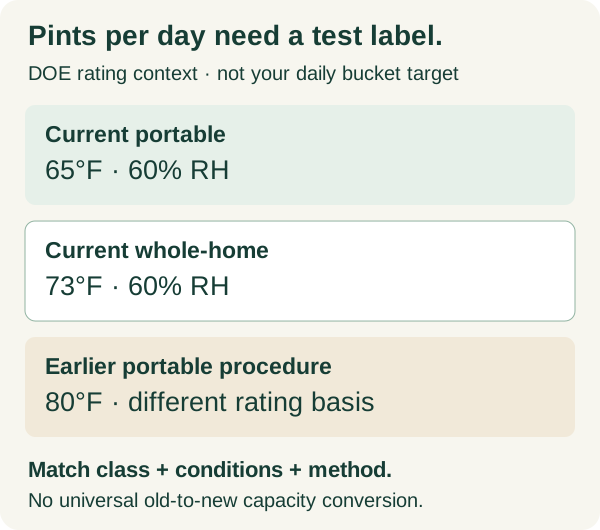
Appendix X1's standard-condition table uses 65°F and 60% relative humidity for portable units, versus 73°F and 60% for whole-home units. The table includes test tolerances, and whole-home testing has configuration requirements beyond temperature. These two classes should not be ranked by pint numbers as if the products had been run side by side in the same room.
ENERGY STAR explains that the earlier portable test used 80°F. Moving to the cooler procedure can reduce the published capacity even for otherwise comparable equipment. Its old-to-new table is explicitly approximate and says actual changes vary by model. Accordingly, there is no honest universal rule that multiplying an old capacity by a fixed factor identifies the exact replacement you need.[1][2]
| Published rating | Stated condition | How to use it |
|---|---|---|
| Current portable capacity | 65°F dry-bulb / 60% RH; Appendix X1 includes tolerances | Compare portable candidates under the same method |
| Current whole-home capacity | 73°F dry-bulb / 60% RH; relevant installation test configuration | Compare the intended whole-home application and configuration |
| Older portable capacity | Earlier 80°F procedure | Find model-specific documentation; approximate tables are not exact replacements |
| EF versus IEF | Different energy-accounting metrics | Do not compare their numerical values as an identical test |
Scroll sideways to read every column on smaller screens.
A useful replacement request includes the old label
Photograph the old model label and retain any rating sheet rather than relying on a remembered '70 pint.' Ask the seller of a candidate replacement for its current rated capacity, test basis and intended application. Record whether the old unit actually controlled humidity, or merely ran continuously. An old machine that struggled is not a successful sizing benchmark, even when its label can be translated approximately.
A helpful request is: 'This is the old model, this is the room's usual temperature and humidity, and this is the drainage arrangement. Which current model is appropriate, and which rating record supports that comparison?' That gives the supplier a concrete question. It does not presume that a lower printed pint number is a downgrade or that a larger number repairs a moisture source.
IEF answers a different question from pints per day
ENERGY STAR distinguishes the integrated energy factor, IEF, from the older EF metric: IEF accounts for energy used when the machine has cycled off. Its units are liters of water removed per kilowatt-hour. A higher comparable IEF indicates better efficiency under the test method; it does not by itself specify how quickly a wet space will dry or the power draw at every moment.
Keep capacity and IEF in separate columns. Do not compare one candidate's EF with another candidate's IEF as if the labels were interchangeable. Likewise, do not turn an efficiency ratio into an annual cost forecast without a defensible operating profile and electricity rate. This article supplies no claimed savings for a named model because those inputs have not been established.[2][3]
Resolve a mixed quote before naming a winner
Consider a hypothetical quote with Portable A listed at 50 pints per day under the current portable test and Whole-home B listed at 80 pints under the current whole-home test. It is tempting to call B '60 percent more effective.' That arithmetic compares label quantities, not performance at the same inlet conditions or in the same installation. It cannot decide which device belongs in the house.
The useful next step is to ask why a ducted system is proposed instead of a room unit, what space it will serve, and what design conditions support the selection. Then compare like-for-like candidates within that application. If a manufacturer provides an additional performance table at matching temperature, humidity and installation conditions, retain that table with the proposal. Do not manufacture a performance curve from a single standardized rating point.
Search the exact model, including suffixes
Use the current ENERGY STAR product finder to check a claimed certification and compare the exact model designation with the seller's quote. Keep a dated copy of the manufacturer rating sheet and the matching certification record when available. A brand logo or a family name is not a substitute for the model record. If a listing cannot be located, ask the supplier to resolve the discrepancy instead of assuming either approval or disqualification.
For this article, no numerical performance or certification claim is made for AprilAire E080 or another specific candidate. The product finder is a verification destination, not evidence that we checked every listing within it. This distinction matters when model suffixes, discontinued versions and regional products appear together in a search result.[4]
A fair label comparison still cannot diagnose the room
ENERGY STAR's buying guidance considers both space size and moisture conditions. It also calls attention to low-temperature suitability and drainage, while whole-home equipment needs appropriate professional sizing and installation. A cool basement, a leaking wall and an inconvenient drain are different constraints; selecting the highest printed capacity does not answer all three.
Our suggested site notes include the usual temperature range, humidity readings with dates, visible water entry, room connections, drain route and access for maintenance. Keep observations separate from diagnoses. Use the seepage-versus-condensation guide when water appears on surfaces and the troubleshooting guide when a running machine does not control humidity. Do not treat a favorable pint rating as proof that existing mold or building damage has been addressed.[3]
Leave checkout with a complete comparison file
For each shortlisted machine, save the exact model, dated source, product class, rated capacity and its conditions, IEF, supported operating temperatures, drainage requirements and proposed installation scope. Mark unknowns explicitly. Ask the supplier to explain any extra high-temperature capacity figure beside the standardized number; do not quietly substitute the larger one in your comparison.
The winning proposal is the one whose application and supporting records fit the problem, not automatically the largest pint claim. Revisit the comparison if the installation design changes. Once installed, assess actual humidity control and maintenance needs using the operating instructions rather than expecting the bucket to reproduce a laboratory label every day.
Related reading and tools
Choose the next step for your situation: measure, compare options, or maintain and verify.
- Measure the problemIdeal Basement Humidity to Prevent Mold: Targets and Troubleshooting
- Measure the problemBasement Condensation vs. Water Seepage: How to Sort the Clues
- Compare your optionsDehumidifier Running but Not Lowering Humidity: What to Check
- Compare your optionsAir Purifier vs Dehumidifier for Mold: Different Jobs, Different Limits
How this guide was checked 2026-10-23T00:00:00.000Z
Guides are built from official sources, product documentation, manufacturer manuals, and practical homeowner decision criteria. We do not claim hands-on product testing unless a page explicitly says a product was tested.
- Source-backed editorial review
- 4 cited source records
- Radon and mold decisions can affect health. Follow EPA/CDC guidance and use qualified mitigation or remediation pros when levels, area, or symptoms justify it.
Ready Home Systems is educational and not a substitute for local code officials, licensed trades, medical providers, water labs, or mitigation professionals.
Read review methodologySources and manuals
- 10 CFR Part 430, Appendix X1: dehumidifier test procedureU.S. Department of Energy / eCFR
- Dehumidifier Testing and CapacityENERGY STAR / U.S. EPA
- Dehumidifiers: buying guidanceENERGY STAR / U.S. EPA
- ENERGY STAR certified dehumidifier product finderENERGY STAR / U.S. EPA
Keep a copy for reference or share the guide. Check the online version for later updates.
Ready Home Systems · https://readyhomesystems.com/dehumidifier-pint-ratings-test-conditions/
Planning guidance, not a professional assessment. Check the online guide and cited sources for updates.