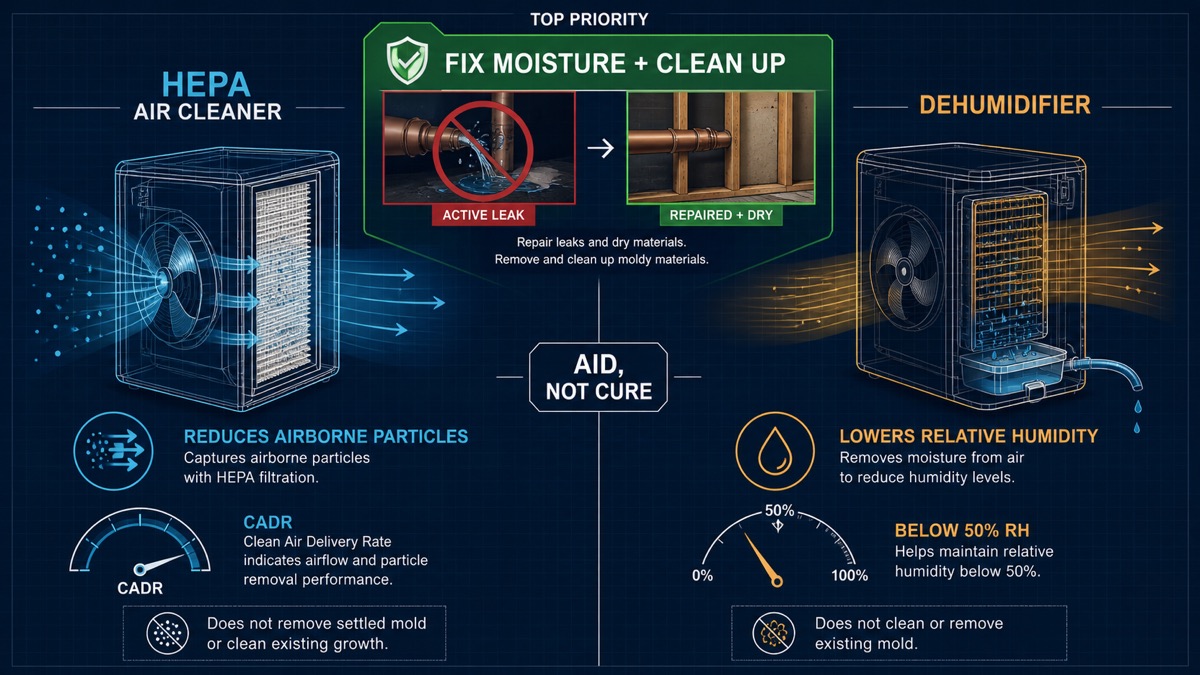
Use the purifier and dehumidifier job boundary
Write the actual job in one sentence. If the problem is high room humidity, a correctly sized and drained dehumidifier may remove water vapor after leaks and bulk-water sources are addressed. If the task is supplemental removal of airborne particles in one occupied area, a properly sized mechanical air cleaner may help while source control and safe cleanup continue. The two outputs are not interchangeable.
EPA states that portable air cleaners and HVAC filters do not solve mold because they do not correct the water or moisture source. They may remove some airborne particles, while a dehumidifier does not remove established growth or clean contaminated materials. Neither device verifies remediation, reaches every hidden cavity, or turns a musty odor into a building-wide health conclusion.
Create separate closure evidence: source repaired, wet materials dried or assessed, growth cleaned or removed within the appropriate scope, humidity trend controlled, and any optional purifier operated in a room and at a rate the exact instructions support. Avoid devices that intentionally produce ozone in occupied spaces. Escalate extensive, hidden, HVAC-related, contaminated-water, structural, or vulnerable-occupant situations.[1][2][4]
The correct order of operations
First stop the water: repair plumbing, roof, foundation, drainage, HVAC condensate, or ventilation failures. Second dry wet material within 24–48 hours when possible and remove material that cannot be cleaned and dried. Third clean or remediate contamination using methods and protective measures appropriate to area and material. Only then optimize ongoing humidity and optional particle control.
After a flood, EPA says to assume mold growth when the home could not be dried within 24–48 hours. High-volume HEPA-filter fans and air cleaners may assist air circulation and cleaning, while dehumidification and humidity monitoring support drying. These are parts of a controlled cleanup, not evidence that a flooded wall cavity or carpet is safe to leave in place. Sewage and structural or electrical damage require qualified help.[2][3]
When a dehumidifier helps
Use a dehumidifier when measured relative humidity remains high after bulk-water sources are addressed or when seasonal air brings a recurring moisture load. EPA recommends below 60% and ideally 30–50%; CDC advises no higher than 50% all day. Size the unit for space, temperature, and dampness, provide reliable drainage, place an independent hygrometer away from the discharge, and check readings across the room.
Dehumidification is especially relevant to basements, bathrooms without adequate exhaust, and spaces with condensation. It may not overcome open soil, major infiltration, an unvented dryer, or continuous leakage. If the unit runs constantly without reaching target, investigate instead of automatically buying another. Clean filters, coils, buckets, drains, and pumps as directed so the appliance does not become dirty or stop when a bucket fills.[2][4]
When a HEPA air cleaner may help
A portable air cleaner with a high-efficiency particulate air filter can reduce airborne particles that pass through it. Select by clean air delivery rate for the room and pollutant type, then operate long enough at a tolerable speed. Close doors or consider multiple units for separated spaces. Replace filters according to loading and handle contaminated filters carefully during remediation.
Particle reduction may be useful during or after a properly contained cleanup, for residual dust, or as one part of allergy management, but EPA notes that health studies do not show the same benefit for every person or symptom. An air cleaner cannot reach mold inside walls or remove settled contamination without cleaning. Avoid marketing that promises to sterilize an occupied building or permanently remove the musty source.[1][3]
Avoid intentional ozone
EPA advises avoiding air cleaners and filters that intentionally produce ozone because ozone is a lung irritant. Some electrostatic precipitators, ionizers, plasma devices, and UV-containing cleaners may emit ozone depending on design. A sharp clean smell is not proof of safe air. Check recognized low-emission listings, manufacturer documentation, and local guidance before bringing an active technology into an occupied space.
Do not use ozone generators in occupied spaces to treat mold. Ozone at concentrations low enough to meet health standards is not a substitute for source removal and physical cleanup. People with asthma or other respiratory conditions may be particularly sensitive. Focus first on moisture, material, ventilation, and filtration decisions supported by EPA guidance rather than adding reactive chemistry to an uncertain indoor-air problem.[1]
Using both without hiding the problem
A dehumidifier and HEPA air cleaner can operate together after source repair: one maintains humidity, the other reduces recirculating particles. Place them so dry discharge does not distort the hygrometer and air-cleaner flow does not spread dust from an active cleanup. Maintain both. Track humidity, odor, visible condition, filter loading, drainage, and symptoms separately so a quieter odor is not mistaken for a dry and clean structure.
HVAC filtration is another layer, but a higher-efficiency filter must be compatible with blower capacity and system design. A restrictive filter can reduce airflow and humidity control during cooling. Ask an HVAC professional about filter rating, fit, bypass leakage, fan settings, condensate, and duct contamination. Do not run a contaminated HVAC system merely to move more air through a new filter.[1][2]
Buying and escalation checklist
For a dehumidifier, compare measured humidity, space and dampness, low-temperature operation, pints per day under the current rating standard, humidistat, drainage, pump, noise, energy use, filter, and service. For an air cleaner, compare room area, smoke/dust/pollen CADR as relevant, fan speed, noise, replacement-filter cost, seal quality, and ozone information. Neither purchase should consume the repair budget for the leak.
Get professional help for large or recurring growth, sewage or contaminated floodwater, hidden cavities, HVAC contamination, structural damage, wet electrical equipment, or occupants with significant health concerns. After remediation, EPA's practical finish line is no visible mold, water damage, or musty odor, with humidity controlled. If those signs return, reopen the source investigation instead of adding more appliances or fragrance.
Evaluate progress with separate evidence: hygrometer trends for moisture, visual and odor inspection for cleanup, drainage and material checks for the building, and filter condition for particle loading. Avoid consumer particle sensors as proof that mold is gone; they do not identify every particle or hidden source. A clean display can coexist with damp contaminated material outside the sensor's view.
Budget for operation. Dehumidifiers consume electricity and need drainage and cleaning; air cleaners need replacement filters and enough fan speed to deliver their rated clean air. A quiet low setting that barely moves air and a dehumidifier that stops on a full bucket may both look active without achieving the plan. Check actual readings and maintenance rather than appliance lights.[1][3][4]
| Task | Dehumidifier role | Purifier role | Required source work |
|---|---|---|---|
| High water vapor | Remove moisture within rated conditions | No humidity control | Fix leaks, drainage and wet materials |
| Airborne particles | No particle filtration job | Supplemental room particle reduction | Clean or remove growth safely |
| Established or hidden growth | Does not remove growth | Does not remediate materials | Qualified assessment when scope is uncertain |
| Verification | Trend only, not clearance | Operation only, not health proof | Inspect source, materials and recurrence |
Scroll sideways to read every column on smaller screens.
Before you buy or hire
Related reading and tools
Choose the next step for your situation: measure, compare options, or maintain and verify.
- Explore the topicIndoor Air, Radon, and Mold
- Measure the problemIdeal Basement Humidity to Prevent Mold: Targets and Troubleshooting
- Measure the problemMold Test Kit for Home: When Testing Helps and When It Distracts
- Measure the problemChoosing a Radon Test: Match the Kit and Protocol to Your Decision
- Measure the problemDigital Radon Detector vs Charcoal Kit: Which Test Should You Use?
How this guide was checked
Guides are built from official sources, product documentation, manufacturer manuals, and practical homeowner decision criteria. We do not claim hands-on product testing unless a page explicitly says a product was tested.
- Source-backed editorial review
- 4 cited source records
- Radon and mold decisions can affect health. Follow EPA/CDC guidance and use qualified mitigation or remediation pros when levels, area, or symptoms justify it.
Ready Home Systems is educational and not a substitute for local code officials, licensed trades, medical providers, water labs, or mitigation professionals.
Read review methodologySources and manuals
- Guide to Air Cleaners in the HomeU.S. EPA
- A Brief Guide to Mold, Moisture and Your HomeU.S. EPA
- Flooded HomeU.S. EPA
- MoldCDC
FAQ
Will a HEPA purifier remove mold from walls or carpet?
No. It may reduce some airborne particles, but moisture repair and safe cleaning or material removal address established growth.
Will a dehumidifier fix a basement leak?
No. It removes water vapor from air. Plumbing, drainage, seepage, flood and wet-material sources need their own correction.
Should I run both devices during cleanup?
Only when the cleanup plan, electrical conditions and exact equipment instructions support them. Devices do not replace containment, PPE or professional scope decisions.
What proves the job is complete?
Evidence that the moisture source is corrected, affected materials are dry or properly handled, growth is addressed, and conditions remain controlled—not one device display or odor change.