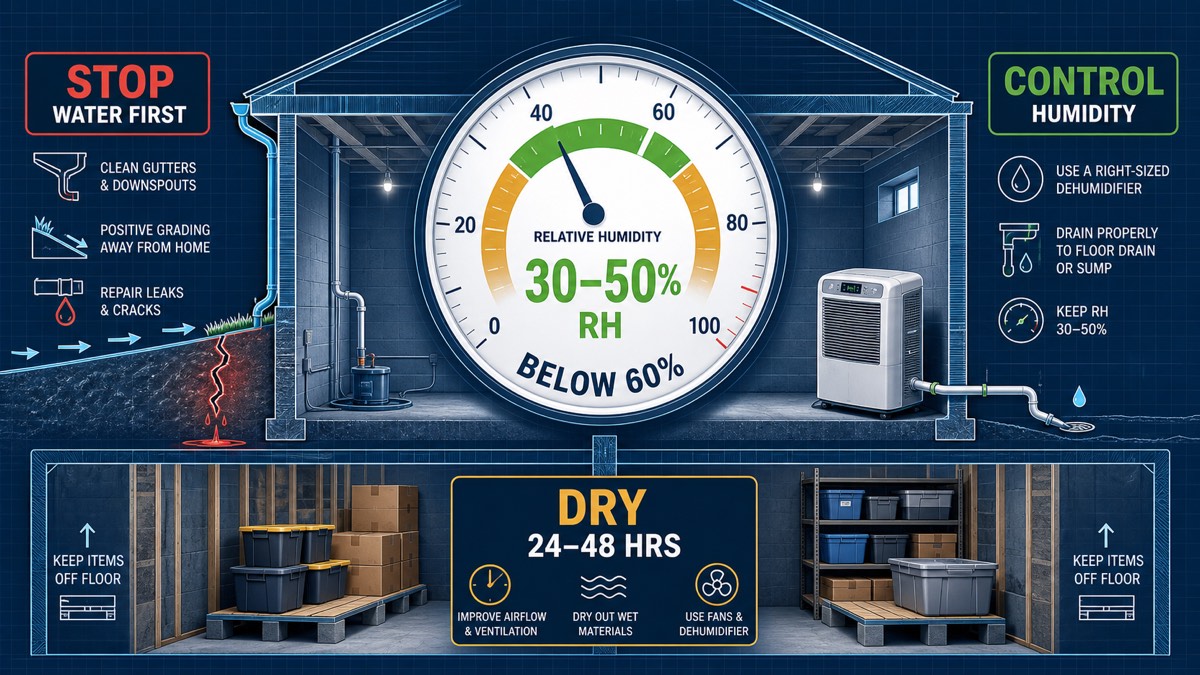
Treat the target as a control range, not a health conclusion
CDC advises keeping home humidity no higher than 50% throughout the day, while EPA and ENERGY STAR describe an ideal or optimum 30% to 50% range. Use those values as moisture-control guidance, not as a guarantee that mold is absent, materials are dry, every room matches the sensor, or an occupant's symptoms have a known cause.
Relative humidity changes with temperature. A cooler basement can show a higher relative-humidity percentage without adding water, and a cold surface can reach condensation conditions even when one room sensor appears acceptable. Record air temperature with every relative-humidity observation and note cold walls, pipes, windows, slab edges, and stored materials rather than lowering a set point blindly.
Bulk water controls the decision. Active seepage, plumbing leaks, wet finishes, flood exposure, or materials that did not dry promptly require source repair and material assessment. A dehumidifier can remove water vapor from air; it cannot prove a foundation, wall cavity, carpet, or insulation is dry or repair incoming liquid water.[2][1][3]
Keep a humidity, temperature, and moisture trend log
Use a humidity, temperature, and moisture trend log with timestamp, sensor identifier, height and location, air temperature, relative humidity, recent rain or outdoor humidity, window and door state, HVAC and dehumidifier state, condensate amount or drain observation, visible wetness, odor, and any intervention. Take comparable readings at more than one basement location and at the living level rather than moving one sensor without labeling the move.
Check the independent hygrometer and the dehumidifier display against each other without treating either as a calibrated building survey. Follow device placement and accuracy instructions, keep them away from discharge air and unusual heat, and note the difference. A device display does not establish whole-house conditions, hidden-cavity moisture, material dryness, or a building-wide health conclusion.
Review patterns, not isolated numbers: repeated rise after rain, a cold-surface event, humidity increasing when windows open, steady condensate with no progress, or a wet material that remains unchanged. Pair each pattern with a source-control or service question. Close the log only when the moisture source, drying evidence, equipment response, and recurrence period support the next decision.[2][3][4]
Fix bulk water before buying capacity
A dehumidifier cannot compensate efficiently for a foundation leak, plumbing drip, open sump, unvented dryer, blocked condensate drain, or surface water directed toward the house. EPA's central principle is moisture-source control. Inspect gutters, downspouts, grading, foundation cracks, plumbing, appliance drains, HVAC pans, bathroom exhaust, and stored wet materials. Correct active water entry and remove water-damaged porous material as appropriate.
Dry damp or wet materials within 24–48 hours when possible. Once mold is established, lowering humidity may stop additional growth but does not clean contaminated material. Do not paint or seal over wet or moldy surfaces. Large areas, sewage, contaminated floodwater, hidden HVAC growth, recurrent leaks, or health concerns call for professional remediation or building investigation.[1][4]
Choose dehumidifier capacity from conditions
ENERGY STAR groups portable capacity by room size and dampness. Its current guidance describes 50–75% RH as slightly to moderately damp, 75–90% as very damp, and 90–100% or visible seepage as wet, with higher daily pint capacity for larger and wetter spaces. Use those bands and the product's current test standard; older nameplate pint ratings may not compare directly with newer ratings.
Capacity is not only square footage. Temperature, open floor plan, ceiling height, infiltration, laundry, drainage, and continuous water entry affect load. A cold basement can reduce portable-unit performance. Oversizing may control quickly but cycle around a poor sensor location; undersizing may run continuously without reaching target. For multiple rooms or a ducted design, get a whole-home load assessment rather than placing a small portable unit behind a closed door.[3]
Drainage determines whether control lasts
A bucket unit stops when full, so it controls humidity only while someone empties it. Continuous gravity drainage can improve reliability when the hose falls continuously to an approved drain and cannot kink, freeze, or become a trip hazard. A condensate pump may lift water but adds another powered component, hose, check path, and alarm need. Follow the appliance and local drain requirements.
Do not route dehumidifier water where it worsens a sump problem or sends water back toward the foundation. Check and clean the filter, coil, bucket, drain hose, and pump as instructed. Keep clearances around intake and discharge, avoid extension cords unless expressly permitted, and use a suitable grounded outlet. Record energy use and runtime; continuous operation after source repairs may signal incorrect sizing, low temperature, air leakage, or a hidden moisture load.[3]
Condensation and seasonal adjustment
Relative humidity rises as air cools, so a basement wall, cold-water pipe, duct, or window can condense moisture even when warmer room air seems acceptable. EPA recommends reducing humidity, increasing air movement where practical, and insulating cold surfaces. Diagnose the source before enclosing it; trapping wet material behind finished walls can hide deterioration and mold.
In humid summer weather, outside ventilation may add moisture rather than remove it. In winter, excessive indoor moisture can condense on cold assemblies, while an overly dry target may be uncomfortable. Adjust based on measured indoor and outdoor conditions, surface condensation, and building design. Keep interior doors or supply/return paths arranged as the HVAC professional recommends so the sensor reading represents the protected space.[1][4]
When humidity control is not enough
Call a building, drainage, HVAC, or remediation professional when humidity remains above target despite continuous operation, water enters during rain, the foundation stays wet, condensation is widespread, odors persist, visible growth returns, the unit ices, drainage cannot be made reliable, or electrical equipment is near water. People with asthma, allergies, immune compromise, or symptoms should discuss health concerns with a healthcare professional rather than using a humidity number as a medical diagnosis.
After correction, verify success over several weather cycles. The basement should stay in the target range without visible condensation, new water damage, or persistent musty odor. Keep a simple log and inspect after severe storms or plumbing failures. Moisture control is an ongoing building operation: drainage, repairs, airflow, temperature, and dehumidification each remove a different part of the risk.
Store hygrometer logs and repair photos with the home record. Note which storms, outdoor dew points, laundry cycles, or HVAC modes drove the highest readings. That history helps distinguish a seasonal capacity problem from a specific leak and gives a contractor evidence for drainage, air-sealing, insulation, or whole-home dehumidification decisions instead of relying on a musty impression. Review it each season and after major storms or repairs. Compare readings from the same locations and times so the trend reflects the building, not a constantly changing measurement routine.[1][2][3]
| Log field | Record | Pattern question | Evidence limit |
|---|---|---|---|
| Air | RH, temperature, time, exact sensor location | Does the pattern repeat under comparable conditions? | One reading is not whole-building evidence |
| Surface and material | Cold surface, condensation, visible wetness, drying | Is water vapor or liquid water controlling? | Room RH does not prove hidden materials are dry |
| Source | Rain, leak, drainage, window, activity | What changed before the rise? | Dehumidification does not repair incoming water |
| Equipment | Setting, airflow, condensate and drain | Does operation change the trend? | A display is not a mold or health clearance |
Scroll sideways to read every column on smaller screens.
Before you buy or hire
Related reading and tools
Choose the next step for your situation: measure, compare options, or maintain and verify.
- Explore the topicIndoor Air, Radon, and Mold
- Measure the problemMold Test Kit for Home: When Testing Helps and When It Distracts
- Measure the problemChoosing a Radon Test: Match the Kit and Protocol to Your Decision
- Measure the problemDigital Radon Detector vs Charcoal Kit: Which Test Should You Use?
- Compare your optionsAir Purifier vs Dehumidifier for Mold: Different Jobs, Different Limits
- Compare your optionsDehumidifier Running but Not Lowering Humidity: What to Check
How this guide was checked
Guides are built from official sources, product documentation, manufacturer manuals, and practical homeowner decision criteria. We do not claim hands-on product testing unless a page explicitly says a product was tested.
- Source-backed editorial review
- 4 cited source records
- Radon and mold decisions can affect health. Follow EPA/CDC guidance and use qualified mitigation or remediation pros when levels, area, or symptoms justify it.
Ready Home Systems is educational and not a substitute for local code officials, licensed trades, medical providers, water labs, or mitigation professionals.
Read review methodologySources and manuals
- A Brief Guide to Mold, Moisture and Your HomeU.S. EPA
- MoldCDC
- DehumidifiersENERGY STAR
- Biological Contaminants and Indoor Air QualityU.S. EPA
FAQ
Is 50% relative humidity a guarantee that mold will not grow?
No. It is a control target. Local cold surfaces, wet materials, leaks, hidden cavities, sensor placement and past water damage still matter.
Why log temperature with relative humidity?
Relative humidity depends on temperature, and cold surfaces can condense moisture. A percentage without temperature and location can mislead.
Where should I place the humidity sensor?
Follow its instructions, avoid direct dehumidifier discharge and unusual heat, label height and location, and compare multiple relevant areas over time.
When is a dehumidifier not the first fix?
When liquid water, leaking plumbing, drainage, flood damage or wet materials are driving the problem. Correct or assess the source while controlling humidity safely.