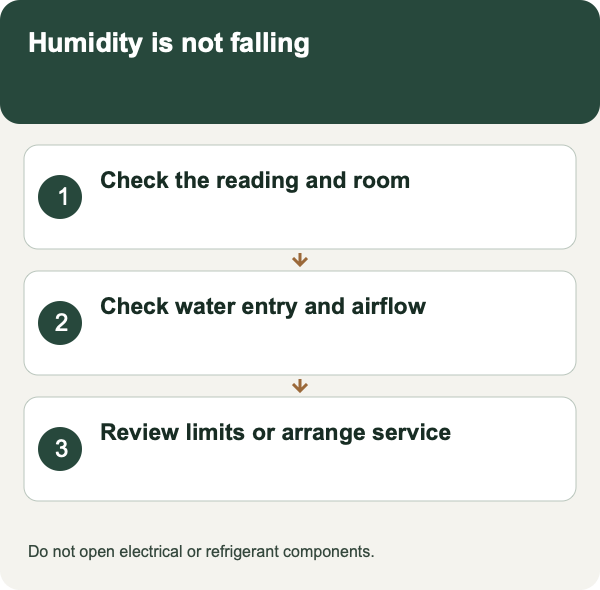
Separate an appliance fault from an unfinished drying job
Before changing settings, write down what you mean by running: a lit screen, audible fan, active compressor indicator, or water arriving in a bucket or drain. Those are different observations. GE explains that a fan can run while the compressor is off during defrost or other operating conditions. Your model’s manual, not the sound alone, defines normal behavior.
Also identify the time scale. Did humidity stop improving after weeks of satisfactory operation, or was the machine just placed in a wet room? GE notes that a new installation must remove moisture from room contents and surfaces as well as the air. That supports patient observation of a safe, improving situation, not waiting through active flooding or accepting indefinite poor performance.[3][2]
Verify the measurement before diagnosing the machine
Use a separate hygrometer to compare trends with the built-in display, and record room temperature beside each humidity reading. Relative humidity depends on temperature, so readings from different places or times are not automatically comparable. Follow the sensor’s placement and stabilization instructions; do not compare a meter beside warm exhaust with one against a cold basement wall and assume one must be broken.
Create a short observation record: time, room, temperature, separate humidity reading, unit display, chosen setting, bucket or drain status, and any recent door opening or laundry activity. Keep the sensor in a consistent representative location. The goal is not laboratory accuracy but a repeatable description of the symptom. If the two meters disagree substantially, investigate placement and specifications before chasing a lower setting.[1]
Check settings and the path into and out of the unit
Read the operating mode and desired humidity rather than relying on yesterday’s setting. A timer, full-bucket stop, or control mode may explain apparent inconsistency. GE notes that collection is not expected when local humidity is already below the selected setting. Consult your manual to determine which lights indicate a call for dehumidification and which merely show that power is available.
With the unit off and unplugged from a dry, safe location, perform only the filter and exterior-care steps described as owner maintenance. Keep curtains, stored boxes, and furniture away from the intake and exhaust, using the model’s required clearances. Reinstall a cleaned filter as instructed before operation. Do not remove the cabinet, bypass a switch, probe electrical parts, or attempt refrigerant work.[2][4]
Follow the condensate instead of assuming the bucket tells everything
If a hose is connected, an empty bucket may simply mean water is draining elsewhere. Identify whether the setup uses the bucket, gravity drainage, or an internal condensate pump. Check visible connections and the destination without dismantling plumbing. Danby’s owner guidance highlights incorrectly seated tanks, blocked or loose hoses, and cracks as reasons to inspect a leaking unit.
A useful question is whether the machine stops because collected water cannot leave, rather than because it cannot remove moisture. Record a full-bucket light, visible hose kink, wet floor, or pump alarm exactly as observed. Follow the manual for accessible hose routing and bucket seating. If water is reaching a receptacle or electrical part, stop use and obtain help instead of standing in the wet area to reset the unit.[5][1]
- Confirm where condensate should appear for the selected drainage method.
- Note whether interruptions coincide with a full bucket or drain alarm.
- Treat visible leakage as its own problem; do not hide it behind a lower humidity setting.
Check whether the room is within the operating temperature range
Look up the exact model’s operating range and defrost behavior. ENERGY STAR warns that colder conditions can produce coil frost and reduce water removal. Its general guidance identifies temperatures below 65°F as a reason to consider equipment designed for low-temperature use; this is not a universal shutdown point. Some machines are intended for considerably cooler rooms, while others are not.
If the fan runs while the compressor repeatedly pauses, consult the status indicators and defrost instructions. Never chip ice off the coils, use an improvised heater on the cabinet, or disable temperature protection. Record the room temperature at the time of the symptom. Persistent icing within the documented operating range, or an unfamiliar error code, is a reason for manufacturer support or an appliance technician.[1][3]
If water is being collected, look for continuing moisture input
A machine can remove water while new moisture continues entering the space. Inspect from safe, accessible locations for plumbing leaks, rain-linked seepage, damp stored materials, indoor clothes drying, and open exterior doors or windows. Record when the problem worsens. A pattern after rainfall is useful information for a drainage or building professional; a pattern during laundry suggests a different investigation.
EPA emphasizes correcting the moisture source, not simply treating visible mold. A dehumidifier does not repair bulk-water entry or remove established contamination. Significant water damage, sewage contamination, suspected hidden growth, or mold involving HVAC equipment needs appropriate professional evaluation. If visible mold exceeds roughly 10 square feet, EPA advises consulting its more extensive cleanup guidance; the size alone does not determine whether a job is suitable for you.[6]
Run a bounded observation, then choose the right handoff
After safe owner checks, compare another observation period with the same sensor location and a documented room condition. Change one accessible setting or placement issue at a time, and note what changed. There is no universal promise that humidity must fall a certain number of points per hour. Compare direction, water removal, interruptions, and moisture events rather than treating a single display value as a pass/fail test.
If correct settings, documented temperatures, clear airflow, and working drainage still produce no collection in a genuinely humid space, contact the manufacturer about diagnosis, warranty, or service. If substantial water is collected but the problem returns with rain or leaks, prioritize the building moisture source. After that, use the basement dehumidifier sizing tool for a planning estimate; buying a larger appliance should follow the diagnosis, not substitute for it.
Tell support whether performance changed abruptly or has always been disappointing in this room. Include the last date of satisfactory operation, any recent relocation, and what changed in the space. Those details help frame the question without claiming that a particular component has failed.[4][2][6]
Stop for a recall, electrical warning, or unsafe water condition
Check the exact model and identifying information against CPSC recall notices, especially for an older, secondhand, or long-stored machine. A recall applies to specified products, not automatically to every appliance carrying the same brand. Follow the notice’s stop-use and remedy instructions if the unit matches; improved water collection would not cancel the recall.
Stop operating equipment that smokes, smells burned, has a damaged cord, or repeatedly trips protection. Do not keep resetting it to finish a drying experiment. For active fire or immediate danger, leave the area and contact emergency services. For a non-emergency service call, provide the model, photos of visible damage or displays, recall check, and your observation record without opening the appliance.[7]
| Observation | Check next | Escalate when |
|---|---|---|
| Fan runs; little or no condensate | Mode, actual room humidity, temperature, and defrost indication. | Conditions fit the manual but collection never resumes. |
| Frequent full-bucket or drain interruption | Bucket seating and visible drainage condition. | Leakage reaches electrical equipment or drainage needs repair. |
| Steady collection; room stays damp | Rain, leaks, wet contents, and air entering the space. | Bulk water or significant contamination is present. |
| Abnormal heat, smoke, or recall match | Stop use and follow safety or recall directions. | Immediately; do not continue a performance test. |
Before you buy or hire
Related reading and tools
Choose the next step for your situation: measure, compare options, or maintain and verify.
- Explore the topicIndoor Air, Radon, and Mold
- Measure the problemIdeal Basement Humidity to Prevent Mold: Targets and Troubleshooting
- Measure with a toolBasement Dehumidifier Size Planner
- Compare your optionsAir Purifier vs Dehumidifier for Mold: Different Jobs, Different Limits
How this guide was checked
Guides are built from official sources, product documentation, manufacturer manuals, and practical homeowner decision criteria. We do not claim hands-on product testing unless a page explicitly says a product was tested.
- Source-backed editorial review
- 7 cited source records
- Radon and mold decisions can affect health. Follow EPA/CDC guidance and use qualified mitigation or remediation pros when levels, area, or symptoms justify it.
Ready Home Systems is educational and not a substitute for local code officials, licensed trades, medical providers, water labs, or mitigation professionals.
Read review methodologySources and manuals
- DehumidifiersENERGY STAR
- Dehumidifier — Not Reaching Proper Humidity LevelGE Appliances
- Dehumidifier — Fan Stays On, Will Not Shut OffGE Appliances
- Dehumidifier — Not Collecting WaterGE Appliances
- The dehumidifier is leaking. How can I fix this?Danby
- A Brief Guide to Mold, Moisture and Your HomeU.S. Environmental Protection Agency
- Dehumidifier Recalls and Safety NoticesU.S. Consumer Product Safety Commission
FAQ
Does a running fan prove the compressor works?
No. The fan and compressor can operate differently, including during defrost. Read the exact-model instructions and observe water removal and status indicators. Noise alone cannot distinguish normal control behavior from a fault.
Should I lower the setting all the way?
First establish that the current setting actually calls for dehumidification. An extreme setting cannot repair a blocked drain, restore airflow, fix a leak, or establish that the sensor is correct. Use our humidity-target guide for the broader target decision.
Is a bigger dehumidifier the next step?
Only after checking operation and the moisture source. Record the served area, temperature, moisture events, and drainage arrangement. Capacity planning can then be useful, but it cannot make an unresolved leak or recalled appliance acceptable.
Related guides
Basement Condensation vs. Water Seepage: How to Sort the Clues
Compare condensation, seepage, and plumbing-leak clues before buying basement equipment. Record weather and moisture patterns, and know when to call a pro.
Best Radon Test Kit: Short-Term, Long-Term, or Digital Monitor?
Compare radon tests by measurement window, qualified lab or device, closed-building rules, placement, follow-up, and real-estate timing.
Digital Radon Detector vs Charcoal Kit: Which Test Should You Use?
Compare digital and charcoal radon tests by window, feedback, lab handling, calibration and QA, repeat use, cost, and confirmation strategy.