Write the outage dependency sequence before comparing equipment
Begin at utility loss and write the sequence minute by minute: primary pump loses power; water continues entering; the independent backup float must detect the rise; the backup pump must move enough water through an open discharge; local and remote alarms must reach a named recipient; and the available battery must bridge the response window. For a generator branch, add retrieval or automatic start, safe outdoor operation, connection, startup acceptance, fuel, refueling, monitoring, and restoration.
Place a failure column beside every dependency. A battery system can have finite energy, unsupported or deteriorated storage, charger failure, a stuck float, or inadequate flow. A portable generator can be inaccessible, lack fuel, fail to start, be incompatible with pump surge or protection, or have no trained person available. Neither path fixes an undersized pump, a frozen or blocked shared discharge, overwhelming inflow, or unsafe access.
Assign evidence and an owner to each dependency: installed manual, measured or published draw, wet-weather cycle observation, alarm delivery test, fuel record, connection plan, and safe deployment drill without energizing an improvised house connection. An untested assumption remains an open risk in the comparison.[1][2][4]
Battery backup strengths and limits
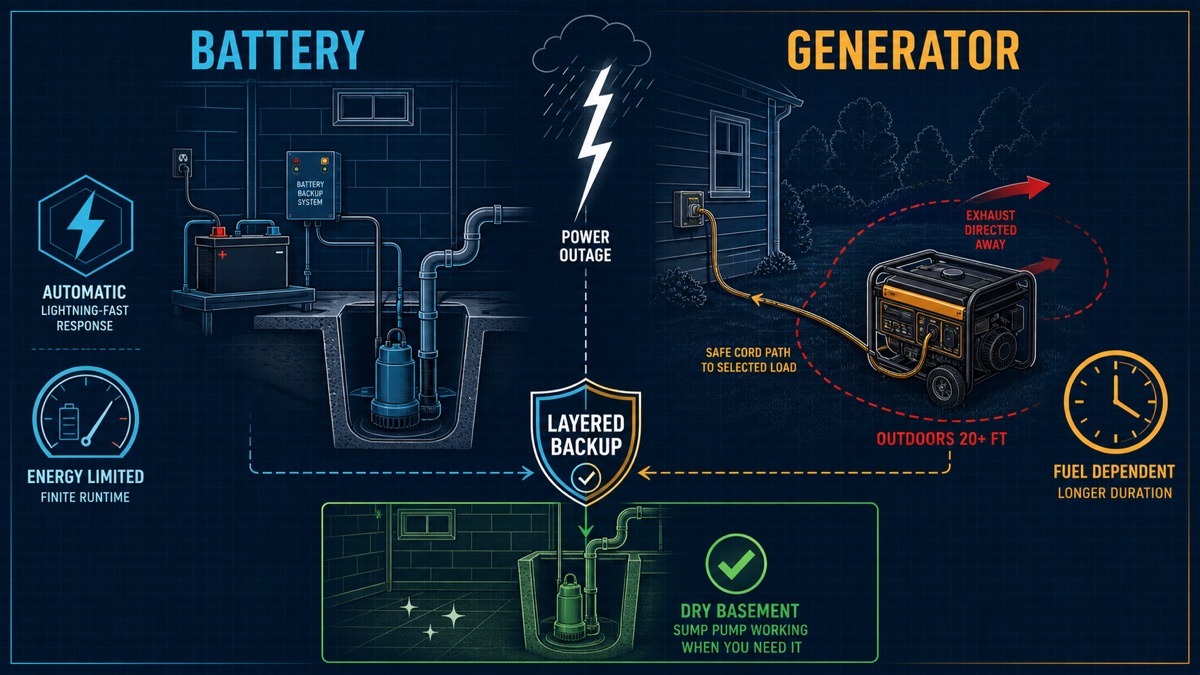
A purpose-built battery system can be independent of the primary AC pump and can respond to either an outage or high water. It is quiet at the point of use, produces no combustion exhaust, and can report controller or battery faults. Its pump capacity is model-specific, and published runtime usually depends on pumping duty cycle, lift, battery type, age, temperature, charger, and water inflow. Continuous run time is not the same as hours of storm protection.
Battery maintenance is the price of automatic readiness. Follow the controller and battery manuals for chemistry, capacity, terminals, ventilation, water level where applicable, testing, replacement, and disposal. A green charger light does not prove useful capacity under load. Estimate runtime with the actual backup pump and revisit it as the battery ages. If inflow exceeds backup capacity, the battery may run continuously and deplete faster than an optimistic estimate.[1]
Generator strengths and limits
A correctly sized generator can operate the main AC sump pump and other selected loads as long as fuel and safe operation continue. Size from running and startup demand in the pump documentation, not horsepower alone. FEMA advises accounting for pump startup load and fuel reliability. A portable unit also needs a dry operating location outdoors, at least 20 feet from homes and openings, with exhaust directed away, plus working CO alarms.
Generators add human and environmental dependencies. Roads may be blocked, fuel unavailable, rain severe, and the person who knows the procedure absent. Refueling, storage, cords, grounding, transfer equipment, and maintenance introduce hazards. Never operate a portable generator in a home, garage, basement, shed, carport, or near openings. Never backfeed house wiring. If continuous generator operation is part of flood protection, write and rehearse the safe plan before the storm.[2][3][4]
Separate immediate pumping, outage duration, and shared failures
First verify that each proposed pump can exceed the assigned inflow at installed head. Next verify power compatibility: battery-side energy and duty for the dedicated backup, and startup plus running load for the generator connection. Finally compare duration dependencies. Battery coverage ends with usable stored energy and condition; generator coverage depends on safe continued operation, fuel, maintenance, weather protection allowed by its manual, and a responder.
Keep the transition explicit. If a battery is intended to bridge generator deployment, record the conservative bridge time and the actions that must occur before it expires. If the generator is intended to recharge a backup controller, obtain exact manufacturer compatibility rather than assuming any AC output will be accepted. Do not alter battery wiring, backfeed a building, or experiment with cords and wet equipment during rising water.
CPSC says portable generators belong outside at least 20 feet from the home with exhaust facing away, and CO alarms remain required protection. Placement, approved connection, grounding or GFCI behavior, fuel storage, and local electrical requirements need qualified review. If safe placement and operation cannot be maintained, the generator branch is unavailable regardless of its rated watts.[1][2][4][5]
Layered protection is often stronger
A common resilience pattern is a primary AC pump, an independent battery backup pump with a higher float, a high-water alarm, and a portable generator plan for long outages. The battery bridges the time needed to deploy the generator and remains available if the generator stops. The generator can recharge supported equipment or run the main pump, subject to manufacturer instructions. Each layer addresses a different failure, but shared discharge constraints can still defeat all layers.
Test layers separately and together. Confirm the primary start and stop, backup float, alarm notification, check valves, outlet flow, battery under load, generator startup, cord or transfer path, and restoration procedure. Avoid creating a test that sends exhaust toward the house or places cords in water. Record who can respond when occupants are away. An alarm without a responder is information, not mitigation.[1][4]
Storm, travel, and maintenance planning
Before storm season, clean and test the pit, inspect discharge, load-test or manually verify the backup as directed, replace overdue batteries, service the generator, rotate approved fuel, check oil, inspect outdoor-rated cords, test CO alarms, and confirm the safe operating location remains at least 20 feet from openings. Move basement contents and verify insurance rather than relying entirely on equipment. Severe inflow can exceed a working system.
For travel, favor automatic detection and response plus a trusted local person. Confirm that notifications work when household Wi-Fi and utility power fail. Label shutdowns and connection steps, store manuals and lights where they can be found during an outage, and keep the generator locked but accessible. Never ask an untrained neighbor to improvise a transfer connection, handle damaged batteries, or enter floodwater.[2][3]
Choose from documented requirements
For a battery proposal, request backup flow at your lift, compatible battery chemistry and capacity, charger recovery, alarms, expected duty-cycle assumptions, maintenance, and replacement costs. For a generator proposal, request startup and running load calculations, fuel duration, outdoor placement, weather protection, approved cords or transfer equipment, grounding and GFCI requirements, and which loads are excluded. Compare complete systems, not only equipment prices.
Use pump, electrical, and drainage professionals when inflow is high, the basement is occupied or valuable, the system needs a transfer switch, fuel installation, dual discharge, or structural drainage work, or prior flooding shows that standard equipment is inadequate. The safest answer may be both battery and generation—or broader flood mitigation—rather than forcing one product category to cover every outage and pump failure.
Write a minimum acceptable outcome for each layer: how high water may rise, how quickly an alert must arrive, who responds, and what happens when capacity is exceeded. That turns a collection of equipment into a response plan and exposes assumptions before the basement is at risk.[1][2][4]
| Outage stage | Battery dependency | Generator dependency | Shared stop condition |
|---|---|---|---|
| 0–1 minute | Automatic float, controller, supported battery | Usually not deployed yet | Pump or discharge cannot lower water |
| Bridge period | Usable energy, duty, alarm, recipient | Trained responder, safe access, equipment ready | High water or wet electrical access |
| Extended outage | Remaining capacity and charger recovery plan | Outdoor 20-foot placement, approved connection, fuel | Blocked outlet or inflow beyond installed capacity |
| Power restoration | Recharge and manual-based retest | Cool-down, disconnect, fuel and service record | Do not assume one successful cycle closes the event |
Scroll sideways to read every column on smaller screens.
Before you buy or hire
Related reading and tools
Choose the next step for your situation: measure, compare options, or maintain and verify.
- Explore the topicSump Pump Backup
- Measure with a toolSump Pump Battery Runtime Calculator
- Compare your optionsChoosing a Sump Pump Battery Backup: Capacity, Duration and Failure Checks
- Compare your optionsHow Far Should a Generator Be From the House? Portable vs. Standby
- Maintain and verifyHow Often Should a Sump Pump Backup Battery Be Replaced?
How this guide was checked
Guides are built from official sources, product documentation, manufacturer manuals, and practical homeowner decision criteria. We do not claim hands-on product testing unless a page explicitly says a product was tested.
- Source-backed editorial review
- 5 cited source records
- Backup pump sizing depends on pit inflow, lift height, discharge path, battery age, and local flood risk. Check manufacturer instructions and local code.
Ready Home Systems is educational and not a substitute for local code officials, licensed trades, medical providers, water labs, or mitigation professionals.
Read review methodologySources and manuals
- Urban Flooding: Guidance for Homeowners and RentersFEMA
- Homeowner's Guide to RetrofittingFEMA
- Use a Generator SafelyCDC
- Carbon Monoxide Information CenterU.S. CPSC
- PC-Series 441 Battery Backup Installation ManualLiberty Pumps
FAQ
Can a portable generator run a sump pump?
It may if its running and startup capacity, connection method, grounding, GFCI behavior, and pump documentation are compatible. Plan and test safely before a storm.
How long will a sump pump battery last?
Runtime depends on pump flow, lift, inflow, duty cycle, battery capacity, chemistry, age, temperature, and charger. Use the actual system manual and a load-based estimate.
Is a battery or generator safer?
They have different hazards and failure modes. A battery avoids combustion exhaust and can start automatically; a generator can offer longer energy but requires strict CO, fuel, weather, and electrical safety.