Portable and installed standby generators are different
First identify the equipment. The 20-foot portable-generator guidance on this page applies to portable fuel-burning units, including portable Generac models. A permanently installed home standby generator is a different installation: use the exact model's installation manual, local requirements, and a qualified installer's site assessment. A brand name alone cannot tell you the clearance. Do not apply a standby model's reduced wall clearance to a portable generator.
Generac directs homeowners to model-specific installation guidance and highlights clearances from the house, windows, doors, and openings, along with local-code compliance. Give the installer the model number and a site sketch showing openings, air intakes, neighboring buildings, fuel supply, and service access. Ask for the approved location and applicable clearances in the proposal. This article is portable-generator safety guidance, not approval of a standby installation or a substitute for inspection.[1][5]
Start with the 20-foot portable-generator boundary
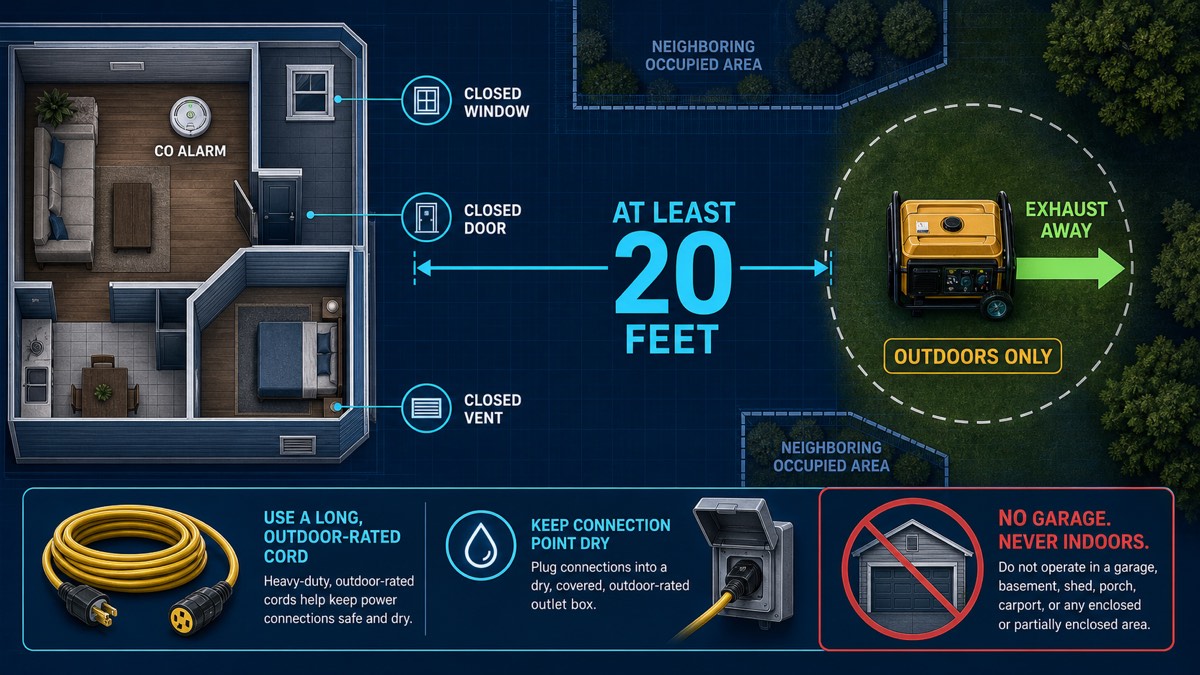
For a portable generator, CPSC says outdoors only, at least 20 feet from the home, with exhaust facing away. Apply the measurement to the building and then screen every nearby door, window, vent, soffit intake, crawl-space opening, neighboring building, and occupied area. More distance or another location may be required by the exact manual, site, local rules, or nearby openings; 20 feet is not permission to ignore those conditions.
Point the exhaust away from all structures and openings, then consider whether expected wind can carry exhaust back toward them. Do not move the unit closer because a cord is short, because rain begins, or because an alarm is installed. CO is colorless and odorless; a running engine, a clear exhaust path by sight, or the absence of symptoms does not establish safe air.
Installed standby generators follow the exact listed installation instructions, equipment clearances, fuel and electrical design, and local approval for that model. Do not apply the portable 20-foot worksheet as a standby installation dimension, and do not use a standby-generator drawing to justify a portable unit near the house.[3][1][6]
Spaces that are still indoors
Never run a portable generator in a home, basement, attached or detached garage, carport, crawlspace, shed, porch, tent, or other enclosed or partly enclosed space. Opening a garage door does not turn the garage into an outdoor location. Exhaust can accumulate and enter through doors, attic paths, soffits, shared walls, or air leaks. A remote corner of a large garage is not an exception to the 20-foot outdoor guidance.
Do not place the unit under a window, next to a dryer or combustion-air vent, beside a neighboring opening, or in a narrow courtyard that traps exhaust. Look at the whole building, including basement windows, pet doors, fresh-air intakes, and temporarily open windows. Discuss property-line and noise rules with local authorities, but never solve a neighbor concern by moving the generator closer to your own occupied space.[2][3]
Exhaust direction and wind
CPSC adds that exhaust should face away from the home. Mark the exhaust side before an outage and position the machine so hot gases and sparks do not point toward buildings, dry vegetation, fuel, people, or cords. Wind direction can change and does not make a too-close location safe. Recheck nearby openings whenever the generator is moved or when storm preparations change doors and windows.
Do not build an improvised box to control noise or rain. An enclosure can trap CO, overheat the engine, restrict cooling, or create a fire hazard. Use only a manufacturer-approved outdoor operating cover or shelter with the required clearances and ventilation. Keep the surface stable and above water flow. If rain or flooding cannot be managed without enclosure or wet contact, shut down and use another plan.[3][1]
Long cords are part of safe distance
CDC advises using an extension cord longer than 20 feet so the generator can remain at a safe distance. CPSC says cords should be heavy-duty, designed for outdoor use, long enough for remote placement, intact, grounded, and rated above the connected wattage. Length increases voltage drop, so choose gauge and rating from the generator and appliance instructions rather than connecting several household cords end to end.
Keep connectors dry and off wet ground, protect cords from traffic and sharp edges, and do not pinch them through doors or windows. Label each cord for its intended load and inspect it before every use. A hot plug, discolored insulation, unstable appliance, repeated trip, or damaged ground pin is a stop signal. Permanent household circuits require approved transfer equipment, not a long cord plugged into a wall outlet.[2][4]
CO alarms and symptom response
CPSC recommends battery-operated CO alarms or alarms with battery backup on every home level and outside sleeping areas; interconnected alarms provide broader warning. Test alarms and replace batteries or units according to their instructions before storm season. An alarm is a last line of warning, not permission to reduce generator distance. Never disable an alarm because it sounds during operation.
Common CO-poisoning symptoms include headache, dizziness, weakness, nausea, vomiting, sleepiness, chest pain, and confusion. If an alarm sounds or symptoms occur, get everyone and pets into fresh air immediately and call 911. Do not reenter to turn off equipment when that requires exposure; tell emergency responders that a generator is operating. People who have been sleeping or drinking alcohol may not notice early symptoms.[3][2]
Fuel, heat, electricity, and security
Distance addresses exhaust entry but not every generator hazard. Shut down and allow the engine to cool before refueling. Store fuel in approved containers away from living areas and ignition sources. Keep the generator dry, operate it with dry hands, and use GFCI and grounding arrangements required by the manual. Directly connected loads need rated cords; household wiring needs professionally installed transfer equipment.
Secure the unit against theft without blocking cooling or exhaust. Keep children and pets beyond a clear boundary. Do not operate near dry vegetation, combustible storage, or where floodwater can rise. Service oil, filters, spark arrestor, battery, and fuel system on schedule. A machine that has been stored for years without testing should not become the household's only plan hours before a hurricane.[4][2]
Draw the placement, exhaust, and weather sketch before the storm
On a site sketch, mark the generator, a measured path of at least 20 feet to the home, every nearby door, window and vent, exhaust direction, expected wind approaches, adjacent buildings, occupied areas, CO-alarm locations, cord routes, fuel and refueling area, and a shutdown route. Walk the layout before an outage and confirm that doors, vehicles, gates, floodwater, snow, storage, or neighbors will not force the unit into an unsafe position.
Add the exact manufacturer's wet-weather instructions. A weather cover is not an enclosure and must not convert the location into a shed, tent, porch, carport, garage, box, or partly enclosed space. Keep the generator and electrical connections dry as directed without blocking cooling or exhaust, and do not operate or handle electrical equipment in standing water.
The sketch is incomplete until working battery-operated or battery-backup CO alarms are located on every level and outside sleeping areas, a responsible operator is named, and fresh-air evacuation and 911 response are written for an alarm or symptoms. Shut down only if it can be done without reentering a dangerous area; getting everyone to fresh air comes first.[3][6][4][2]
| Sketch layer | Record | Pass condition | Boundary |
|---|---|---|---|
| Distance and openings | Measured 20-foot path plus doors, windows, vents and neighbors | At least 20 feet and site/manual conflicts resolved | Not a standby-generator clearance |
| Exhaust and wind | Exhaust direction and likely wind approaches | Directed away from all structures and openings | No visual or odor-based CO clearance |
| Weather and electricity | Exact weather method, dry cords and flood route | Outdoor cooling and exhaust remain unobstructed | Cover is not an enclosure; no standing-water operation |
| Response | CO alarms, operator, fresh-air route and 911 plan | Every occupant knows the action | Alarm does not authorize closer placement |
Scroll sideways to read every column on smaller screens.
Before you buy or hire
Related reading and tools
Choose the next step for your situation: measure, compare options, or maintain and verify.
- Explore the topicHome Power Backup
- Measure the problemSolar Generator for Refrigerator Backup: Size Watts and Runtime
- Measure the problemCPAP Battery Backup for Power Outages: What to Check First
- Compare your optionsGenerator Transfer Switch vs Extension Cords: Safe Power Paths
- Compare your optionsWhole-House Battery vs Generator: Which Backup Fits Your Outages?
How this guide was checked
Guides are built from official sources, product documentation, manufacturer manuals, and practical homeowner decision criteria. We do not claim hands-on product testing unless a page explicitly says a product was tested.
- Source-backed editorial review
- 6 cited source records
- Follow device manuals and carbon-monoxide safety guidance. Generators must stay outdoors and away from openings; medical-device users should confirm backup plans with providers.
Ready Home Systems is educational and not a substitute for local code officials, licensed trades, medical providers, water labs, or mitigation professionals.
Read review methodologySources and manuals
- Use a Generator SafelyCDC
- What to Do to Protect Yourself During a Power OutageCDC
- Carbon Monoxide Information CenterU.S. CPSC
- Portable Generator HazardsU.S. CPSC
- Can I install my own home standby generator?Generac
- CPSC Warns of Generator, Carbon Monoxide and Fire Hazards Ahead of Hurricane SeasonU.S. Consumer Product Safety Commission
FAQ
Is 20 feet enough in every yard?
It is CPSC's minimum portable-generator distance from the home. Openings, exhaust direction, wind, neighbors, the exact manual and local rules may require a safer location or a different plan.
Can a generator run in a shed, open garage, porch or carport?
No. Portable generators belong outdoors only, never in enclosed or partly enclosed spaces, even when doors are open.
Can I build a box around the generator for rain?
Do not improvise an enclosure. Follow the exact manufacturer's wet-weather instructions while preserving outdoor separation, cooling and exhaust, and keep electrical connections dry.
Do CO alarms make a closer placement acceptable?
No. Alarms are an additional warning layer, not a substitute for outdoor placement, distance and exhaust direction.