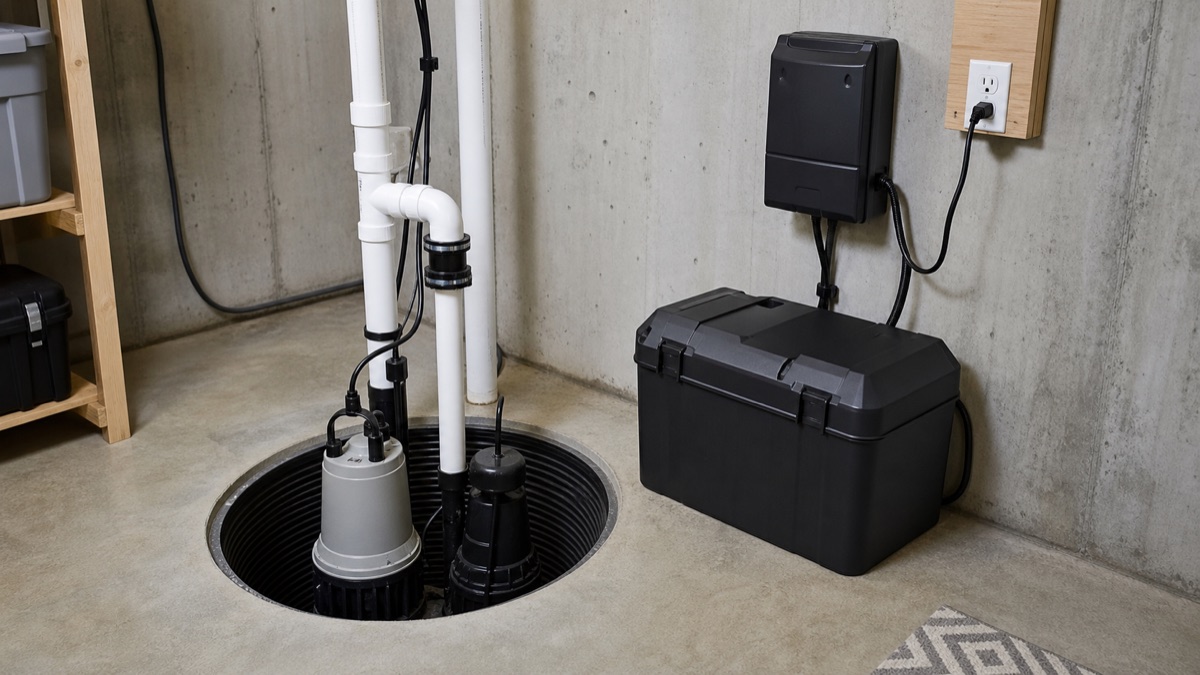
Before you buy or hire
Quick answer: use a condition-based range
There is no replacement interval that applies to every backup sump battery. Start with the pump-controller manual and the approved battery type, then consider age, warning indicators, test behavior, environment, and the consequence of failure. Zoeller's current AquaNot Key manual recommends replacing the battery every three to four years for that system; this is manufacturer-specific guidance, not a promise for another controller, chemistry, or installation.
Replace sooner when the controller reports a bad or low battery, the case is damaged or swollen, terminals are badly corroded, required wet-cell maintenance has been missed, a qualified load test shows inadequate capacity, or the battery cannot complete the manual's functional test. Do not wait for a storm to discover that an old battery can light the controller but cannot run the pump under real head and inflow.[4][1]
Why there is no universal replacement interval
A calendar cannot capture battery construction, capacity, discharge depth, recharge history, charger design, temperature, maintenance, or pump load. Two batteries installed on the same date may age differently if one experiences repeated outages and the other remains on a healthy float charger. Runtime also changes with static head, inflow, pump condition, and battery condition; the Zoeller manual explicitly qualifies its model-specific runtime example with these factors.
A conservative plan combines a manual-based age window with periodic inspection and functional testing. Record purchase and installation dates, exact battery and controller models, test results, alarms, outages, and maintenance. When the system protects a finished basement or experiences frequent inflow, choose a larger replacement margin rather than stretching a weak battery to its theoretical last month.[4][2]
Battery chemistry and system support
Use only a battery chemistry, size, terminal arrangement, and capacity supported by the backup controller manufacturer. Wet-cell lead-acid batteries may require electrolyte checks and a fluid sensor; maintenance-free designs do not receive that same task. Mixing instructions can create unsafe handling, incorrect charging, missed maintenance, or a controller that cannot interpret battery condition correctly.
The Basement Watchdog BWSP checklist, for example, includes fluid-sensor cleaning and fluid-level checks specifically for its listed large wet-cell battery. The Zoeller AquaNot manual separately identifies a supported deep-cycle size and distinguishes monthly electrolyte checks from maintenance-free batteries. Apply each procedure only to the named equipment. Never open a sealed battery or add fluid unless its own documentation explicitly requires and explains it.[3][4]
Age, load, temperature, and charger effects
Battery capacity fades with age and use, but the pace is installation-specific. Frequent deep discharge, long periods without full recharge, a failing charger, high heat, cold conditions during an outage, corrosion, and a pump drawing abnormal current can reduce useful margin. A runtime calculator is a planning tool, not a certification of remaining capacity. It cannot see internal battery deterioration or changing pit inflow.
Check that the controller shows its normal ready or charging state under the manual's definitions. After an outage or test, allow the specified recharge process and investigate a battery that never returns to ready. Do not substitute an automotive starting battery where a deep-cycle type is required. Do not increase capacity, parallel batteries, or change charger components unless the system documentation permits that configuration.[4]
Warning indicators and failure modes
Treat low-battery, bad-battery, charging, pump-fault, and power-loss indications according to the controller legend. A silence button usually acknowledges sound; it does not repair the cause. Also inspect for a cracked or bulging case, leakage, heat, odor, loose cables, corroded terminals, a damaged battery box, or water exposure. Keep ignition sources away and do not handle a compromised battery casually.
The quiet failure mode is reduced capacity without an obvious alarm. The controller may pass a brief self-check while sustained pumping would still be inadequate. That is why storm readiness includes a manual-based water test and periodic professional battery evaluation where the consequences are high. A pump that runs but cannot overcome the discharge head is a hydraulic problem, not proof of a good battery.[4][1]
A safe manual-based test routine
Read the installed system manual before testing. Confirm the pit and discharge are clear, observe the normal ready indicators, and use clean water to raise the backup float only through the documented method. Stay dry and keep hands away from energized connections. Verify that the backup pump starts, moves water, the alarm behaves as described, and the pump stops when the float falls. Restore every plug and control to its normal state.
Zoeller specifies at-least-quarterly inspection and testing for the cited AquaNot model and provides a particular power-disconnection and water-test sequence. That interval and sequence are not universal. Basement Watchdog supplies its own BWSP checklist. Use the exact manual in the utility room; if labels or wiring do not match it, stop and have the installation identified before proceeding.[4][3]
Replacement checklist
Before purchase, record controller and pump models, required battery chemistry and size, reserve-capacity requirement, terminal layout, enclosure dimensions, and any manufacturer-approved battery list. Before removal, follow shutdown instructions, ventilate the area, keep sparks and metal tools controlled, wear specified protection, and photograph cable polarity. A heavy battery may require lifting help. Never work while standing in water.
After replacement, secure the battery in the approved box, connect exactly as documented, verify normal controller indicators, complete the prescribed functional test, and record the date and model. Keep the receipt and recycling record. Recheck the area after charging for heat, odor, alarms, or loose connections. If the controller rejects the new battery, diagnose compatibility and charger condition rather than repeatedly resetting it.[4][3]
Disposal and recycling
Lead-acid batteries should enter an appropriate battery-recycling stream, often through the retailer or a local household hazardous-waste program. Keep the old unit upright and protected from short circuits during transport, following local instructions. Do not place it in household trash, open the case, drain electrolyte, or leave it where children, pets, rain, or metal objects can reach it.
Ask the seller about the core return before delivery so the old battery does not remain in the basement. For a leaking, hot, swollen, or physically damaged battery, avoid routine handling and contact the manufacturer, fire authority, or local hazardous-waste program for instructions appropriate to the condition. Local rules govern transport and disposal.[4]
Failure modes and professional triggers
Call for service when the controller reports persistent faults, the charger does not return to ready, cables or terminals overheat, the pump fails a water test, the pit rises despite operation, the discharge is blocked, or the battery is damaged. Keep out of flooded electrical areas. An alarm or battery replacement cannot correct an undersized pump, frozen line, stuck float, failed check valve, or inflow above system capacity.
Federal preparedness guidance treats battery backup as one layer in reducing outage-related flood risk. Pair it with a maintained primary pump, clear discharge, independent high-water warning, storm checks, and a response plan. Where water damage would be severe, periodic professional inspection and an earlier battery replacement policy can be rational even if the old unit has not yet announced failure.[1][2][4]
| Signal | Meaning | Action |
|---|---|---|
| Inside the manual's age window and tests normally | Age alone does not prove failure | Keep testing and plan replacement margin |
| Low or bad battery indicator | Controller has detected a battery condition | Follow the model manual and arrange replacement or diagnosis |
| Passes brief test but runtime margin is uncertain | Capacity may be lower than indicated by voltage | Use qualified load evaluation and conservative planning |
| Swelling, leak, heat, or damaged terminals | Potential battery hazard | Stop routine handling and obtain qualified guidance |
Related reading and tools
Sources Used
- FloodsReady.gov / Federal Emergency Management Agency
- Five Facts to Help New Homeowners Protect Against Water DamageNational Flood Insurance Program
- Special CONNECT BWSP Resources and Maintenance ChecklistBasement Watchdog / Glentronics
- AquaNot Key ProPak Installation InstructionsZoeller Pump Company
FAQ
Do all sump backup batteries last three to four years?
No. Three to four years is a recommendation in the cited Zoeller AquaNot manual for its supported battery setup. Another manufacturer, battery chemistry, environment, or duty cycle can require a different interval.
Can the controller tell me the battery's remaining runtime?
Indicators can report defined faults or charge states, but they cannot promise runtime under the next storm's head, inflow, pump condition, temperature, and battery capacity. Combine indicators with manual-based testing and conservative replacement.
Can I use a car battery for a backup sump pump?
Use only the battery type and capacity supported by the controller manufacturer. Automotive starting batteries and deep-cycle batteries are designed for different duty, and an unsupported substitute may charge or perform incorrectly.
Related guides
Best Sump Pump Battery Backup: How to Choose Before the Storm
The best backup sump pump is the one that moves enough water for your pit, runs long enough for your outage risk, and alerts you before the basement becomes a claim.
Primary and Backup Sump Pump Maintenance Checklist
Maintain the sump system as one chain: pit, primary pump and float, backup pump and float, battery and controller, alarm, check valves, discharge, power, and the person who responds. Use installed manuals for intervals and procedures.
Sump Pump Battery Runtime Calculator: Estimate Backup Hours
Runtime estimates are not guarantees, but they help homeowners see whether a backup battery is sized for a short outage or a storm night.