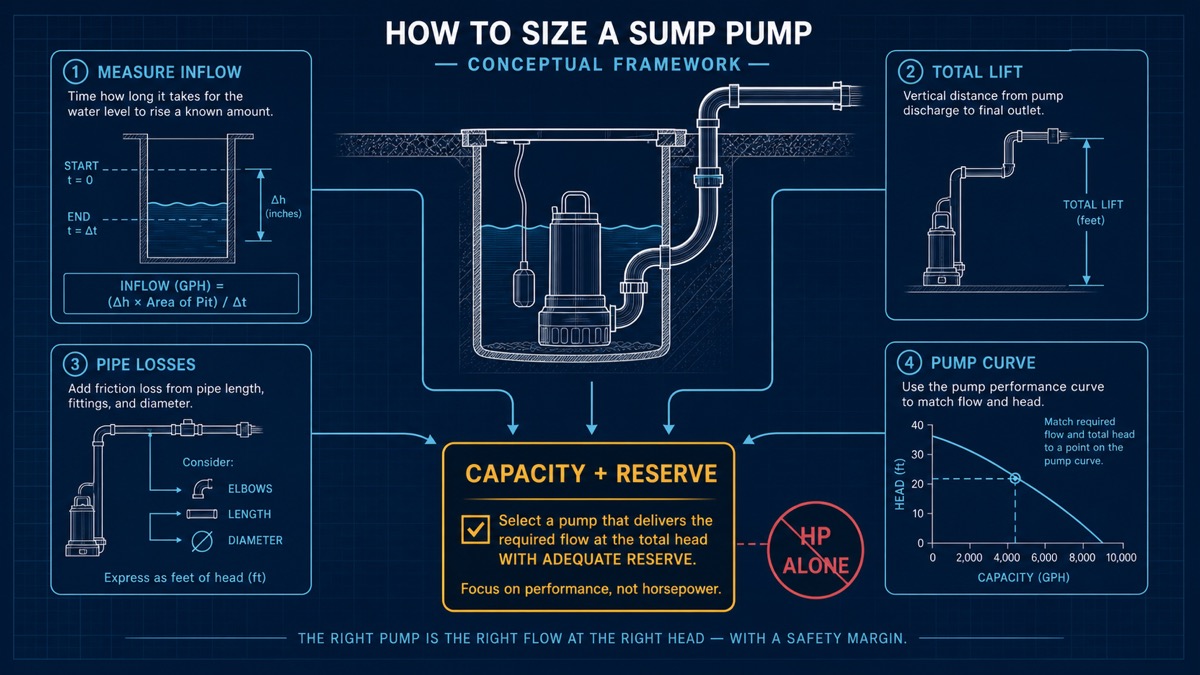
Record observed inflow without pretending the basin is empty
Use a documented wet-weather interval when it is safe to observe. Mark two stable water-level references, record elapsed rise time while the pump is not being asked to run, and convert the effective volume between the marks to gallons. Divide gallons by minutes to estimate observed inflow in gallons per minute. Do not disable a pump during rising water, reach into an energized pit, or use a simplified cylinder calculation when the pump body, connected drains, or irregular walls materially displace volume.
Repeat across more than one storm stage and note rainfall context, starts, run seconds, recovery after each cycle, and whether water continues rising while the pump runs. The highest credible observed interval is evidence, not a guaranteed design peak. Prior flooding, uncertain drainage, valuable finished space, or inflow that approaches continuous operation calls for drainage and pump professional review rather than an arbitrary percentage added to one observation.
Keep the primary and backup requirements separate. Each pump must move water at its own installed head and discharge arrangement; the backup must also cover the failure cases assigned to it. A shared obstructed outlet can defeat both pumps even when each motor has adequate nameplate horsepower.[1][6][4]
Estimate peak pit inflow
Observe the pit during the wettest safe conditions available, not only on a dry afternoon. Mark a known water-level interval, calculate the basin volume for that interval, and time how quickly water rises while the pump is off only if the manual and conditions allow a controlled observation. Convert volume per time to flow, repeat several times, and use the highest credible value. Irregular pits, drain tiles, and changing groundwater make this an estimate rather than a laboratory measurement.
Never disable protection during active flooding to obtain a prettier number. Historical high-water marks, prior pump run time, alarm events, local rainfall, soil, foundation drains, and contractor experience can inform a conservative design. FEMA notes that seepage can exceed standard pump capacity and that soil and construction conditions affect design. High-consequence or unusually high-inflow basements need professional drainage analysis rather than a consumer horsepower guess.[4]
Calculate TDH and read the exact-model pump curve
Liberty defines total dynamic head, or TDH, as static head plus friction head. Measure static head from the relevant basin water level to the highest point in the discharge route. Have the pipe length, internal diameter, fittings, check valves, transitions, and intended flow included in the friction calculation; a long, narrow, or fitting-heavy run can make vertical lift alone an incomplete input.
On the exact model's current curve or published performance table, locate calculated TDH on the head axis and read across to the model curve, then down to flow. Record the document revision and model beside that duty point. Pentair's FPZS50RP page, for example, labels one exact model's flow at ten-foot lift; that value is not transferred to another pump, another head, a backup pump, or a changed pipe route.
Compare curve flow at TDH with the observed inflow requirement and the selected design margin, then verify minimum basin size, float travel, cycling volume, discharge diameter, check-valve layout, electrical supply, outlet route, and local requirements. If the proposed point is near shutoff, outside the published curve, or built from uncertain friction assumptions, return the worksheet to the manufacturer or qualified installer instead of selecting by horsepower.[6][2][3]
Basin and float geometry control cycling
The basin stores water between the pump's on and off levels. A larger usable volume usually allows longer, less frequent cycles, while a cramped pit or obstructed float can cause rapid starts. Pentair describes 18–25 gallon basins as common and notes the cycling benefit of larger basins, but the correct dimensions depend on the pump and site. The cited Flotec model lists a ten-inch minimum basin diameter; another switch or pump may need more.
Measure diameter, depth, inlet elevation, pump footprint, backup footprint, switch type, and unobstructed float travel. Include the lid, radon sealing requirements, cables, discharge, and service access. A pump that fits physically can still have too little level difference to run efficiently. Do not bend switches or alter set points outside the manual. If two pumps share a pit, confirm that neither float blocks the other.[1][2]
Build margin without creating new failure modes
A sizing margin covers estimation error, wear, variable voltage, and worse storms, but an arbitrary multiple can create short cycling, high discharge velocity, check-valve slam, and a backup that cannot match the primary. Compare the estimated peak inflow with pump flow at head and discuss an appropriate margin with a drainage professional. If one residential pump cannot provide credible protection, address drainage, basin capacity, dual pumps, alarms, and emergency planning as a system.
The backup should be evaluated against the water risk, not simply labeled as a second pump. Battery systems have model-specific flow and runtime; generators must meet startup load and be operated safely; water-powered systems depend on municipal water conditions and local approval. A smaller backup may buy response time but may not keep up with the peak that drove primary sizing. State that limitation in the household plan.[1][4]
Electrical and outlet constraints
Check voltage, full-load current, recommended branch circuit, plug configuration, cord length, and manufacturer requirements. The cited Flotec product recommends direct connection to a grounded outlet on its own breaker and discourages extension cords. Electrical capacity and wet-location protection belong in the sizing decision because a larger motor that trips a shared circuit is not an upgrade. Have a qualified electrician correct an unsuitable outlet.
FEMA emphasizes that a sump pump needs backup power if it must operate during an outage. Determine running and startup demand from documentation rather than multiplying horsepower by a generic number. For a generator, include safe outdoor placement and an approved power path. For a battery backup, use the backup pump's own performance curve and battery requirements. Test the transition before storm season.[2][5]
Selection worksheet and professional triggers
Bring a seller or contractor the pit dimensions, inlet height, measured or estimated peak inflow, vertical lift, pipe diameter, route and fittings, check valve, outlet location, power circuit, existing model, observed run time, backup type, alarm, and discharge destination. Request the full performance curve and mark the proposed operating point. Confirm solids handling, switch clearance, temperature, materials, warranty, and service parts without turning any one specification into a universal winner.
Use professional design when the basement is finished or high value, inflow is rapid or uncertain, the pump runs nearly continuously, the discharge freezes or backs up, sewage is involved, foundation drainage is changing, multiple pumps are needed, or failure could threaten occupants or critical equipment. Test the installed system with water under safe conditions, observe the outlet, record cycle behavior, verify the alarm and backup, and repeat on the maintenance schedule.
Keep the completed worksheet with the pump manual and update it after any discharge, landscaping, drainage, or electrical change. The replacement decision years later will be faster and safer when the actual operating point, not only the old horsepower, is available.[4][1][3]
| Worksheet step | Record | Decision test | Boundary |
|---|---|---|---|
| Observed inflow | Level interval, effective gallons, elapsed minutes, storm context | Highest credible observed GPM and recovery pattern | Do not disable protection during rising water |
| Static head | Water reference to highest discharge point | Measured vertical component | Use the installed route, not a catalog example |
| Friction head | Pipe, length, fittings, valves, flow assumption | Documented resistance component | Installer or manufacturer resolves uncertain calculations |
| Exact pump curve | Model, revision, TDH, curve flow | Curve flow exceeds requirement with justified margin | Horsepower and zero-head maximum are not duty points |
| System fit | Basin, floats, power, discharge, backup, quote scope | All constraints and commissioning checks are named | Unresolved constraints stay open in the replacement quote |
Scroll sideways to read every column on smaller screens.
Before you buy or hire
Related reading and tools
Choose the next step for your situation: measure, compare options, or maintain and verify.
- Explore the topicSump Pump Backup
- Measure with a toolSump Pump Battery Runtime Calculator
- Measure the problemSump Pump Check Valve Symptoms: Backflow, Banging, and Short Cycling
- Compare your optionsChoosing a Sump Pump Battery Backup: Capacity, Duration and Failure Checks
- Maintain and verifyPrimary and Backup Sump Pump Maintenance Checklist
- Maintain and verifySump Pump Replacement Quote Checklist: Compare the Complete Scope
How this guide was checked
Guides are built from official sources, product documentation, manufacturer manuals, and practical homeowner decision criteria. We do not claim hands-on product testing unless a page explicitly says a product was tested.
- Source-backed editorial review
- 6 cited source records
- Backup pump sizing depends on pit inflow, lift height, discharge path, battery age, and local flood risk. Check manufacturer instructions and local code.
Ready Home Systems is educational and not a substitute for local code officials, licensed trades, medical providers, water labs, or mitigation professionals.
Read review methodologySources and manuals
- Sump Pump Info FAQPentair
- Flotec FPZS50RP Pre-Plumbed Sump PumpPentair
- Hydromatic CSS-3V Pre-Plumbed Sump SystemPentair
- Homeowner's Guide to RetrofittingFEMA
- Urban Flooding: Guidance for Homeowners and RentersFEMA
- FAQ - GeneralLiberty Pumps
FAQ
Is a 1/2 HP sump pump always better than 1/3 HP?
No. Compare measured need and model flow at actual head. An oversized pump can short-cycle or increase discharge impact, while an undersized pump may run continuously or fall behind.
Should I use maximum GPH on the box?
No. Use the performance curve at your lift and discharge resistance. Maximum capacity and maximum head are endpoints, not the normal operating point.
How much extra capacity should I add?
Use a conservative margin based on measurement uncertainty, consequence, site conditions, backup design, and professional judgment. A generic multiplier can create new cycling and plumbing problems.