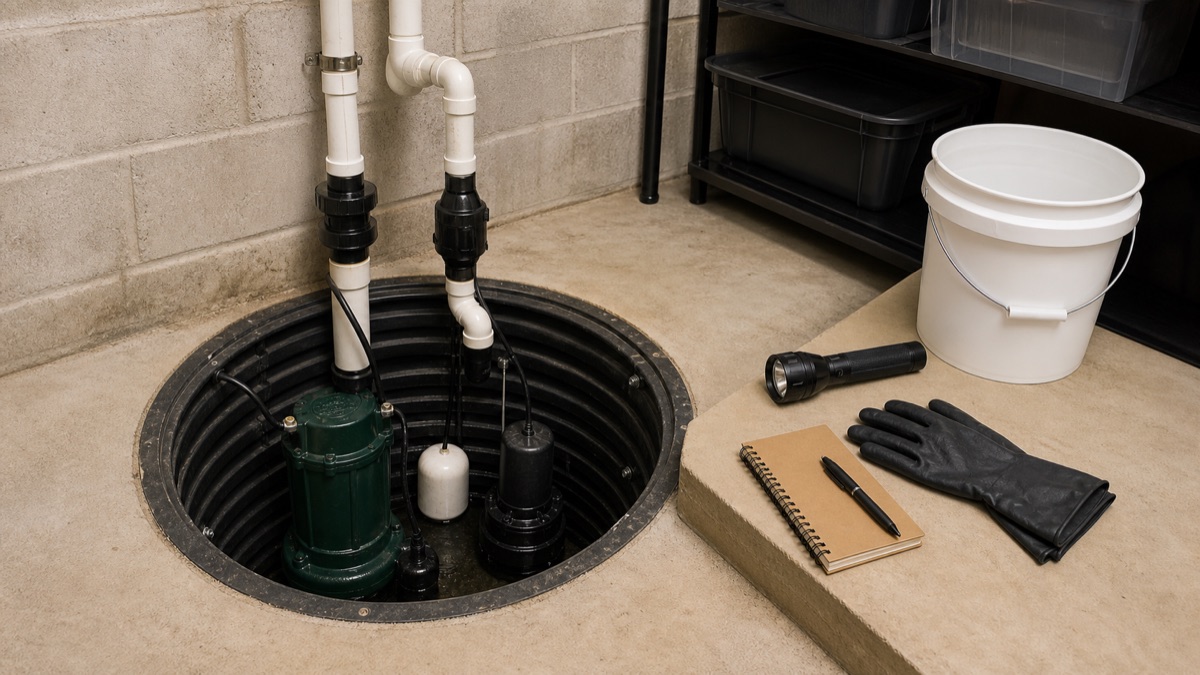
Before you buy or hire
Quick maintenance rule
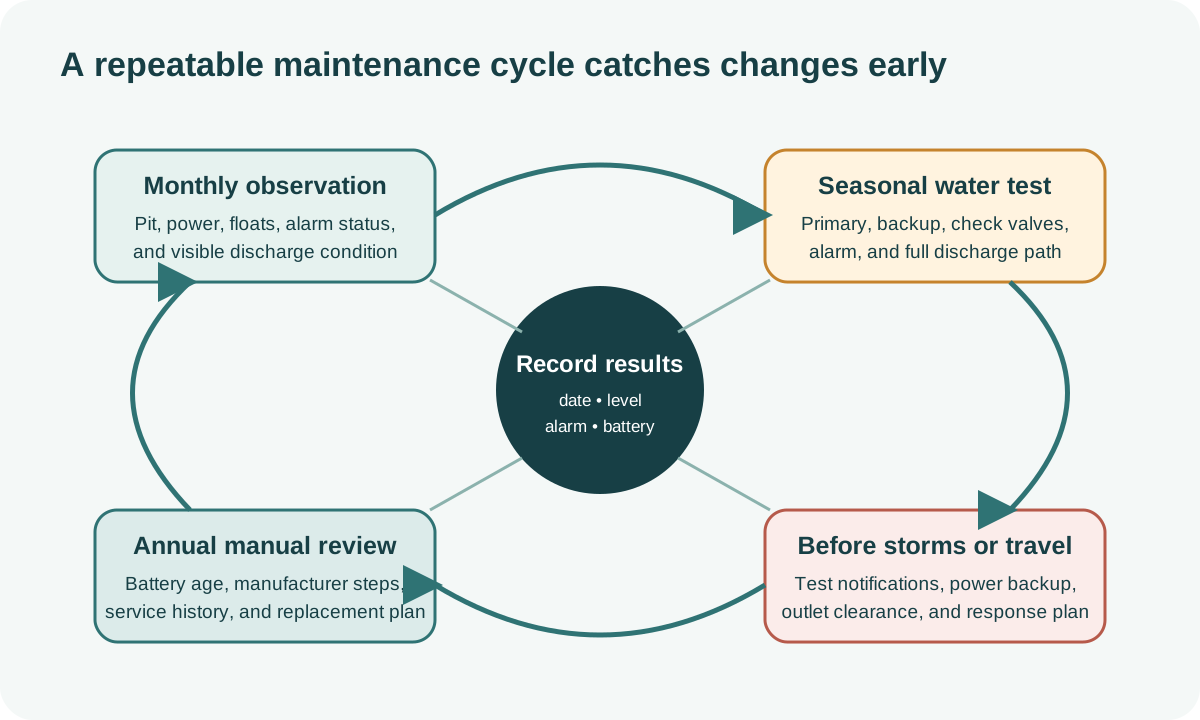
A checklist should reveal change before a storm, not encourage unnecessary disassembly. Inspect from a dry location, test with clean water through documented procedures, and record the result. The generic cadence below is a planning framework; the pump, controller, battery, and alarm manuals control actual tasks and intervals.
FEMA's homeowner guidance asks whether a sump pump is maintained, has battery backup, and has a high-water alarm. FloodSmart also notes that battery backup can preserve pumping during an outage. These layers still depend on a clear pit and discharge, adequate capacity, working power or battery, and someone responding to faults.[2][3]
Monthly visual check
From a dry floor, verify normal controller lights, no active alarms, connected plugs, an upright battery box, clear access, and no water on cords or receptacles. Look for leaks, corrosion, swollen battery cases, debris, unusual odor, loose discharge supports, or a pit level that differs from normal. Do not open electrical controls.
Record the date and any change. A quick observation is especially useful after an outage, plumbing work, heavy inflow, or a contractor visit. If the system manual requires more frequent checks, follow it. Wet-cell electrolyte inspection is a separate model-specific task and must not be applied to sealed maintenance-free batteries.[5][4]
Seasonal water test
Before the local wet season and major storms, add clean water in the manner allowed by the manuals. Observe the primary float rise, pump start, water movement, stop level, and check-valve behavior. Continue only as instructed to activate the backup float and alarm. Keep hands, tools, and extension cords out of the pit.
Verify that water exits at the intended exterior point and does not return toward the foundation. Restore every plug, silence/reset state, and controller connection. Zoeller's cited AquaNot manual specifies at-least-quarterly inspection for that system; Liberty specifies six-month alarm tests for covered ALM models. Keep those intervals attached to those products.[5][6]
Primary float
Confirm the primary float moves through its intended range without touching the pit, pump, backup float, cords, or discharge pipe. Tethered, vertical, electronic, and integrated switches behave differently. Do not bend, shorten, or relocate a float without the pump instructions. A primary pump that starts too late can consume backup margin; one that chatters may wear controls.
During the water test, note start and stop levels and whether the pump clears water promptly. If operation changes, investigate debris, mounting, check valve, discharge restriction, pump condition, or inflow. Do not treat repeated manual lifting as maintenance when the float cannot move correctly under water.[2]
Backup float
The backup float should activate above the normal primary range yet below overflow, with independent movement. Test it according to the backup manual, often by disabling the primary only through a defined procedure and raising water. Confirm backup pumping and alarm behavior, then restore primary power immediately after the test.
Zoeller's cited instructions provide a particular unplugging, fill, alarm, silence, stop, and reconnection sequence for the AquaNot system. Do not transplant that sequence to another brand. In a crowded pit, an installer should prove that both floats operate without tangling under realistic water flow.[5]
Battery and controller
Check the controller legend for ready, charging, low battery, bad battery, pump fault, and float fault. Record persistent or recurring indications rather than clearing them repeatedly. Inspect the battery box and cables without bridging terminals. Use only the supported battery chemistry, capacity, and maintenance procedure.
The BWSP checklist includes cleaning and fluid checks for its specified wet-cell setup. Zoeller distinguishes monthly electrolyte checks for wet-cell batteries from no such check for maintenance-free types and gives its own replacement guidance. These details demonstrate why one generic battery task can be unsafe or irrelevant across systems.[4][5]
Alarms
Test the local horn and visual indicator, backup battery, low-battery signal, and every configured remote recipient. Listen from occupied rooms. Confirm the sensor sits above normal activation without interfering with floats. A silenced alarm still represents a condition until water falls and the cause is corrected.
Liberty's manual specifies sensor placement, testing, and maintenance for covered ALM models, including a six-month alarm test and model-specific battery guidance. Use the installed manual. Repeat end-to-end notification testing after changing phones, Wi-Fi, router, subscription, alarm battery, or monitoring service.[6]
Check valves and discharge
Liberty's cited 441 backup manual requires a primary-pump check valve for that arrangement and documents separate-discharge and shared-discharge methods. During the prescribed water test, inspect accessible joints for leaks and confirm water leaves the pit instead of recirculating. Do not transplant its dimensions or assembly steps to a different model.
Outdoors, Guilderland advises routing discharge away from the foundation by natural slope and using cold-climate freeze relief; Superior advises disconnecting flexible corrugated hose during winter. A blocked shared path can defeat both pumps. Do not add valves, reduce pipe, or connect to a drain without the installed manuals and local approval.[7][8][9]
Pit debris
Remove loose debris only through a safe shutdown and cleaning method supported by the pump manual. Keep cords and floats free; do not reach into an energized pit. Sediment, gravel, fasteners, cloth, or biological buildup can obstruct intakes and switches. A cover should fit the application and preserve necessary access and venting.
The Basement Watchdog checklist contains model-specific cleaning steps for its system. Use it only where applicable. Investigate recurring debris or unusual inflow rather than treating removal as the entire repair. Sewage ejector basins require different equipment and professional precautions.[4]
Storm preparation
Before a forecast event, complete the water and notification tests early enough to repair failures, verify normal battery charge, clear the outlet, preserve access, and review expected inflow. Put pump, battery, controller, and contractor information in one dry location. Charge phones and support the network if remote alerts depend on it.
Do not enter floodwater or remain in a dangerous building to save equipment. Ready.gov emphasizes personal flood safety and evacuation instructions. The sump system is property protection with finite capacity; it cannot make a basement safe against every flood, sewer backup, structural failure, or electrical hazard.[1][3]
Absence and travel plan
Assign at least two alert recipients and one local responder who has safe access, knows the shutoffs, and will call qualified help rather than enter water. Share the alarm meaning, contractor number, property address, discharge location, and restrictions. Test that recipient while away from home.
Decide what happens if internet, cellular service, or power is down. A local audible alarm needs someone nearby; a remote alarm needs a working communications chain. Review insurance and emergency contacts before travel. Do not promise a neighbor that a battery runtime estimate guarantees a response window.[2][3]
Manufacturer differences and professional triggers
Keep every installed manual and model number. Build the schedule from those documents: inspection, water test, alarm test, battery service, battery replacement, cleaning, and professional service. When manuals conflict with a generic checklist, the applicable manufacturer and local requirements win. Record who completed each task and the measured result.
Call service for rising water, failed tests, repeated faults, overheated cables, damaged batteries, breaker trips, float interference, poor discharge, recurring freezing, check-valve problems, sewage exposure, or water near electrical equipment. A professional should also review a system protecting high-value finished space or one that has never been tested under realistic inflow.[5][6][4]
| Cadence trigger | Check | Record | Escalate when |
|---|---|---|---|
| Monthly or manual interval | Visual condition and controller state | Lights, leaks, corrosion, pit level | Fault, heat, damage, or wet electrical area |
| Seasonal or manual interval | Primary, backup, alarm, discharge water test | Start, stop, outlet, notifications | Any stage fails or interferes |
| After outage or storm | Battery recharge and system condition | Run event, charge state, damage | Battery does not recover or capacity is uncertain |
| Before travel | Recipients and responder | Successful end-to-end alert | No reliable response path |
Related reading and tools
Sources Used
- FloodsReady.gov / Federal Emergency Management Agency
- Urban Flooding: Guidance for Homeowners and RentersFederal Emergency Management Agency
- Five Facts to Help New Homeowners Protect Against Water DamageNational Flood Insurance Program
- Special CONNECT BWSP Resources and Maintenance ChecklistBasement Watchdog / Glentronics
- AquaNot Key ProPak Installation InstructionsZoeller Pump Company
- ALM-Series Indoor Alarms Installation ManualLiberty Pumps
- PC-Series 441 Battery Backup Installation ManualLiberty Pumps
- Residential Stormwater Management: Sump Pumps and Roof DrainsTown of Guilderland, New York
- Sewer Smarts and Plumbing BasicsCity of Superior, Wisconsin
FAQ
How often should I test my sump pump?
Use the installed manuals and local risk. The cited Zoeller backup manual says at least every three months for that system, while the cited Liberty alarm manual says every six months for covered alarms. A pre-storm test may be prudent.
Can I test the backup by unplugging the primary pump?
Only if the backup-system manual specifies that procedure and you can do it from a dry safe location. Follow the complete reconnection and reset steps; never leave the primary unplugged.
What should be in a sump maintenance log?
Record date, normal indicators, water-test start and stop behavior, outlet flow, alarm recipients, battery condition, cleaning, parts replaced, faults, outages, contractor findings, and the next manual-based due date.
Related guides
Best Sump Pump Battery Backup: How to Choose Before the Storm
The best backup sump pump is the one that moves enough water for your pit, runs long enough for your outage risk, and alerts you before the basement becomes a claim.
How Often Should a Sump Pump Backup Battery Be Replaced?
Replace a backup battery according to its system manual and condition, not a universal calendar. Age is one input; warnings, test performance, chemistry, charging, temperature, terminal condition, and the home's storm exposure determine how much margin remains.
Sump Pump Battery Runtime Calculator: Estimate Backup Hours
Runtime estimates are not guarantees, but they help homeowners see whether a backup battery is sized for a short outage or a storm night.