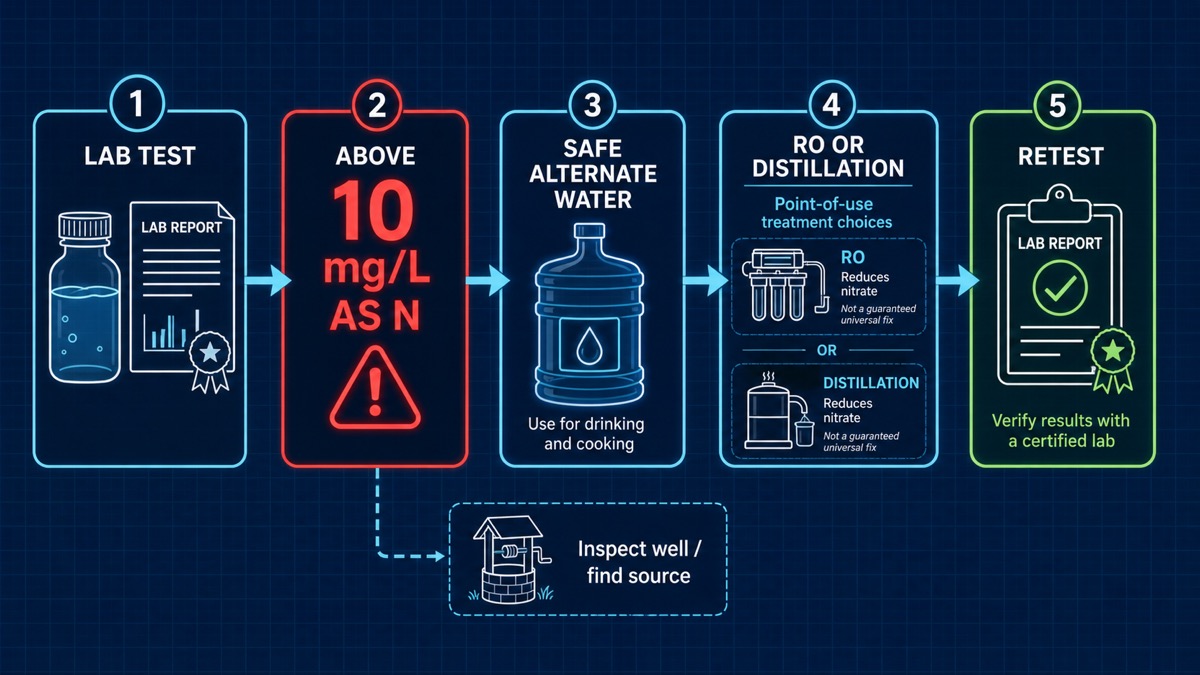
Start with the number and the unit
EPA uses a maximum contaminant level of 10 milligrams per liter for nitrate measured as nitrogen in public drinking water. A private-well report should be read with its exact analyte and units because laboratories may report nitrate as nitrogen or use another expression. Do not compare two numbers until the basis is clear. Call the laboratory or health department when the report notation is unfamiliar, and keep the original report rather than copying only a number into a shopping note.
The public-water MCL is a useful health benchmark for private-well decisions, but EPA does not routinely regulate a household well. The owner must test and act. Nitrate can occur naturally and can be influenced by fertilizer, septic systems, animal waste, wastewater, runoff, and local geology. A result does not prove a particular source. It tells you that exposure and source investigation need attention.[2][3]
Immediate-use branch: protect drinking and cooking first
If a certified result is above 10 mg/L nitrate measured as nitrogen, switch drinking, cooking, beverage, ice, and infant-formula preparation to a known-safe source and contact the local health department for case-specific instructions. Do not wait for a treatment quote. Minnesota Department of Health specifically advises that babies under six months not drink the affected well water and that boiling makes nitrate more concentrated.
Record the reported analyte, value, unit, sample location, collection date, laboratory, and whether the report states nitrate as nitrogen or in another form. Do not convert units or declare a borderline result acceptable without the laboratory or health department. Ask which household uses must remain on alternate water, whether anyone with symptoms or an illness concern needs medical attention, and what confirmation sampling the authority wants.
Separate the immediate-use branch from the source and treatment branch. A licensed well contractor can inspect construction and possible entry pathways; the local authority can help frame additional testing. Boiling, a sediment filter, activated carbon without a nitrate claim, UV, softening without a nitrate claim, or improved taste does not establish nitrate control.[6][2][4]
Confirm the result and investigate the source
Work with a certified laboratory and health department on confirmation sampling, the sampling point, and any additional analytes. CDC includes nitrate in the annual private-well baseline and notes that elevated nitrate can be associated with other contaminants. Coliform testing and locally relevant chemicals may help describe the contamination pathway. A repeat sample is not a reason to continue drinking suspect water while waiting; it is a quality-control and diagnostic step.
Inspect the well setting with a qualified professional. Consider the well cap and casing, surface drainage, setbacks, recent flooding, septic condition, fertilizer or manure activity, and changes in nearby land use. Some source problems can be corrected; others reflect aquifer conditions that require treatment or a different supply. Document season and rainfall because nitrate can vary. One acceptable sample after an elevated result may not establish a stable long-term condition.[1][3]
Reverse osmosis and distillation
EPA identifies reverse osmosis and distillation as treatment options that can remove nitrate. Point-of-use reverse osmosis is often considered for drinking and cooking water, while whole-house decisions require much larger flow, pretreatment, waste-water, plumbing, and cost analysis. A membrane's reduction claim must cover nitrate at the tested concentration and expected water chemistry. Recovery rate, reject-water connection, storage-tank hygiene, pressure, and replacement schedule affect real performance.
Distillation boils water and condenses the vapor in a controlled appliance; it is different from boiling a pot and drinking the remaining water. Capacity, energy use, cleaning, volatile contaminants, storage, and certified claims require review. Neither technology should be selected from category name alone. Ask for independent certification or validated reduction data, the rated service conditions, consumable costs, and the exact sample plan that will confirm treated-water nitrate.[2][5]
Point of use or whole house
The treatment boundary should follow exposure. A point-of-use unit can produce water for drinking and cooking if every relevant user consistently uses that faucet and the system has enough daily capacity. It does not reduce nitrate at bathrooms, utility sinks, refrigerator lines, or other unconnected taps. Whole-house treatment covers more outlets but increases equipment, drain, monitoring, and maintenance demands. Health officials can clarify which household uses require treated water in the local situation.
Map every drinking-water path before installation: kitchen, ice maker, formula preparation, pet water, secondary kitchen, and seasonal occupants. Label treated and untreated taps and plan for outages or exhausted consumables. If the household cannot reliably manage a split system, a different design or alternate supply may be safer. Treatment planning should also consider other report findings so one solution does not worsen pressure, corrosion, sodium, microbial growth, or waste disposal.[5][4]
Treatment-verification branch: prove the named nitrate job
For each candidate, record point of use or point of entry, exact model, a label or certification that names nitrate, permitted inlet water and pressure, production rate, reject-water or concentrate path, storage volume, maintenance parts, service trigger, and sample ports. CDC identifies reverse osmosis and distillation as treatment categories that may reduce nitrate, but the exact product claim and conditions determine the supported job.
Create a commissioning row for installation date, untreated result, treated sample location, accredited laboratory, target supplied by the health authority, and result. Keep using the known-safe source until the required treated-water result and authority guidance support return to use. Taste, appearance, total dissolved solids, a membrane display, or an installer statement is not a nitrate result.
Keep a continuing verification row for every service event, cartridge or membrane change, alarm, long shutdown, pressure or production change, and follow-up sample. If treatment fails, is bypassed, loses required feed conditions, or lacks parts, return to the alternate-water branch and arrange service and testing. A successful result at one treated tap does not establish that untreated or other household taps meet the same condition.[5][4][6]
Buying and professional-review checklist
A credible proposal starts with the laboratory report and states which outlets will be protected. It identifies the nitrate reduction claim, rated influent concentration, flow or daily production, pressure, temperature, pretreatment, recovery or reject-water ratio, drain needs, storage, power, monitoring, consumables, sanitation, and testing. It should disclose what the equipment does not remove. Avoid sales claims that rely on taste, a generic parts-per-million display, or an unlabeled demonstration.
Use a qualified water professional and local health guidance when nitrate is elevated, infants or pregnant people may be exposed, multiple contaminants are present, the well has flooded, or whole-house treatment is being considered. Medical questions belong with healthcare professionals. If treatment cannot be maintained and verified reliably, a permanent alternate supply or source correction may be more protective than complex equipment. The goal is sustained exposure control supported by laboratory evidence.
Ask how the household will know when performance changes. A useful design provides a sample tap, written maintenance intervals, locally available parts, a clear bypass policy, and a backup drinking-water plan while equipment is out of service. Put the next laboratory date on the calendar at commissioning rather than waiting for taste or production to change.[4][2]
| Decision point | Record | Action | Evidence boundary |
|---|---|---|---|
| Result above 10 mg/L as N | Lab, value, unit, date, sample point | Known-safe water and local health department | Do not boil or wait for equipment |
| Result or unit uncertain | Original report and laboratory contact | Ask lab or authority before interpreting | Do not perform an unsupported conversion |
| Treatment selection | Exact nitrate claim and inlet limits | Compare point-of-use and point-of-entry scope | Category alone is not a nitrate claim |
| Commissioning | Untreated and treated accredited-lab results | Follow authority return-to-use guidance | Displays and taste are not verification |
| Failure or maintenance event | Date, symptom, bypass, parts, resample | Return to known-safe water until resolved | One treated tap does not cover every tap |
Scroll sideways to read every column on smaller screens.
Before you buy or hire
Related reading and tools
Choose the next step for your situation: measure, compare options, or maintain and verify.
- Explore the topicWell Water Treatment
- Measure with a toolWell Water Lab Report Decision Helper
- Measure the problemSulfur Smell in Well Water: Causes, Tests, and Treatment Paths
- Compare your optionsWhole-House Well Water Filter Order: Sediment, Iron, Softener, UV, and RO
- Compare your optionsChoosing an Iron Filter for Well Water: Lab Report to Installable Quote
How this guide was checked
Guides are built from official sources, product documentation, manufacturer manuals, and practical homeowner decision criteria. We do not claim hands-on product testing unless a page explicitly says a product was tested.
- Source-backed editorial review
- 6 cited source records
- Private well owners should test before buying treatment. Odor, stains, and taste are not complete safety assessments.
Ready Home Systems is educational and not a substitute for local code officials, licensed trades, medical providers, water labs, or mitigation professionals.
Read review methodologySources and manuals
- Guidelines for Testing Well WaterCDC
- What should I do if my water has elevated nitrates and/or exceeds the MCL?U.S. EPA
- Estimated Nitrate Concentrations in Groundwater Used for DrinkingU.S. EPA
- Guidelines for Treating Well WaterCDC
- About Home Water Treatment SystemsCDC
- Nitrate in Well WaterMinnesota Department of Health
FAQ
Does boiling well water remove nitrate?
No. Boiling does not remove nitrate and evaporation can concentrate it. Use an approved alternate source and follow health-department guidance.
Will a water softener or carbon filter remove nitrate?
Do not assume it will. Nitrate requires a verified contaminant-specific reduction claim. EPA identifies reverse osmosis and distillation as treatment options.
Should I treat the whole house?
That depends on exposure uses, household behavior, source concentration, other contaminants, flow, maintenance, and local health advice. Point-of-use treatment may protect drinking and cooking only when every relevant outlet and user is covered.