Before you buy or hire
Testing-first rule
Do not build a treatment train from stains, odor, taste, or a generic internet diagram. EPA advises private-well owners to test regularly and when water quality or well conditions change. A useful design sample can include microbial indicators and locally relevant health contaminants as well as pH, hardness, iron, manganese, turbidity or sediment observations, and other parameters recommended by the certified laboratory or local health department.
The result determines whether treatment is for an aesthetic nuisance, equipment protection, or a health-related contaminant. Those categories have different evidence and follow-up needs. If a health standard is exceeded, involve the appropriate health authority and confirm the result as directed. A whole-house filter sequence should never create false confidence by improving appearance while leaving an unaddressed contaminant.[2][3]
Treatment-order principles
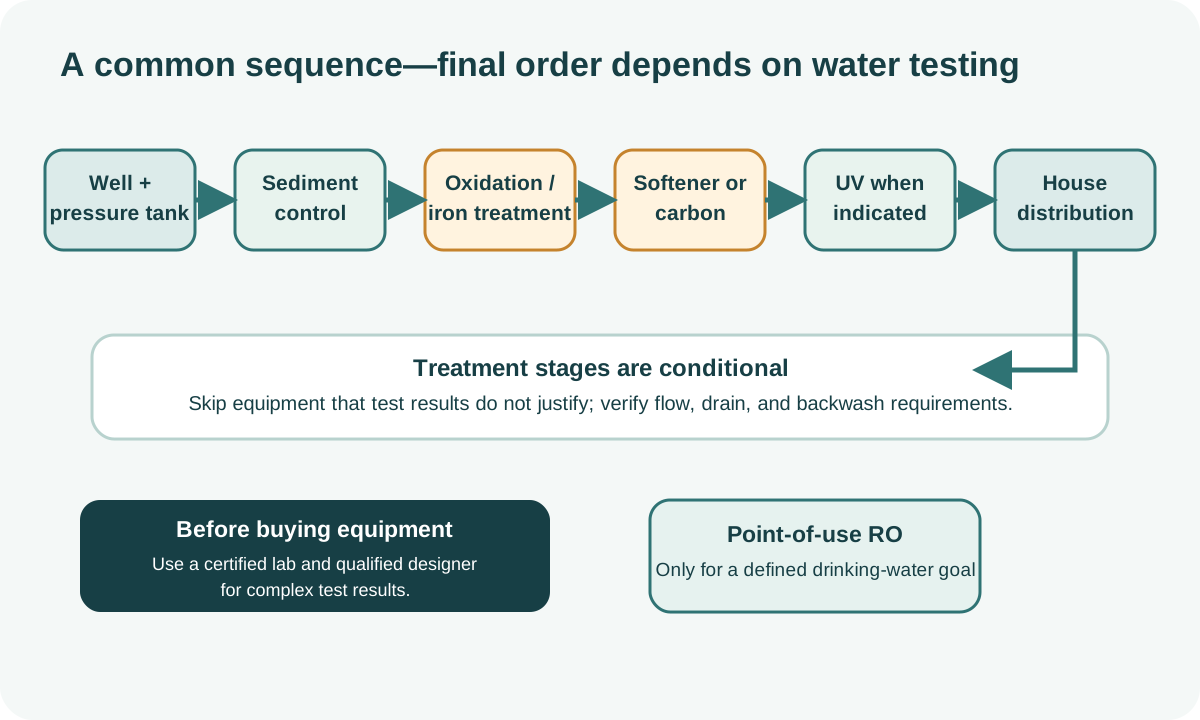
Order equipment by dependency. Remove material that would foul the next process, create the water conditions that the next process requires, preserve enough flow for service and regeneration, and put final barriers after the processes that could reintroduce particles. Each device has an inlet-water range, service-flow limit, pressure requirement, drain need, and maintenance method. The manufacturer's design data and the actual water analysis outrank a generic sequence.
Keep sampling possible before and after major stages. Untreated sampling helps detect well changes; intermediate sampling helps diagnose which stage is failing; finished-water sampling verifies the intended result. Include isolation, bypass, drainage, leak management, and service clearance according to local rules. Complexity is not automatically resilience: every added tank, valve, lamp, cartridge, and drain line creates another maintenance obligation.[5][6][1]
Pressure tank and treatment boundary
In many conventional private-well systems, the pump fills a pressure tank before household treatment so the tank and controls can manage pump cycling and supply demand. Filters placed where they restrict the pump-to-tank relationship can affect control behavior. Actual layouts vary, especially with variable-speed equipment, atmospheric storage, booster pumps, or specialty treatment. Map the well, controls, tank, raw-water sample point, treatment, and household branches before changing pipe.
The Water Systems Council describes pressure tanks as preventing rapid pump cycling, supplying pressurized water between cycles, and adding storage under pressure. It ties sizing to system demand, pump capacity, and well capacity. Treatment designers therefore need to know more than pipe diameter. Backwashing equipment, simultaneous fixture use, and filter loading can all change the flow the system must deliver.[4]
Sediment control
Coarse sediment control is often early because grit can foul valves, media distributors, softeners, UV sleeves, and small passages. The right stage could be a flushable screen, a cartridge, or no added filter if sediment is not a meaningful problem. Select from observed load, particle size, pressure loss, and downstream needs. A fine cartridge installed too early can starve a backwashing tank as it loads.
Sudden sediment should trigger well investigation rather than an ever-finer filter stack. Record whether material follows storms, pump work, or changes in pressure. EPA recommends testing after changes and following flood precautions when contamination is possible. Sediment filtration is particle control; it does not establish that the water is free of dissolved chemicals or microorganisms.[2][3]
Oxidation and iron or manganese treatment
Dissolved iron or manganese may need oxidation before filtration, while already oxidized particles may be captured directly. pH, concentration, competing constituents, sulfur odor, and peak flow influence media and chemical choices. Some systems introduce air; others use an oxidant and contact time. The sequence must prevent chemical carryover and provide the required backwash. Do not infer a treatment method only from orange or black stains.
If disinfection or chemical feed is part of the design, dosing, contact, residual control, storage, and maintenance require professional attention. Test data should identify the target and post-treatment sampling should verify performance. Iron bacteria, microbial contamination, and damaged well construction are not interchangeable with ordinary dissolved iron. A well or treatment professional can decide whether source correction, cleaning, or treatment is appropriate.[3][2]
Softening and carbon
A softener addresses hardness through ion exchange and may have limited, model-specific tolerance for other constituents. Significant iron, manganese, or sediment can foul resin, so problem-specific removal commonly precedes softening when testing shows it is needed. Regeneration requires adequate flow and a lawful drain destination. Salt use, discharge, bypass behavior, and maintenance belong in the system decision rather than being treated as afterthoughts.
Activated carbon can reduce certain tastes, odors, disinfectants, or specifically documented organic contaminants, depending on the product and certification. Carbon is not a universal contaminant filter and can create a maintenance point where exhausted media no longer performs as intended. Place it according to the target, downstream process needs, and manufacturer instructions. Claims must match the exact model and test condition, not the generic word carbon.[5][6]
UV disinfection
Ultraviolet equipment depends on water that meets the unit's inlet requirements. Suspended particles, color, scale, iron, manganese, or hardness can shield organisms or foul the sleeve, so pretreatment often comes first. The UV unit must be sized for peak flow and the specified dose, with lamp and sleeve maintenance performed on schedule. Power loss removes the barrier unless the design includes an appropriate response.
UV does not remove dissolved chemicals and does not repair a contaminated or flooded well. EPA advises protective action and qualified help after well flooding. For microbial concerns, coordinate certified testing, well inspection, corrective work, and any continuous disinfection with health guidance. The treatment sequence should include a safe plan for alarms, lamp failure, power interruption, maintenance, and post-service sampling.[5][2]
Reverse osmosis at point of use
Reverse osmosis is commonly considered at a drinking-water tap because treating all household flow can waste water, require larger equipment, and remove minerals where no reduction is needed. A point-of-use system can address specific documented contaminants when the exact product claim matches the water test. Pretreatment may be needed to protect the membrane from sediment, hardness, iron, chlorine, or other conditions listed by the maker.
RO produces a reject stream and needs adequate feed pressure, sanitation, filter changes, and storage-tank service. It is not automatically the final answer for every well. Confirm the contaminant, concentration, certification or performance evidence, recovery, drain route, and replacement cost. Retest at the frequency recommended for the risk and local guidance; clear-tasting water is not a substitute for verification.[5][2]
Example sequences, not prescriptions
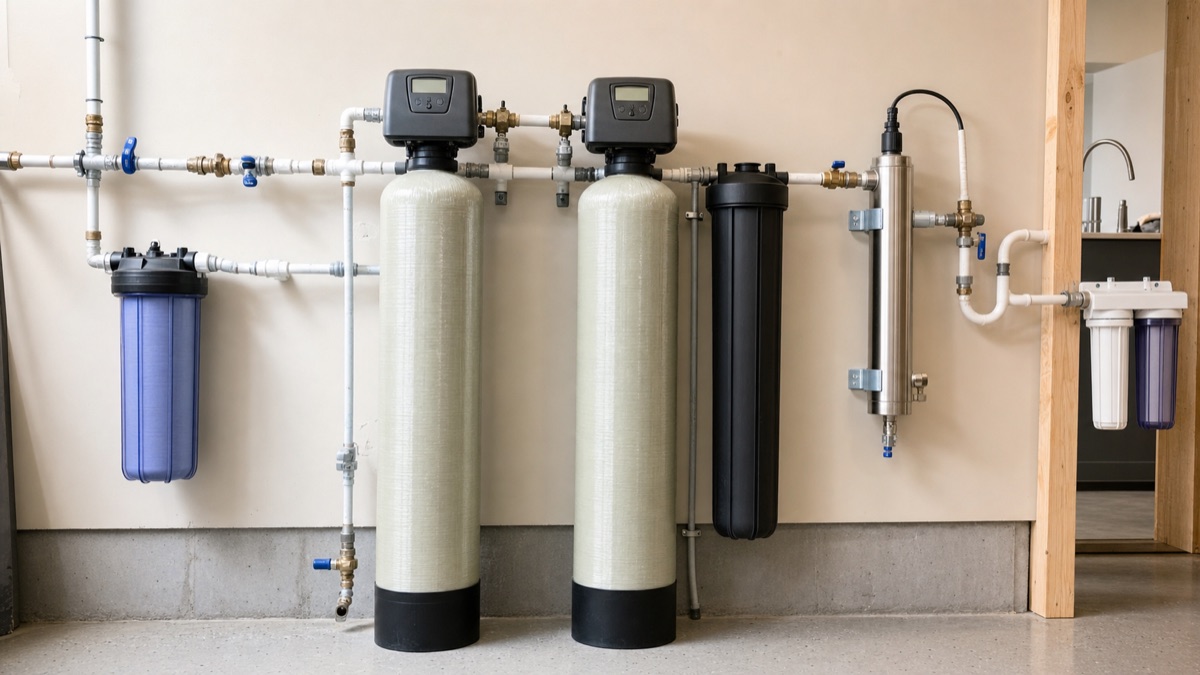
A home with stable coarse grit and hardness might use pressure storage, coarse sediment control, an appropriately sized softener, and untreated/correctly treated sampling points. A home with tested dissolved iron and hardness might need oxidation and iron filtration before the softener. A microbial barrier design might add pretreatment that meets UV inlet requirements, followed by UV near the distribution entry. A defined drinking-water contaminant might add certified point-of-use RO at the kitchen.
Each example can be wrong when chemistry or equipment changes. Carbon placement can move based on the target. Oxidant contact and residual removal can add stages. Acidic water may require correction. Arsenic speciation, nitrate, PFAS, radionuclides, or bacteria require contaminant-specific decisions. Use the examples to ask dependency questions, then design from laboratory data and verified product requirements.[3][4]
Drain, flow, backwash, and maintenance constraints
Backwashing filters and softeners need enough sustained flow to lift or clean media. Confirm pump output, pressure-tank behavior, pipe loss, simultaneous use, and the effect of loaded prefilters. Drain lines must handle the specified rate without cross-connection, freezing, erosion, or prohibited septic impact. Chemical systems need safe storage and containment. UV and RO need accessible consumables and a response when power or pressure is unavailable.
Create one maintenance table for the entire train: inspection, pressure readings, flushing, cartridge changes, regeneration supply, media service, chemical refill, UV sleeve and lamp care, RO sanitation, and testing. Use model-specific intervals rather than a generic calendar. Label valves and sample points. Keep manuals and part numbers. A system is only as reliable as the least-maintained stage.[6][4]
Professional design triggers
Use professional design when a test shows a health-related contaminant, microbial risk exists, multiple constituents interact, chemical feed is proposed, the well has limited yield, backwash flow is uncertain, drainage is constrained, pressure behavior is abnormal, or local permits apply. Flooded wells require safety precautions, inspection, disinfection, and testing under official guidance—not an ordinary filter-order change.
Ask for a written basis: raw-water results, design flow, each stage's purpose, inlet limits, expected performance, drain requirements, maintenance, sampling plan, operating cost, and what happens during power loss or failure. That document makes proposals comparable and gives future service technicians a coherent system rather than a row of tanks whose original purpose has been forgotten.[2][1][4]
| Stage | Place it when | It protects or prepares | Verify before design |
|---|---|---|---|
| Sediment control | Test and observation show a particle load | Valves, media, UV sleeve, and point-of-use devices | Particle load, pressure loss, and backwash flow |
| Iron or manganese treatment | Lab chemistry supports a defined process | Softener, carbon, UV, fixtures | pH, concentration, oxidation, flow, drain |
| Softener or carbon | Hardness or a documented carbon target exists | Appliances or a downstream process | Exact claim, regeneration, media life |
| UV | A microbial barrier is professionally justified | Distribution after suitable pretreatment | UV transmittance factors, peak flow, alarms |
| Point-of-use RO | A specific drinking-water reduction is needed | One drinking/cooking outlet | Certification, feed conditions, reject drain |
Related reading and tools
Sources Used
- Private Drinking Water WellsU.S. Environmental Protection Agency
- Protect Your Home's WaterU.S. Environmental Protection Agency
- Potential Well Water Contaminants and Their ImpactsU.S. Environmental Protection Agency
- Wellcare Information SheetsWater Systems Council
- About Home Water Treatment SystemsCenters for Disease Control and Prevention
- Water Quality and Common Treatments for Private Drinking Water SystemsUniversity of Georgia Cooperative Extension
FAQ
Does the sediment filter always go first?
It is often the first treatment stage after the pressure-system boundary because it protects downstream equipment, but the correct location depends on the pump, tank, sampling needs, backwash flow, and manufacturer's design.
Should UV come before or after the water softener?
UV usually needs water that meets strict clarity and fouling limits, so sediment, iron, manganese, and scale control may need to precede it. Confirm the UV maker's inlet requirements and the complete water analysis.
Is whole-house RO the final stage?
Not usually for an ordinary home. Point-of-use RO can be more practical for a specific drinking-water target. Whole-house designs require specialized sizing, pretreatment, storage, pumping, drain, sanitation, and cost analysis.
Related guides
Best Iron Filter for Well Water: A Testing-First Buying Guide
The right iron filter depends on whether the iron is dissolved, oxidized, bacterial, or mixed with manganese and sulfur odors. Start with a lab test and match equipment to the result.
Best Sediment Filter Micron Size for Well Water
There is no single best micron rating for every private well. Start with the material you can observe, confirm broader water-quality risks through testing, protect household flow, and use staged filtration when one element would otherwise clog too quickly.
Iron Filter vs Water Softener: Which One Does Well Water Need?
A softener handles hardness. An iron filter handles iron and manganese more directly. Many well homes need both, but order and sizing matter.