Before you buy or hire
Quick answer: match the filter to the sediment and the job
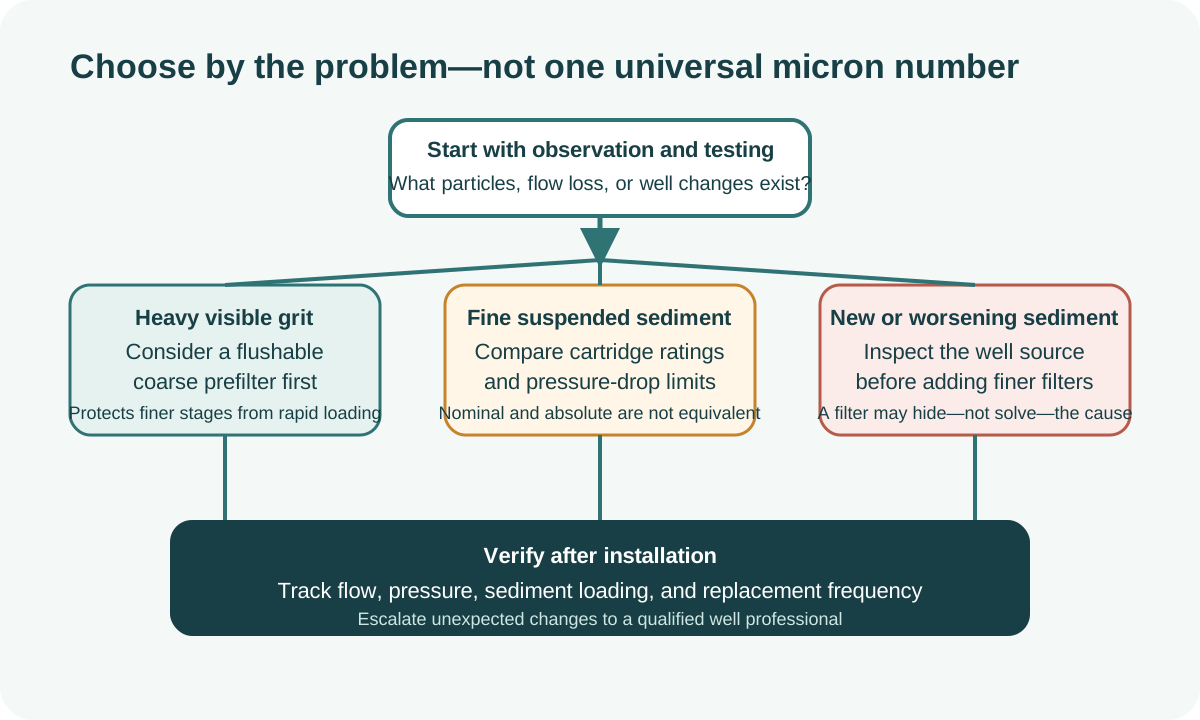
A practical starting point is the coarsest filter that captures the troublesome particles without creating unacceptable pressure loss. A flushable spin-down element can intercept sand and visible grit; a cartridge can catch smaller suspended material; a finer point-of-use element may polish water for one tap. Those are roles, not universal micron prescriptions. Actual selection depends on particle size, sediment volume, peak household flow, housing size, and the documentation for the element you intend to buy.
Sediment appearance does not tell you whether drinking water is safe. Private-well owners are responsible for their water, and EPA recommends testing rather than treating from taste, color, or odor alone. If sediment appeared after flooding, well repair, land disturbance, or a sudden water-quality change, pause the shopping decision and arrange appropriate testing and well inspection first. A filter can make water look clearer while leaving dissolved or microbial contaminants unchanged.[1][2]
- Identify whether the material is gritty, cloudy, rusty, or slimy.
- Record pressure before and after the current filter during high flow.
- Confirm that the proposed housing and element support the home's peak flow.
What micron ratings mean
A micron is a unit of size, but the number printed on a filter is not a complete performance description. It tells you the particle scale the manufacturer associates with that element. It does not, by itself, say how much dirt the element can hold, how efficiently it captures particles at that size, how quickly pressure will fall, or whether it treats a dissolved contaminant. Compare the rating together with the element type, tested capacity, flow curve, housing, and replacement instructions.
Moving to a smaller number generally means targeting smaller particles, but it also asks the filter to retain more material. On a sediment-heavy well, a very fine first stage may load rapidly and make showers or appliances starve for flow. On a relatively clean well, the same nominal rating may last much longer. That is why a service record—installation date, pressure readings, visual condition, and household water use—becomes more useful than copying another homeowner's micron choice.[5][6]
Visible grit versus fine suspended material
Coarse sand that settles in a clear jar poses a different filtration problem from fine clay that keeps water hazy. Settling material may be suitable for a reusable coarse stage that can be flushed. Fine material can pass a coarse screen and may require a cartridge with more media area. Rust-colored particles may also come from plumbing, a pressure tank, or oxidized iron rather than the aquifer. Record whether debris appears at every fixture, only after the pump starts, or only at one branch before assigning the cause.
Use a simple observation jar only as a maintenance clue, not as a laboratory test. Note how quickly particles settle, whether the problem changes after heavy rain, and whether hot and cold water differ. EPA's contaminant information explains that private wells may be affected by naturally occurring materials and by nearby activities. Certified testing and a local well professional can separate an aesthetic particle issue from a damaged well, corrosion, or a source-water change that deserves correction upstream.[3][2]
Nominal ratings and label limits
A micron number is incomplete unless the manufacturer also explains the performance terminology and test context. Pentair's particulate-reduction guidance explains its nominal terminology as roughly 85 percent capture. That definition belongs to Pentair's cited context and should not be generalized to every filter label or used as evidence of microbial control.
When comparing products, look for a published efficiency statement, test conditions, flow rate, pressure-drop data, and the model number of the compatible housing. If a listing gives only a micron number, treat the comparison as incomplete. The safest purchasing note is specific: this element, in this housing, at this documented flow, is intended for this particle-control role. Potability or contaminant-reduction claims require separate evidence and should never be inferred from a sediment rating.[5]
Single-stage versus staged filtration
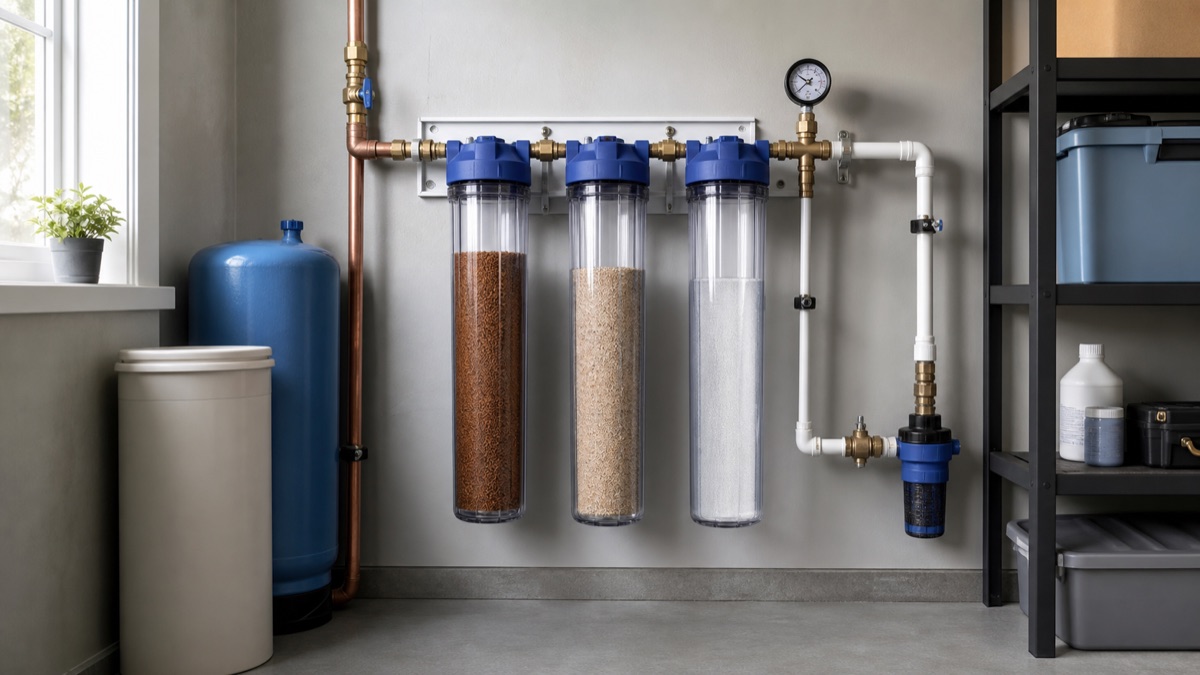
One cartridge is simplest when sediment is light, particle sizes are fairly consistent, and replacement frequency is acceptable. Staging becomes useful when a fine element is being asked to hold large quantities of coarse material. A coarse flushable stage can take the grit, followed by a larger-area cartridge for finer particles. This arrangement can make maintenance more predictable, but every stage adds fittings, leak points, purchase cost, and some resistance to flow.
Do not add stages because a diagram looks comprehensive. Start with a defined problem and measure the result after each change. Leave gauges or test ports where pressure can be compared under similar flow. Provide bypass and isolation only in ways allowed by local requirements and the equipment instructions. If later treatment needs a minimum backwash rate, verify that upstream filtration and plumbing will not prevent that rate when the sediment elements begin to load.[4]
Pressure drop and replacement signals
A dark-looking cartridge is not the only replacement signal. Reduced shower flow, appliance fill time, or a widening pressure difference across the filter under a repeatable flow can show that the element is restricting the system. Compare readings when water is actually moving; static pressure alone may hide a clogged element. Use the housing and cartridge maker's maximum differential-pressure and service instructions rather than inventing a universal gauge threshold.
Short life can mean the element is too fine for the first stage, the housing is undersized, the well is producing unusual sediment, or household demand is higher than expected. Replacing cartridges more often may manage the symptom but not the source. Keep dates, pressure observations, and photographs of removed elements. A pattern tied to storms, pump work, or a sudden change is useful information for a qualified well contractor.[4]
When sediment signals a well problem
New sediment deserves more caution than a stable, long-understood nuisance. Changes after flooding, construction, casing damage, pump replacement, or a drop in well yield can indicate conditions that filtration should not conceal. EPA advises immediate testing when well conditions or water quality change and recommends experienced help after a flood. Avoid repeatedly opening a pressurized housing while the cause remains unknown, especially if the equipment area is wet or electrical components are nearby.
Call a well contractor when sand volume rises, the pump begins cycling abnormally, air enters the plumbing, water stays cloudy, or pressure behavior changes alongside the debris. Call the local health department or a certified laboratory when contamination is possible. Treatment equipment can be selected after the source and safety questions are understood; repairing the well or changing pump placement may be the more durable answer.[2][3]
Buying checklist
Bring measured information to the comparison: pipe size, available installation space, peak-flow estimate, normal pressure range, observed sediment, current cartridge life, and any downstream equipment requirements. Compare housing pressure and temperature ratings, port size, element dimensions, replacement availability, drain needs for a flushable unit, and whether clear housings are permitted for the installation environment. Sunlight, freezing, and mechanical impact can affect where equipment belongs.
Budget for valves, gauges, mounting, leak protection, replacement seals, cartridges, and safe disposal—not only the filter body. Favor documented performance over vague multi-stage marketing. If the product claims to reduce a contaminant rather than merely trap sediment, identify the exact certification or test documentation for that model and confirm that it applies to the water conditions and flow you have.[1]
Professional triggers
Use qualified help when sediment is sudden or severe, the well may have been flooded, the pump or pressure system behaves differently, plumbing changes require permits, or a filter would restrict required treatment flow. A professional can inspect the well construction, measure pump performance, evaluate pressure-tank operation, and size equipment from real demand. Health-related test results belong with a certified laboratory and the appropriate local health authority, not a filter-size guess.
For a routine, stable sediment problem, the homeowner's best contribution is a clear record. Document sample appearance, dates, pressure under a repeatable fixture load, cartridge life, and maintenance actions. That record makes a later decision about coarse screening, cartridge area, staged filtration, or well repair evidence-based and keeps the micron number in its proper role: one specification inside a larger system.[2][4]
| Filter approach | Best fit | Main tradeoff | Next check |
|---|---|---|---|
| Coarse spin-down | Visible sand or grit with enough load to justify flushing | Fine material may pass through | Confirm mesh rating, drain method, and flow limit |
| 20–50 micron cartridge | Moderate visible particles or a second coarse stage | May load quickly on heavy sediment | Track pressure loss and replacement life |
| 5–10 micron cartridge | Finer suspended particles after coarse control | More restriction and maintenance risk | Verify housing area and peak household flow |
| Finer point-of-use treatment | Polishing one drinking-water outlet for a defined need | Not a whole-well safety solution | Match the exact claim to test results and documentation |
Related reading and tools
Sources Used
- Private Drinking Water WellsU.S. Environmental Protection Agency
- Protect Your Home's WaterU.S. Environmental Protection Agency
- Potential Well Water Contaminants and Their ImpactsU.S. Environmental Protection Agency
- Wellcare Information SheetsWater Systems Council
- Particulate Reduction: Water Treatment ProcessPentair
- Sediment Cartridges Technical SheetPentair
FAQ
Is 5 micron always better than 20 micron for well water?
No. Five micron targets smaller particles but can restrict flow or clog faster. The better choice is the coarsest documented element that solves the observed particle problem while preserving required flow, sometimes after a coarse first stage.
Will a one-micron sediment filter remove bacteria?
Do not treat a sediment rating as a disinfection claim. Microbial safety requires appropriate testing and a treatment method validated for the identified risk. Follow health-department guidance and equipment documentation.
Should the sediment filter go before every other treatment tank?
Often sediment control is early, but the correct order depends on water chemistry, pump and pressure-tank layout, required backwash flow, and manufacturer instructions. Use the whole-house sequencing guide and a professional design for complex systems.
Related guides
Best Iron Filter for Well Water: A Testing-First Buying Guide
The right iron filter depends on whether the iron is dissolved, oxidized, bacterial, or mixed with manganese and sulfur odors. Start with a lab test and match equipment to the result.
Iron Filter vs Water Softener: Which One Does Well Water Need?
A softener handles hardness. An iron filter handles iron and manganese more directly. Many well homes need both, but order and sizing matter.
Spin-Down vs Cartridge Sediment Filter for Private Wells
A spin-down filter is usually strongest at reusable coarse sediment control, while a cartridge offers broader choices for finer particles. Many high-load wells benefit from both in sequence, but flow, maintenance, and the source of new sediment come first.