The annual baseline
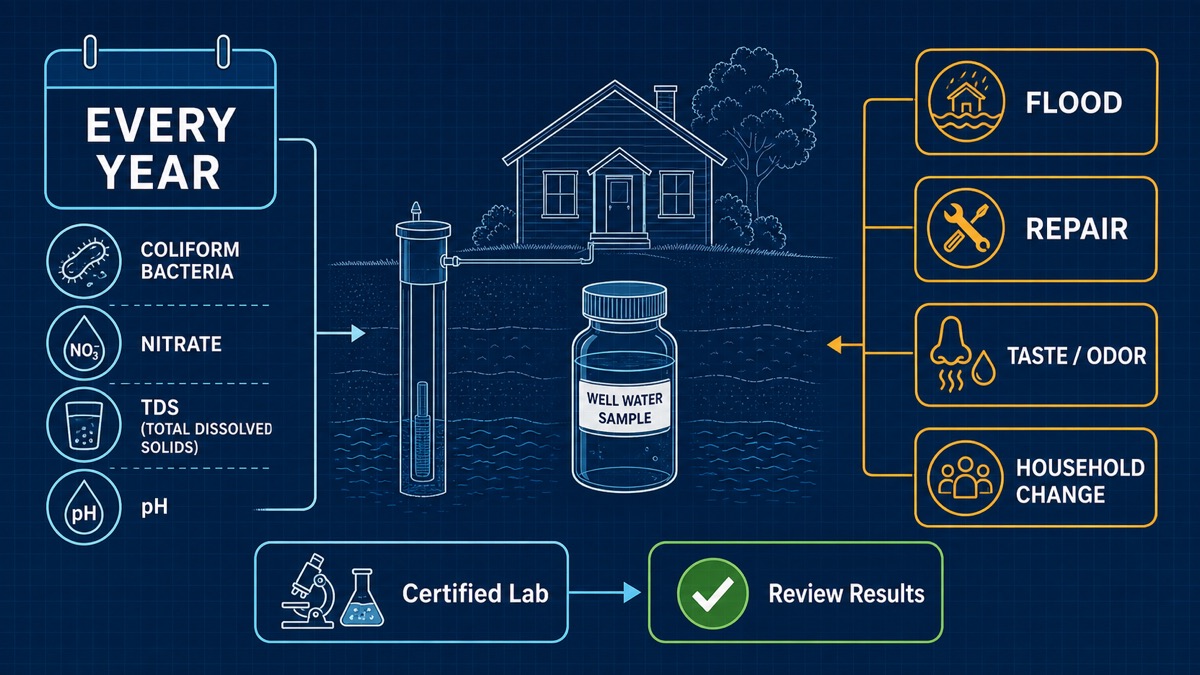
For most private-well households, the simplest defensible schedule begins with one laboratory test every year. CDC identifies total coliform bacteria, nitrate, total dissolved solids, and pH as the annual baseline. EPA gives the same core list and emphasizes that private wells are not routinely regulated or monitored like public water systems. Put the test on a recurring calendar rather than waiting for a smell or stain. Many important contaminants have no obvious taste, odor, or color, so a normal-looking glass is not evidence that the well is safe.
The baseline is a floor, not a universal panel. Ask the local or state health department which contaminants occur in your geology and land-use setting. Agricultural activity can change the value of nitrate and pesticide testing; fuel storage or industrial activity can change the value of volatile-organic-compound testing; naturally occurring arsenic, radium, or other constituents may matter in particular regions. A certified laboratory or health department can help match the sample bottle, preservation method, collection instructions, and analytical method to the question.[1][2]
Use an event-triggered well-test schedule
Keep the annual baseline on the calendar, then add event rows rather than resetting everything to one anniversary. CDC and EPA identify triggers including flooding or land disturbance, well or pump repair, significant nearby changes, changed taste, color, or odor, pregnancy, and a child joining the household. Add pressure loss, treatment installation or bypass, a positive result, and recurring illness concerns to the local-health conversation because each can change the sample locations, analytes, or timing.
For each event, record date, what changed, whether pressure or sanitary protection was lost, who was contacted, alternate-water instructions, laboratory, required analytes, sample locations, collection prerequisites, result, and authority return-to-use guidance. Do not collect first and ask about the method later. Flood exposure or a flooded pump also creates an electrical stop point and professional inspection branch before sampling.
A normal-looking sample is not a schedule outcome. If bacteria, nitrate, another harmful result, or illness is involved, use known-safe water as directed and contact the local health or environmental department. The event closes only when the required inspection, corrective work, valid samples, and authority guidance are recorded; a filter change or clearer water does not close it.[1][2][3][5]
Flooding requires a separate safety plan
A flooded well is not an ordinary annual-test situation. EPA warns people to stay away from a flooded well pump because of electrical-shock risk and advises against drinking or washing with water from a well that may have been contaminated. Use bottled water or another safe supply and contact the health or environmental department. Inspection, cleaning, disinfection, pumping, and sampling have to occur in the correct order; taking a sample while floodwater is still affecting the system does not make the system safe.
Have an experienced well or pump contractor assess physical damage and electrical components before energizing equipment. After the approved cleanup and disinfection process, collect the specified confirmation samples and wait for acceptable results before returning the water to normal use. Chemical contamination after a flood requires different decisions from microbial contamination, and boiling does not remove chemicals. The local authority should define the sampling timing and parameters because flood sources, well construction, and state requirements differ.[3][2]
Choose a certified laboratory and collect the sample correctly
Use a state-certified laboratory rather than treating a color-strip kit as a complete safety assessment. Ask the laboratory to provide the correct containers and written instructions before collecting. Some samples require sterile bottles, preservatives, cooling, a particular tap, a flushing period, or delivery within a short holding time. Touching the inside of a cap, sampling through an unsuitable treatment device, or missing the delivery window can undermine a result and create either false reassurance or an unnecessary alarm.
Tell the laboratory whether the goal is source-water diagnosis, treated-water verification, or the water actually consumed at a kitchen tap. Those are different questions and may require different locations or paired samples. Label every bottle with the location and time, follow the chain-of-custody instructions, and keep the report with the well log. Consistent sampling locations and methods make year-to-year trends more interpretable than a folder of results collected from changing taps under unknown conditions.[1]
Turn results into a decision sequence
First, compare the laboratory result with guidance from the health department and confirm units. Milligrams per liter, micrograms per liter, presence/absence results, and colony counts are not interchangeable. If a harmful germ or chemical is reported, CDC advises using bottled water or another safe source and getting specific help. Do not select treatment only from a contaminant name; concentration, water chemistry, household flow, exposure route, and whether the problem is at the well or inside the plumbing all influence the remedy.
Second, confirm the solution. Treatment equipment needs a verified reduction claim for the actual contaminant and operating conditions. A softener, sediment filter, carbon filter, UV reactor, reverse-osmosis unit, and distiller solve different problems. After a repair or treatment installation, sample again as directed to show that the action worked. Create a maintenance schedule for lamps, cartridges, salt, cleaning, disinfection, membranes, drains, alarms, and repeat laboratory testing. A treatment device without maintenance is not a permanent result.[4][1]
Build a household testing record
Keep one record with the well depth and construction, service visits, repairs, flooding, nearby land-use changes, laboratory reports, treatment settings, consumables, and post-treatment verification. Plot recurring numerical results only when the units and methods are comparable. A slow change in nitrate, pH, dissolved solids, iron, or another local parameter may justify earlier investigation even before a threshold is crossed. The record also prevents a future owner or contractor from repeating failed guesses.
Set reminders for the annual baseline, local multi-year tests, and equipment service. Add a household rule that any visible well damage, floodwater, change in water, pregnancy, new infant, local advisory, or repair triggers a review instead of waiting for the reminder. Post the health department, certified laboratory, and well contractor contacts near the pressure equipment. The objective is a repeatable system that converts uncertainty into measured evidence and timely action.[2][1]
When to call rather than troubleshoot
Get immediate local guidance when a test reports a health-related contaminant, the well has flooded, the cap or casing is damaged, sewage or fuel may have entered the area, water users become ill, or electrical equipment is wet. Do not enter a well pit, open energized equipment, improvise chemical dosing, or assume that boiling solves a chemical result. Pregnant people, infants, older adults, and people with weakened immune systems may need more conservative advice from health professionals.
For persistent aesthetic problems, begin with the same discipline. Document the symptom and get a laboratory panel before purchasing equipment. A rotten-egg odor, orange staining, cloudy water, scale, or sediment can have multiple causes and can coexist with hazards that have no sensory signal. A qualified water-treatment professional should show how the proposed system follows the report, provide certified performance information, state service-flow and drain requirements, and specify the test that will verify performance.[4][3]
| Trigger | Immediate record | Ask before sampling | Close-out evidence |
|---|---|---|---|
| Annual baseline | Last result and local hazard review | Certified lab and local analyte list | Valid report and next due date |
| Flood, land disturbance, or damaged well | Exposure, pressure, electrical condition | Health department and well contractor | Inspection, corrective work, valid tests, return-to-use guidance |
| Well, pump, or plumbing service | Work scope and pressure loss | Lab timing and sample points | Required post-work result |
| Taste, color, odor, or treatment change | Untreated/treated observations | Contaminants and sample locations | Cause and performance evidence |
| Pregnancy, child, positive result, or illness concern | Household change or original report | Local health department promptly | Authority-directed action and testing |
Scroll sideways to read every column on smaller screens.
Before you buy or hire
Related reading and tools
Choose the next step for your situation: measure, compare options, or maintain and verify.
- Explore the topicWell Water Treatment
- Measure with a toolWell Water Lab Report Decision Helper
- Measure the problemRed Sediment in Well Water: Causes, Tests, and What to Do
- Measure the problemSulfur Smell in Well Water: Causes, Tests, and Treatment Paths
- Compare your optionsWhole-House Well Water Filter Order: Sediment, Iron, Softener, UV, and RO
- Compare your optionsChoosing an Iron Filter for Well Water: Lab Report to Installable Quote
- Maintain and verifyWell Water After a Power Outage: Pressure, Testing, and Safe Restart
- Maintain and verifyWell Water Pipe Freeze Preparation: A Whole-System Winter Checklist
How this guide was checked
Guides are built from official sources, product documentation, manufacturer manuals, and practical homeowner decision criteria. We do not claim hands-on product testing unless a page explicitly says a product was tested.
- Source-backed editorial review
- 5 cited source records
- Private well owners should test before buying treatment. Odor, stains, and taste are not complete safety assessments.
Ready Home Systems is educational and not a substitute for local code officials, licensed trades, medical providers, water labs, or mitigation professionals.
Read review methodologySources and manuals
- Guidelines for Testing Well WaterCDC
- Protect Your Home's WaterU.S. EPA
- What to Do With Your Private Well After a FloodU.S. EPA
- Guidelines for Treating Well WaterCDC
- Protecting Your Private Water Supply in an EmergencyMichigan Department of Environment, Great Lakes, and Energy
FAQ
Is annual testing enough after a repair or flood?
No. Annual testing is a baseline. Contact the laboratory, health department, and well professional for the event-specific inspection, analytes, timing, and return-to-use steps.
What if the water looks and tastes normal?
Appearance, taste, and odor cannot establish potability. Keep the annual and local-risk schedule and add event tests even when sensory clues disappear.
What should I do with a positive bacteria or elevated nitrate result?
Use a known-safe source as directed and contact the local health department promptly. Do not choose generic treatment or return to use from appearance alone.
Should I sample before or after treatment?
Ask the laboratory and health authority. Untreated and treated points answer different questions, so label them clearly and follow the required method for each.