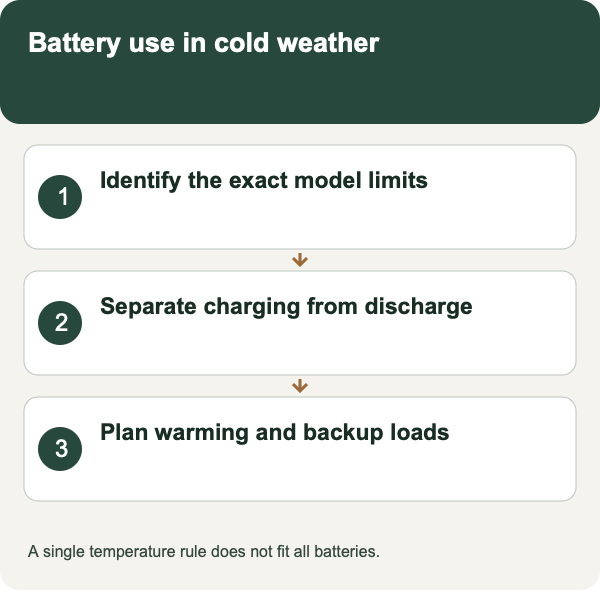
Read three temperature specifications, not one
Cold-weather suitability starts with the exact model and manual revision, not the battery chemistry name. EcoFlow's DELTA 2 manual lists charging at 0–45°C (32–113°F) and discharging at -10–45°C (14–113°F). Jackery's Explorer 1000 v2 support specification lists those same charging and discharge ranges. These are examples for those products, not universal lithium-battery limits or a recommendation to operate near the boundaries.
Storage is another category. Jackery lists different Explorer 1000 v2 storage ranges for one month, three months, and one year; its one-year range is 0–25°C (32–77°F). A short-term storage limit therefore cannot automatically justify a winter of unattended use. Copy the three relevant categories onto your equipment card and note which manual supplied them. If a page only says 'operating temperature,' ask the manufacturer whether that includes charging. Resolve missing information before depending on the unit.[1][2]
Choose the winter location before the outage
Identify a dry location where the power station can operate within its manual's temperature and ventilation requirements. Check the conditions where it will sit, not just the temperature at the household thermostat. A garage shelf, vehicle, or unheated utility room needs its own assessment. Keep the display accessible so someone can see an alarm without moving heavy equipment or reaching across cords.
The Yeti 1500X manual requires ventilation and warns against obstructed fan openings and wet operation. Do not generalize an insulated-case suggestion for one product into permission to wrap any power station in blankets or seal it in a cooler. A carrying case may have different transport and operating instructions. USFA also advises keeping charging equipment out of exit routes. Our placement checklist is simple: approved conditions, clear airflow, no water exposure, no blocked escape route, and an accessible path for checking the unit.[3][5]
Make charging readiness a separate check
If a cold-temperature warning appears or charging is refused, follow the model's troubleshooting instructions. Do not repeatedly reconnect chargers, disable sensors, open the case, or apply a heat gun or other improvised heat source. A unit that can still power a lamp has not demonstrated that charging is permitted. The charging condition must be satisfied independently.
After moving a cold unit to a suitable location, use the manufacturer's guidance for returning it to service. Do not invent a universal warm-up delay or treat a warmer room as proof that every required condition has been met. If moisture is present or the product was wet, stop and consult its instructions and support service. Before winter, save the relevant error-code page offline and record the approved charger and cable. That preparation is easier than diagnosing an unfamiliar icon when household lighting is already limited.[1][3][5]
Build the energy plan around loads, not a cold-weather percentage
Goal Zero's Yeti 1500X manual notes that cold can affect battery capacity. The magnitude is not a fixed percentage that can be applied to every station, load, and temperature. Its runtime also depends on conversion losses and the connected equipment. A temperature within the permitted range is an operating boundary, not a promise of full nameplate energy at the outlet.
List each intended load, its measured or documented average demand, and the hours it must operate. Watt-hours equal average watts multiplied by hours; a hypothetical 25-watt load used for eight hours needs 200 watt-hours before losses and reserve. This is arithmetic, not a tested runtime result. Starting demand and output compatibility still need separate checks. Use the site's runtime tool for a baseline, then label unsupported cold-weather assumptions as unknown. Keep a smaller essential-load plan available if the observed battery decline is faster than expected.[3][4]
Do not count on a summer solar recharge schedule
DOE explains that winter brings shorter days and a lower sun angle in the United States. Its winter-resilience guidance also notes that snow and ice can limit solar production, even though cooler photovoltaic modules can operate efficiently. Those facts do not yield a universal winter recharge time for a portable panel. Panel output and battery acceptance are separate constraints.
Prepare two plans: one with the recharge you have actually observed in suitable conditions, and one with no dependable recharge during the outage. Record the panel model, approved connection arrangement, and a safe placement location in advance. Do not assume a larger panel resolves a battery's cold-charge lockout. If severe conditions make panel deployment unsafe, use the no-recharge plan. Avoid climbing onto roofs or scraping icy electrical equipment to meet an optimistic energy budget. Damaged connectors, cables, or panels require manufacturer guidance, not improvised repairs in the snow.[8][7][1]
Run a supervised readiness check while conditions are suitable
Our proposed readiness check is a short, supervised rehearsal inside the product's permitted operating conditions, using the actual intended loads and approved connections. Record starting charge, load settings, duration, room conditions, and ending charge. Confirm that anyone expected to use the station can identify the correct output controls and read the display. Do not test the lower temperature cutoff by deliberately chilling the battery.
This rehearsal can reveal missing adapters, confusing controls, or an impractical cord route. It does not certify a future cold-weather runtime, medical-device suitability, or uninterrupted operation. Decide what event triggers load reduction and what fallback applies if the station cannot charge or deliver power. For essential medical equipment, coordinate the backup plan with the equipment supplier and care team. A percentage display alone is not an adequate contingency plan. Keep the notes with the device rather than relying solely on an app login.
Write down which loads can be omitted, which can be scheduled, and which require another contingency altogether. Assign a person to check the plan during an outage. An explicit priority list is easier for another household member to follow than a collection of unlabeled plugs.[4][5]
Separate ordinary cold protection from a damaged-battery emergency
A temperature warning is a reason to follow the manual, not automatically evidence of a defective battery. However, USFA identifies bulging, cracking, hissing, venting, and rising temperature as warning signs associated with damage or thermal runaway. Stop using a damaged unit. If it is smoking, hissing, venting, or becoming dangerously hot, move people away and contact emergency services; do not handle or carry the unit through the house.
For a persistent fault without an immediate emergency, contact the manufacturer and provide the model, serial number, displayed code, observed conditions, and charger details. Do not open the enclosure or bypass a protection system. After the winter event, follow the exact storage-maintenance schedule. EcoFlow's DELTA 2 manual, for example, specifies a periodic charge/discharge routine and a storage charge level; that schedule does not become the instruction for a different model. Calendar the applicable maintenance and reassess whether the planned storage location remains suitable.[6][5][1]
| Observation | Decision | Important limit |
|---|---|---|
| Discharge allowed, charge range not met | Use only as the exact manual permits; arrange a suitable recharge location | Output operation does not authorize charging |
| Cold garage is the planned storage site | Check both storage duration and operating conditions | A storage specification is not a winter runtime guarantee |
| No dependable winter solar input | Use an essential-load plan with no assumed recharge | Nameplate panel watts are not daily energy delivery |
| Bulging, hissing, smoke, or escalating heat | Stop use, keep people away, and seek appropriate emergency help | Do not treat damage as an ordinary low-temperature warning |
Before you buy or hire
Related reading and tools
Choose the next step for your situation: measure, compare options, or maintain and verify.
- Explore the topicHome Power Backup
- Measure the problemHow to Estimate Portable Power Station Runtime Conservatively
- Measure the problemSolar Generator for Refrigerator Backup: Size Watts and Runtime
- Measure with a toolPortable Power Station Runtime Calculator
How this guide was checked
Guides are built from official sources, product documentation, manufacturer manuals, and practical homeowner decision criteria. We do not claim hands-on product testing unless a page explicitly says a product was tested.
- Source-backed editorial review
- 8 cited source records
- Follow device manuals and carbon-monoxide safety guidance. Generators must stay outdoors and away from openings; medical-device users should confirm backup plans with providers.
Ready Home Systems is educational and not a substitute for local code officials, licensed trades, medical providers, water labs, or mitigation professionals.
Read review methodologySources and manuals
- DELTA 2 User ManualEcoFlow
- Explorer 1000 V2 Basic InformationJackery
- Goal Zero Yeti 1500X User GuideGoal Zero
- What Is a Watt Hour?Goal Zero
- Lithium-ion Batteries: Educating Your CommunityU.S. Fire Administration
- Risks and Response Strategies for Lithium-ion Battery FiresU.S. Fire Administration
- Solar Photovoltaic Hardening for Resilience – Winter WeatherU.S. Department of Energy
- Solar Radiation BasicsU.S. Department of Energy
FAQ
Can every lithium power station charge at 32°F?
No universal limit is appropriate. The examples in this guide are specifications for named models. Your station, expansion battery, charger, and any heating feature must be checked against their own instructions.
How much runtime should I subtract for winter?
There is no verified single percentage for all products and conditions. Begin with actual load demand, retain a contingency plan, and use model-specific performance evidence where available. Label any unverified estimate as an assumption.
Can I keep it warm in a tightly closed storage box?
Not unless the manufacturer explicitly permits that operating arrangement and its ventilation requirements are met. Transport storage and powered operation are different uses. Do not cover fans or apply an improvised heater to the battery.
Related guides
CPAP Battery Backup for Power Outages: What to Check First
Plan CPAP backup with the exact machine manual, compatible adapter, measured settings load, humidifier and heated-tube choices, testing, and provider escalation.
Generator Transfer Switch vs Extension Cords: Safe Power Paths
Compare a professionally installed generator transfer switch with direct appliance extension cords, and understand why backfeeding is never an acceptable shortcut.
Home Backup Power Load Checklist: Build a Critical-Loads Inventory
List critical appliances, running watts, startup demand, operating hours and connection needs before selecting home backup power. Includes transparent example math.