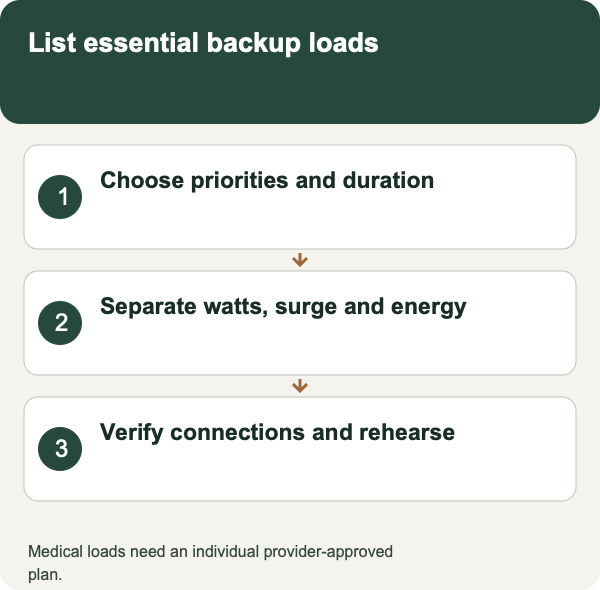
Define the outage task before listing appliances
Start with a sentence describing the scenario: keep selected household functions available through an overnight outage, for example. Name the season, the people present, the intended duration and the point at which you would seek another location or assistance. These are planning assumptions, not a prediction of how long the utility outage will last. A short list with a clear purpose is easier to evaluate than 'power the house.'
Our editorial worksheet uses three labels: essential for this scenario, useful if capacity permits and excluded. Assign the label with everyone who will operate the backup. Refrigeration, communications, lighting, water movement and medical equipment can have very different consequences when interrupted. There is no universal priority order; identify your own non-negotiable requirements before browsing the home-power-backup hub or requesting an installer proposal.[2][5]
Make one record for each actual device
Give every row an appliance name, room, exact model and evidence source. Record the manufacturer's electrical requirements, running-power information, starting-power information when relevant, voltage and connection type. Preserve units. If a value comes from a label, say label; if it comes from a compatible measurement, record the observation period and operating mode. Do not present a borrowed appliance-chart value as a measurement of your device.
For equipment connected through a power adapter, distinguish the appliance from the adapter and keep the input and output labels visible in your notes. An unresolved rating belongs in an unresolved column. Do not open panels, alter wiring or bypass equipment to obtain a number. Ask the device supplier or a qualified electrician to resolve hardwired equipment and unclear electrical requirements. The checklist is an information handoff, not an electrical design.[2][3]
Separate power at one moment from energy over time
EIA distinguishes watts, a measure of power, from watt-hours, a measure of energy over time. For a constant load, watts multiplied by operating hours gives watt-hours; divide by 1,000 for kilowatt-hours. A capacity figure in watt-hours therefore answers a different question from an output rating in watts. Keep both columns instead of replacing them with one vague 'power needed' total.
Record the intended schedule beside each device. Twelve hours of availability does not establish twelve hours at a measured running level for equipment that cycles or changes modes. If you have a relevant energy observation over a complete period, retain that period and its conditions. If the schedule is an assumption, label it that way and ask whether a different season, setting or operating pattern would change the calculation.[1]
Keep startup and automatic restarts visible
Honda's generator guidance separates running demand from starting demand and explains deliberate load management. Your inventory therefore needs both the normal overlap and the starting event. Ask the equipment supplier whether a listed starting value is total demand during startup or an additional amount above running demand. Combining those two conventions without noticing can produce the wrong total.
Draw a short operating sequence in words: which devices are already on when another starts? Include automatic restarts, not only the order you intend to switch things on. A manually staggered schedule is an operating assumption that somebody must be able to follow. Equipment compatibility, starting-event duration and circuit limits still require confirmation against the selected backup system; a successful addition exercise cannot establish those conditions.[2]
Worked inventory example: arithmetic, not appliance specifications
The following figures are deliberately hypothetical and are not typical wattages, measured products or a buying recommendation. Assume a communication device draws 15 W for 12 hours, a group of lights draws 24 W for 5 hours and a laptop setup draws 50 W for 3 hours. Their energy entries are 180 Wh, 120 Wh and 150 Wh. Together that is 450 Wh of device-side energy for the stated schedule.
If all three run at once, their assumed simultaneous demand is 15 + 24 + 50 = 89 W. For a separate startup illustration, add a hypothetical motor drawing 180 W while running and 900 W total during startup. With the other devices operating, the running total becomes 269 W and the assumed startup event becomes 989 W, not 1,169 W. The motor's energy is not included in the earlier 450 Wh because no operating time was specified.[1][2]
Translate the inventory into questions for the supplier
Take three separate results to the supplier: the running overlap, the relevant startup event and the scheduled energy requirement. Ask the supplier to verify the proposed equipment against all three and the recorded connection requirements. Do not assume the 450 Wh example calls for a product labeled 450 Wh. Request the selected system's usable-energy information and an explanation of any conversion, idle-consumption or reserve assumptions used in the proposal.
Add a separate row for recharging or fuel replenishment. Record when it would be available, who would arrange it and what happens if it is unavailable. Do not count an unspecified solar input or a hoped-for fuel delivery as guaranteed support. Once the device data and battery assumptions are established, the portable-power-station runtime tool can explore scenarios; it cannot correct missing device requirements or approve a house connection.[1][2]
Keep connection and generator safety outside the arithmetic
Identify whether each item is cord-connected or requires an approved connection to household wiring. CPSC warns never to energize house wiring by plugging a generator into a wall outlet. Have a qualified electrician assess any proposed home connection; use the transfer-switch-versus-extension-cords guide to prepare questions, not as permission to improvise a wiring arrangement. A small wattage total does not make an unsafe connection acceptable.
For a portable fuel-burning generator, CDC says to operate outdoors at least 20 feet from doors, windows and vents. CPSC also warns against indoor or partially enclosed operation and recommends CO alarms with battery power or backup. Include a suitable operating location and an operator in the plan before counting generator power as available. Follow the actual equipment's safety instructions; this load worksheet does not design weather protection, fuel storage or cord routing.[3][4]
Give medical equipment a separate continuity plan
If someone relies on powered medical equipment, do not decide acceptable interruptions from this worksheet. FDA advises reading the instructions or contacting the distributor or manufacturer about battery or generator compatibility. Confirm the emergency plan with the care team, including what to do if the intended backup fails. FDA also advises checking device settings after power is restored because some equipment may reset.
Keep an operator-ready copy of the final inventory, supplier answers and contacts. Update it when a device, adapter, household need or intended outage duration changes. Before relying on the setup, arrange an appropriate demonstration with the relevant supplier or qualified professional; record the result and any limits. The useful output is a reviewed requirements list with named unresolved questions, not a claim that every essential load is now guaranteed.[5]
| Field | What to enter | Unresolved-question flag |
|---|---|---|
| Device and priority | Exact model, purpose and scenario priority | Who decides if this load may be deferred? |
| Running demand | Watts and evidence source | Is this a rating or an observation? |
| Starting event | Total or additional watts, with source | Will another device already be running? |
| Operating schedule | Hours or measured energy over a stated period | Does cycling or a different mode change it? |
| Connection | Voltage, adapter and cord or hardwired status | Does the supplier or electrician need to verify it? |
| Continuity | Operator, replenishment and fallback plan | What happens if the assumed support is unavailable? |
Before you buy or hire
Related reading and tools
Choose the next step for your situation: measure, compare options, or maintain and verify.
- Explore the topicHome Power Backup
- Measure with a toolPortable Power Station Runtime Calculator
- Measure the problemHow to Estimate Portable Power Station Runtime Conservatively
- Measure the problemSolar Generator for Refrigerator Backup: Size Watts and Runtime
- Measure the problemCPAP Battery Backup for Power Outages: What to Check First
- Compare your optionsGenerator Transfer Switch vs Extension Cords: Safe Power Paths
How this guide was checked
Guides are built from official sources, product documentation, manufacturer manuals, and practical homeowner decision criteria. We do not claim hands-on product testing unless a page explicitly says a product was tested.
- Source-backed editorial review
- 5 cited source records
- Follow device manuals and carbon-monoxide safety guidance. Generators must stay outdoors and away from openings; medical-device users should confirm backup plans with providers.
Ready Home Systems is educational and not a substitute for local code officials, licensed trades, medical providers, water labs, or mitigation professionals.
Read review methodologySources and manuals
- Electricity Explained: Measuring ElectricityU.S. Energy Information Administration
- What Size Generator Do I Need?Honda Power Equipment
- Portable Generator HazardsU.S. Consumer Product Safety Commission
- Use a Generator SafelyCenters for Disease Control and Prevention
- FDA Offers Tips about Medical Devices and Natural DisastersU.S. Food and Drug Administration
FAQ
Can I size backup equipment from my monthly electric bill?
A monthly total does not identify which selected devices overlap or what they require at startup. Use it as household context, then build a device-level inventory for the specific outage functions you intend to support.
Does the 450 Wh example specify the battery I should buy?
No. It is hypothetical device-side energy for three assumed loads and schedules. It excludes the motor's energy and is not a battery capacity recommendation. Verify the real loads and the selected system's usable-energy and operating assumptions.
May I omit starting watts if I turn devices on one at a time?
Keep them recorded. A managed sequence may change overlap, but it does not eliminate each device's starting event or every automatic restart. Ask the supplier to verify the complete operating scenario and the equipment's actual requirements.
Related guides
How Far Should a Generator Be From the House? Portable vs. Standby
Place a portable generator outdoors at least 20 feet from homes and openings, direct exhaust away, use proper cords, and maintain working CO alarms.
Hurricane Power Outage Checklist: Before, During, and After
Use this hurricane power outage checklist to prepare essential loads, generators, food, medical devices, evacuation steps, and safe restoration.
Portable Power Stations in Cold Weather: Charging, Runtime, and Storage
Check model-specific charging, discharge, and storage limits before winter. Build a realistic cold-weather backup plan without assuming full rated runtime.