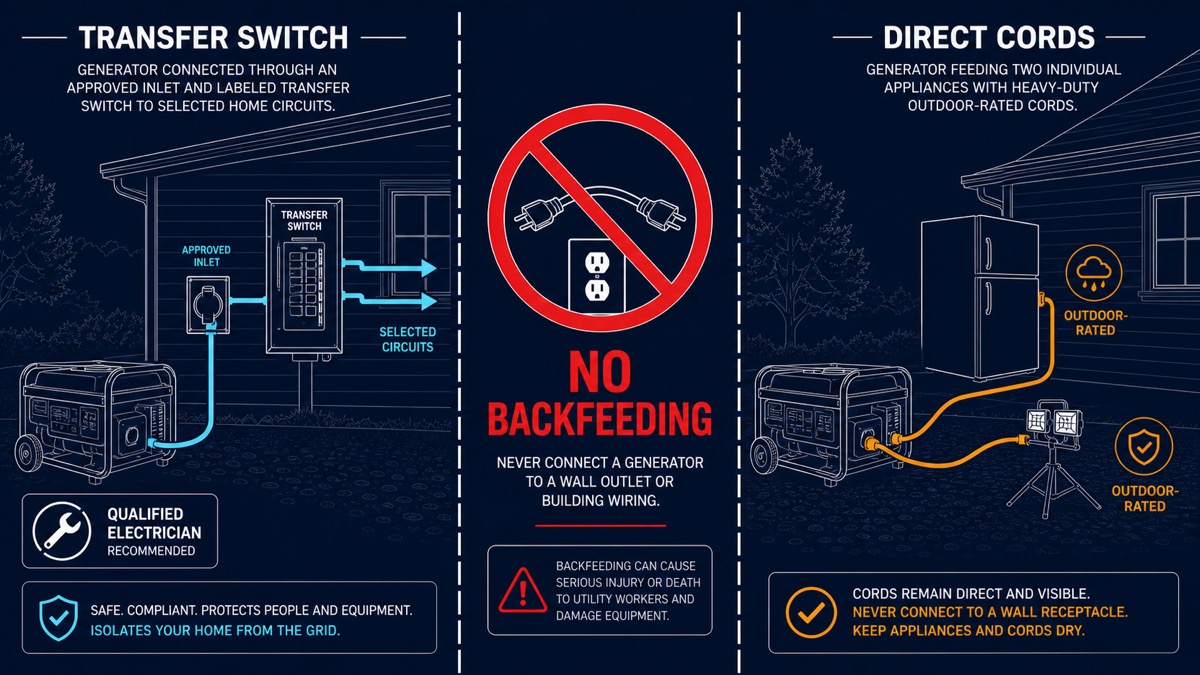
Define the two legitimate connection paths and the boundary
In the direct-cord path, plug selected appliances directly into the generator receptacles using undamaged, grounded, outdoor-rated heavy-duty cords whose voltage, conductor, ampere, length, plug, and environment fit the generator, appliance, and cord instructions. The cord does not enter the panel, energize a branch circuit, or become a substitute for permanent wiring. Loads with prohibitions or special connection needs remain off.
In the premises-wiring path, a qualified electrician designs and installs approved transfer equipment, inlet, overcurrent protection, conductors, grounding or bonding treatment, circuit selection and labeling for the actual generator and electrical service. OSHA states that a generator must not attach directly to a structure's electrical system unless it has a properly installed transfer switch, because unintended energization can electrocute utility workers.
There is no third path through a dryer outlet, range outlet, improvised panel lead, male-to-male cord, or disabled interlock. Those methods can backfeed utility lines, energize exposed prongs, overload conductors, and start fires. Stop at the connection boundary when the inlet, neutral, grounding, transfer sequence, permitted load, or local inspection status is uncertain.[1][2][3][4]
When direct extension cords fit
Use cords specifically suitable for outdoor generator use, with an intact grounding conductor and three-prong connectors. CPSC advises that each cord's wattage rating exceed the total connected appliance load and that cords be long enough to keep the generator safely outdoors and away from openings. Inspect the entire length for cuts, crushed insulation, heat damage, missing ground pins, loose ends, and wet connectors before every use.
Route cords to avoid water, vehicle traffic, sharp edges, doors, and trip hazards. Do not permanently pinch a cord through a window to make a temporary system feel permanent. Connect only loads allowed by both generator and appliance manuals, account for motor startup, and distribute loads among receptacles as directed. A power strip does not increase generator capacity, and household indoor cords are not upgraded by plugging them into an outdoor cord.[4][1]
When a transfer switch fits
A transfer switch or approved interlock arrangement controls whether selected household wiring is connected to utility power or the generator and prevents simultaneous connection when correctly designed. This isolation protects utility workers and neighbors from backfed voltage and protects the home when grid service returns. It also lets hardwired equipment use the home's branch-circuit protection rather than an improvised cord arrangement.
The transfer equipment, inlet, generator, neutral and grounding configuration, overcurrent protection, load selection, and labels must work together. OSHA states that structure connection and grounding requirements differ from a generator supplying cord-connected equipment and that transfer equipment should be installed according to its instructions by a qualified electrician. Do not select a switch only by amp number or copy another home's wiring.[1][2]
Backfeeding is never the third option
Backfeeding means energizing household wiring through an outlet or another unapproved reverse connection. Male-to-male cords expose energized prongs and bypass safety controls. In a 2026 warning, CPSC said these cords present electrocution and fire hazards and should never be used under any circumstances. Turning off a main breaker does not convert an improvised cord into listed transfer equipment or eliminate human error.
Do not keep a suicide cord for emergencies, lend one, or assume an online listing proves compliance. Unplug and stop using it, prevent others from accessing it, and follow CPSC or local disposal guidance. If the desired result is to run household circuits, have a licensed electrician install an approved inlet and transfer method. If that work is not complete when the outage arrives, use only the safe direct-load path permitted by the manuals or choose another shelter plan.[3][4]
Load planning differs by path
For cords, list each directly connected appliance, running watts, startup watts, plug type, cord gauge and length, and generator receptacle. The sum must remain within generator and receptacle limits. For transfer equipment, the electrician performs a load calculation and selects circuits or load-management controls. A transfer switch does not make a small generator capable of every breaker in the panel.
Prioritize refrigeration, pumps, medical needs, communications, and safe lighting. Large heating, cooling, cooking, and water-heating loads can consume capacity quickly. Test one planned configuration under normal conditions and label cords at both ends. If a motor does not start cleanly, breakers trip, plugs heat, voltage is unstable, or the generator labors, shut down and correct the design rather than removing protection or trying a larger cord at random.[4][2]
Outdoor placement and weather remain mandatory
Neither a transfer switch nor a long cord makes indoor generator operation safe. Keep portable units outside, at least 20 feet from the home and openings, with exhaust directed away. Use manufacturer-approved weather protection that does not enclose exhaust or create heat and fire hazards. Keep the unit and connections dry, operate on a stable surface, and never touch electrical equipment with wet hands.
Install and test CO alarms independently of generator connection method. Shut down and cool the generator before refueling, store fuel as allowed outside living areas, and check for leaks. If severe weather prevents safe outdoor placement or cord routing, the correct response may be to leave or use non-combustion backup rather than moving the generator into a garage, porch, shed, or basement.[4][1]
Commission the connection boundary checklist before an outage
For a direct-cord plan, identify each appliance, receptacle, running and startup demand, cord model and rating, full route, trip and pinch protection, dry connections, GFCI instructions, and the load that stays off. Practice only in safe conditions with the generator outdoors at the required distance and the appliance manuals available. A successful start does not prove the cord remains within rating or that every automatic restart will be coordinated.
For a transfer plan, the electrician's handoff should identify the generator model, inlet, transfer or interlock equipment, protected circuits, conductor and breaker scope, utility-isolation sequence, grounding and neutral treatment, load-management instructions, inspection or permit record, labels, and commissioning results. Have the owner demonstrate the approved operating sequence without opening energized equipment.
Record automatic loads that may restart together, wet-weather constraints, CO-alarm check, safe shutdown and cool-down, return-to-utility sequence, and the person responsible for future inspection. If any connection overheats, arcs, trips repeatedly, becomes wet, is damaged, or does not match the approved drawing, shut down by the manual and call qualified help rather than bypassing protection.[1][2][3][4][5]
| Boundary | Direct appliance cords | Transfer equipment | Stop point |
|---|---|---|---|
| Destination | Compatible appliance plugged directly into the generator | Selected premises circuits through approved equipment | No wall-outlet or improvised panel feed |
| Hardware | Grounded outdoor-rated cord sized for the full route and load | Inlet, conductors, breakers, transfer and labels | Damaged, wet, undersized or unidentified hardware |
| Isolation | No connection to household wiring | Utility and generator sources mechanically or electrically isolated | Any possible backfeed |
| Handoff | Documented appliance and cord plan | Qualified installation, inspection and commissioning | Unknown neutral, grounding, circuit or permit scope |
Scroll sideways to read every column on smaller screens.
Before you buy or hire
Related reading and tools
Choose the next step for your situation: measure, compare options, or maintain and verify.
- Explore the topicHome Power Backup
- Measure the problemSolar Generator for Refrigerator Backup: Size Watts and Runtime
- Measure the problemHow to Estimate Portable Power Station Runtime Conservatively
- Compare your optionsWhole-House Battery vs Generator: Which Backup Fits Your Outages?
- Compare your optionsHow Far Should a Generator Be From the House? Portable vs. Standby
How this guide was checked
Guides are built from official sources, product documentation, manufacturer manuals, and practical homeowner decision criteria. We do not claim hands-on product testing unless a page explicitly says a product was tested.
- Source-backed editorial review
- 5 cited source records
- Follow device manuals and carbon-monoxide safety guidance. Generators must stay outdoors and away from openings; medical-device users should confirm backup plans with providers.
Ready Home Systems is educational and not a substitute for local code officials, licensed trades, medical providers, water labs, or mitigation professionals.
Read review methodologySources and manuals
- Portable Generator SafetyOSHA
- Grounding Requirements for Portable GeneratorsOSHA
- CPSC Warning on Male-to-Male Extension CordsU.S. CPSC
- Portable Generator HazardsU.S. CPSC
- Carbon Monoxide Information CenterU.S. CPSC
FAQ
Can extension cords power a home's wall outlets?
No. Direct cords serve compatible appliances from generator receptacles. Supplying household wiring requires approved transfer equipment and qualified installation.
Why is a male-to-male cord unsafe?
It can expose energized prongs and backfeed household and utility wiring, creating electrocution and fire hazards. Do not use one.
Does a transfer switch mean every circuit can run?
No. The generator, transfer equipment, conductors and load plan still limit what can run and start at the same time.
Who resolves neutral and grounding questions?
The exact generator, transfer design, service configuration, manufacturer instructions and local requirements must be reviewed by a qualified electrician and authority where applicable.