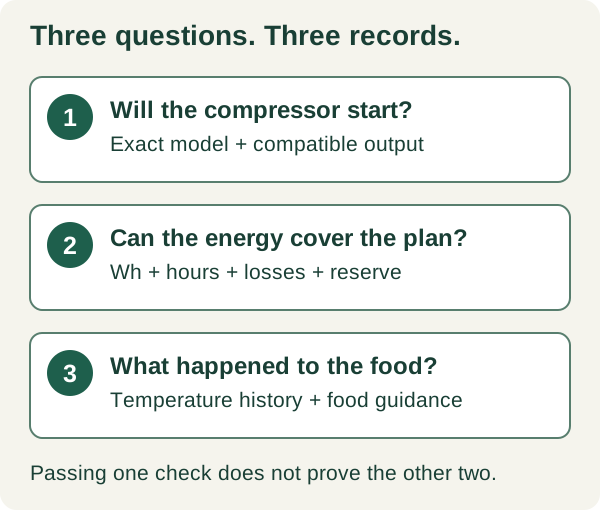
Start with the nameplate, not the cubic-foot category
Photograph or transcribe the exact freezer model and electrical rating before shopping for a backup. GE's freezer guidance points owners to the individual rating plate for auxiliary-power planning. Its general support guidance distinguishes running demand from extra demand when the compressor starts. A table for 'a small chest freezer' is not model-specific confirmation for the appliance in your garage.
Collect the freezer manual, intended location and temperature range, normal supply requirements, and any manufacturer advice on backup sources. Ask the backup-source manufacturer about the exact load when startup information is missing. A large energy-capacity number cannot compensate for an output stage that cannot start the compressor. This guide does not assign a universal two-, three- or seven-times surge multiplier.
For the energy record, use the exact EnergyGuide or a matching model entry where available. ENERGY STAR directs buyers to the yellow label for model energy use. DOE's lookup tool can help identify ratings, but its documented coverage excludes some models and specifies appliances over 10 cubic feet. A search miss is therefore not a zero-consumption result; return to the appliance manufacturer rather than borrowing a nearby model's number.[3][4][1][2]
An annual number gives a starting estimate, not outage runtime
ENERGY STAR uses about 215 kWh per year as a general chest-freezer illustration. Dividing 215 × 1,000 by 365 gives approximately 589 Wh per day, or an arithmetic average near 24.5 W. This conversion is a planning example, not a prediction for your freezer and not its compressor's running watts. It says nothing about whether a particular battery source can start that compressor.
For an actual household plan, record representative appliance energy over time when suitable metering is permitted by the equipment instructions. Note the room conditions, thermostat setting, loading, door openings and whether the appliance was already cold. Use an instrument suitable for the load and ask qualified help if the connection arrangement is uncertain. A short idle observation or a single running-watt reading does not describe a complete day.
Our hypothetical cases deliberately use three different daily-energy assumptions: 0.6, 1.0 and 1.5 kWh. They are not a range claimed for all freezers. At twelve hours those assumptions correspond to 300, 500 and 750 Wh at the appliance boundary, before backup conversion losses, idle consumption or a held-back reserve. Put the assumed conditions beside the number so a winter measurement is not silently reused for a hot garage.[1][2]
| Assumed daily energy | 12-hour energy | 24-hour energy | Not included |
|---|---|---|---|
| 0.6 kWh/day | 300 Wh | 600 Wh | Source losses, source idle energy and reserve |
| 1.0 kWh/day | 500 Wh | 1,000 Wh | Source losses, source idle energy and reserve |
| 1.5 kWh/day | 750 Wh | 1,500 Wh | Source losses, source idle energy and reserve |
Scroll sideways to read every column on smaller screens.
Choose one energy boundary and avoid counting losses twice
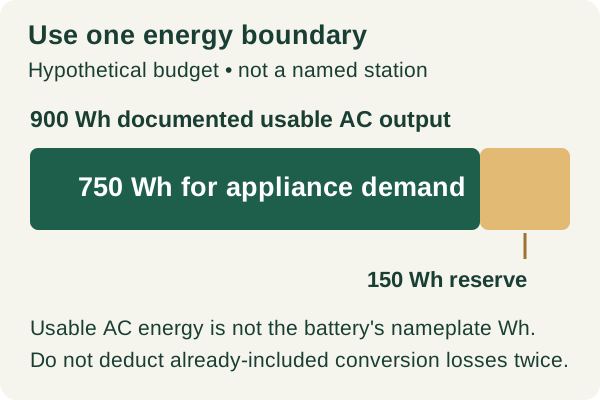
If your evidence is usable AC-output energy from the exact power station under a comparable load, compare the appliance demand against that documented AC energy after the reserve you intend to retain. Do not apply another generic inverter-efficiency deduction to a figure that already includes conversion losses. If you have only battery-nameplate Wh, the usable AC amount is still unresolved; the label is not the energy delivered to the freezer.
Hypothetical arithmetic only: assume an independently documented 900 Wh of usable AC energy for the intended load, and a deliberate 150 Wh AC-energy reserve. That leaves 750 Wh for the plan. It exceeds the 500 Wh twelve-hour scenario by 250 Wh, but only equals the 750 Wh scenario before allowing for any further uncertainty. This example is not a recommendation for a named station or a promise that its displayed battery percentage maps linearly to those quantities.[4]
Treat restart and low-load behavior as a separate acceptance test
Ask two different questions: can the source start and run the compressor, and will it remain ready when the thermostat later calls for cooling? A brief successful startup does not settle long off-cycle behavior. Use the exact power-station manual to check any AC timeout, energy-saving mode and supported settings. The related refrigerator-shutdown guide explains why an apparently idle appliance can lose its supply between cycles.
Arrange a manufacturer-permitted observation with the freezer already at its normal condition. Record the connected model, source settings, whether a normal compressor restart succeeds, any overload or shutdown, and restoration of normal charging and supply. Do not force rapid compressor restarts or deliberately warm food to make a demonstration. If safe testing cannot establish compatibility, mark it unresolved rather than translating a marketing surge number into a pass.[4][3]
The food clock is not the battery clock
FDA gives approximate cold-holding periods of 48 hours for a full freezer and 24 hours for a half-full freezer when its door stays closed. These are not battery duration estimates, not permission to let a battery remain off for a fixed interval, and not guarantees for repeated opening or unusual conditions. FDA also recommends appliance thermometers. The state of the food is not established by a power station still displaying charge.
Keep a separate temperature and outage record. Note when power was lost, any periods of restored cooling, observed temperatures and relevant door openings. Consult the official food-specific guidance linked from our outage food-safety article when deciding what can be kept. Never use taste to determine safety. This sizing worksheet does not replace food-handling advice or turn a later return to cold temperature into evidence about the preceding hours.[6][7]
Give the seller a completed brief, not just a capacity target
Send the exact appliance identity, operating requirements, unresolved startup question, intended twelve- or twenty-four-hour scenario, and the evidence boundary for energy use. Ask for the model-specific compatibility basis and what settings must remain active. Include any other appliances sharing the output; their demand and starts do not disappear because the freezer is the main reason for buying the system.
Check placement, ventilation, grounding and connection instructions for both devices. GE's electrical guidance calls for the correct grounded supply and warns against defeating the grounding prong. Do not backfeed a household receptacle or improvise house wiring from a portable source. The useful deliverable is a conditional plan with a safe fallback: what has been verified, what remains unknown, when someone checks the freezer, and what happens if the source fails or the outage lasts longer than planned.[5][4]
| Question | Evidence to retain | If the answer is unknown |
|---|---|---|
| Which appliance? | Exact model, rating plate and manual | Do not use a cubic-foot estimate as confirmation |
| Can it start and restart? | Model-specific advice / permitted observation | Ask both manufacturers; keep compatibility unresolved |
| How much energy over the target window? | Measurement duration and conditions; AC/battery boundary | Use clearly hypothetical scenarios, not promised hours |
| Will AC remain enabled? | Supported settings and observed normal cycling | Check the exact source manual |
| How will food condition be assessed? | Temperature record and official food guidance | Do not infer safety from elapsed time or battery charge |
| What ends the plan? | Reserve, responder and alternate food-storage arrangement | Resolve the fallback before relying on the system |
Scroll sideways to read every column on smaller screens.
Related reading and tools
Choose the next step for your situation: measure, compare options, or maintain and verify.
- Measure the problemSolar Generator for Refrigerator Backup: Size Watts and Runtime
- Measure the problemHow to Estimate Portable Power Station Runtime Conservatively
- Measure the problemHome Backup Power Load Checklist: Build a Critical-Loads Inventory
- Maintain and verifyPortable Power Station Refrigerator Shuts Off: A Troubleshooting Guide
- Maintain and verifyRefrigerator Food After a Power Outage: Keep, Move or Discard?
How this guide was checked 2026-10-23T00:00:00.000Z
Guides are built from official sources, product documentation, manufacturer manuals, and practical homeowner decision criteria. We do not claim hands-on product testing unless a page explicitly says a product was tested.
- Source-backed editorial review
- 7 cited source records
- Follow device manuals and carbon-monoxide safety guidance. Generators must stay outdoors and away from openings; medical-device users should confirm backup plans with providers.
Ready Home Systems is educational and not a substitute for local code officials, licensed trades, medical providers, water labs, or mitigation professionals.
Read review methodologySources and manuals
- Freezers: EnergyGuide and buying guidanceENERGY STAR
- Refrigerator and Freezer Energy Rating Online Search ToolU.S. Department of Energy
- Upright and Chest Freezer: Running AmpsGE Appliances
- Running an Appliance on a GeneratorGE Appliances
- Upright and Chest Freezer: Electrical RequirementsGE Appliances
- Food and Water Safety During Power Outages and FloodsU.S. Food and Drug Administration
- Food Safety During Power OutageFoodSafety.gov
Keep a copy for reference or share the guide. Check the online version for later updates.
Ready Home Systems · https://readyhomesystems.com/chest-freezer-battery-backup-sizing/
Planning guidance, not a professional assessment. Check the online guide and cited sources for updates.