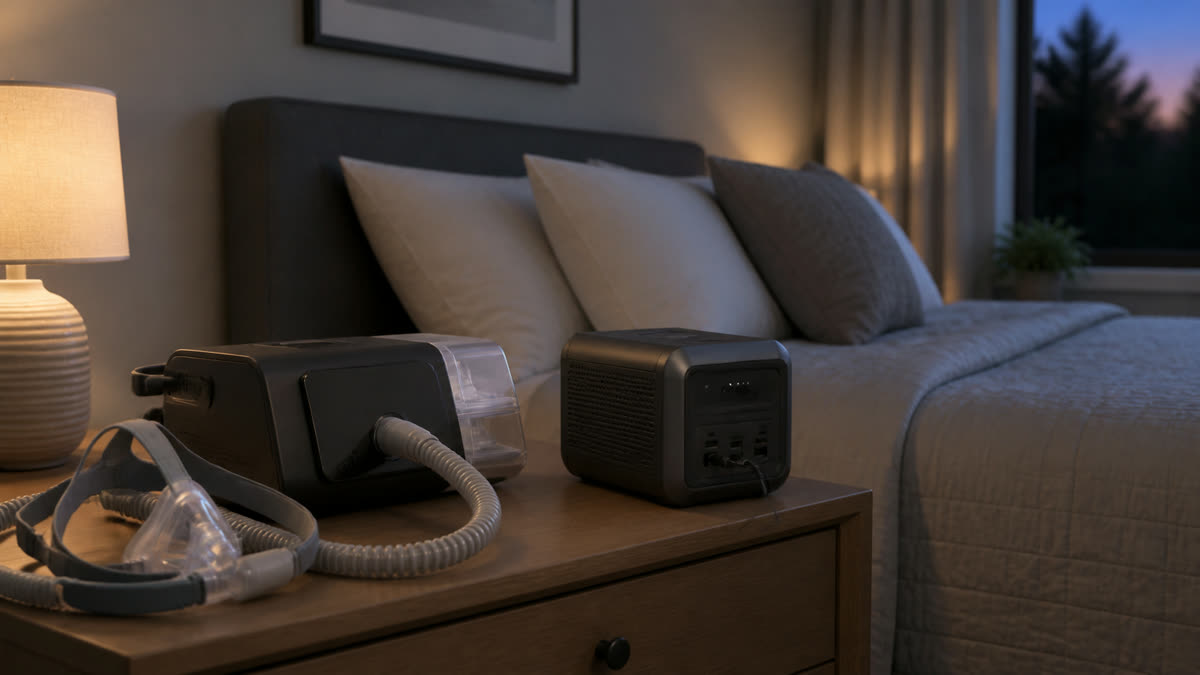
Build the medical contingency with your care team
This guide does not change prescribed therapy, select settings, or determine whether skipping treatment is safe. Ask the sleep clinician, prescriber, home-care supplier, or device manufacturer what to do during an outage, how urgent uninterrupted use is for your circumstances, and when to relocate or seek emergency help. FDA's home-device booklet supports writing down the device, model, provider, supplier, utility, fire department, and emergency contacts before power fails.
Document the expected outage lengths, available transportation, shelter or hotel options, and whether another medical condition or device depends on electricity. Ask what symptoms or device alarms require urgent escalation. Utility priority or medical-baseline programs can improve communication but do not promise uninterrupted power. Keep the plan with the CPAP travel bag and share it with household members; a battery is one component of that plan, not individualized medical advice.[1][2]
Identify the exact machine, power supply, and accessories
Record brand, exact model, serial number, therapy mode, prescribed settings, power-supply part number and output, humidifier, tubing, mask, oxygen connection if any, and every adapter in the path. Similar names are not interchangeable. The AirSense 11 user guide, for example, documents a 65W supply with 24V DC output and identifies HumidAir 11 and ClimateLineAir 11 components. Those facts apply to that system, not every CPAP or bilevel device.
Use the current user guide for the region where the device is operated and check manufacturer notices or recalls. FDA advises reading the instructions or contacting the supplier or manufacturer to learn whether a home medical device can use batteries or a generator. If the prescribed setup includes supplemental oxygen, a ventilatory mode, or other equipment, obtain specific professional guidance; do not extend a CPAP-only battery example to a more consequential system.[3][2]
Use only a model-compatible DC or AC path
For an AirSense 11 example, ResMed documents the Air11 DC/DC converter for a suitable 12V or 24V vehicle source and identifies it as compatible with the AirSense 11, including configurations using HumidAir and ClimateLineAir. That is the level of specificity to seek: exact device, exact adapter, input range, output, fuse and connection requirements, ventilation, and its own warnings. A connector that physically fits is not evidence of electrical compatibility.
An AC power station can use the normal approved supply when both manuals permit it, but inverter losses and standby draw reduce runtime. A supported DC path may avoid the AC inverter, yet its efficiency and source requirements still need evidence. Never splice leads, reverse polarity, substitute an unlisted adapter, or bypass protection. Ask the manufacturer or supplier when compatibility documentation is missing, especially before connecting to a vehicle or unfamiliar battery.[4][3][2]
Measure the current settings and heated features
Runtime can change materially with prescribed pressure behavior, leaks, humidifier operation, heated tubing, ambient conditions, and the chosen AC or DC path. ResMed's battery guide shows large differences among model- and settings-specific examples when humidification or heated tubing is involved. Treat those tables as evidence that setup matters, not as a promise for a different machine. Measure the exact configured system through a properly rated device when the manuals permit.
Do not switch off humidification, heated tubing, ramp, pressure relief, or any therapy-related feature merely to reach a desired number. Ask the care provider whether a comfort-feature contingency is appropriate and tolerable for you, then record the approved outage configuration. If any change causes dryness, intolerance, poor sleep, alarms, unusual data, or concern about therapy, return to the provider or supplier. Energy optimization does not outrank safe, effective prescribed use.[5][3]
Estimate runtime without promising an overnight result
Start from the battery's rated watt-hours, exact-model usable-energy limits, conversion efficiency for the chosen output, and battery-side standby draw. Use measured CPAP watts over a complete sleep period, not only the idle display. Hold back reserve and compare the current setup with a higher-load case. If the battery manufacturer provides only a single runtime claim, ask for its machine, settings, humidifier, tubing, temperature, battery age, and test endpoint.
No article or calculator can state one universal number of CPAP nights. A test on one AirSense 11 configuration cannot establish runtime for another pressure profile, accessory set, battery, or aging state. Size around the provider-approved plan and test it under supervision before dependence. For multi-night outages, identify a verified recharge path and a relocation threshold rather than assuming one battery can be repeatedly stretched below reserve.[5][1][4]
Account for battery aging, storage, and testing
Follow the exact backup battery or power-station manual for charge state, storage temperature, location, and maintenance. As a model-specific example, the EcoFlow DELTA 2 manual specifies a dry, cool, ventilated storage environment, a recommended temperature range, and a periodic charge-discharge routine; those instructions must not be transferred to another pack. ResMed's battery guide supplies configuration-specific demand examples, not a universal storage schedule. Record the exact battery model, purchase date, applicable manual interval, and each controlled test result.
Use a published retained-capacity or cycle-life statement only for the exact battery and its stated test basis, then retest the configured backup rather than calculating age from a generic percentage. Practice the transition from wall power while awake, confirm that the prescribed device starts normally and retains its settings, and stop the test at the selected reserve. FDA advises checking device settings after power returns. Repeat when the prescribed settings, accessories, battery, adapter, firmware, or documented storage condition changes.[1][3][5][6]
Separate home-outage equipment from air-travel rules
A large home power station may be inappropriate or prohibited for passenger travel even when it works at home. FAA PackSafe guidance distinguishes devices with installed batteries from spare lithium batteries, requires spare batteries in carry-on baggage, calls for terminal and damage protection, and applies watt-hour and quantity limits. FAA also says damaged or recalled batteries likely to create heat or sparks must not be carried. Airlines can be more restrictive, and international rules may differ. Check the battery label, airline, itinerary, and current official rules before packing.
Also ask the airline about in-flight device use, approved outlets, seating constraints, advance notice, and whether the CPAP counts separately from ordinary baggage. Do not assume an aircraft outlet will remain available or support the device. Pack the prescribed machine, approved supply, compatible battery or adapter, documents, and essential accessories where loss is less likely, while following security screening and hazardous-material rules. Home runtime calculations do not answer carriage or in-flight-use questions.[7][3]
Escalate early and avoid generator exposure
Contact the care provider or supplier when the exact compatible adapter cannot be confirmed, the battery cannot meet the provider-approved window, settings or accessories change, alarms occur, the patient cannot tolerate the contingency configuration, or outages may outlast safe recharge. Use the written relocation and emergency plan rather than improvising therapy or waiting until the last battery indicator. If immediate health concerns arise, follow the provider's emergency instructions or contact emergency services.
Never operate a fuel generator in a bedroom, home, garage, basement, porch, shed, or other enclosed or partly enclosed space to power CPAP. CPSC says use it outdoors only, at least 20 feet from homes, with exhaust directed away, and maintain CO alarms on every level and outside sleeping areas. If safe outdoor generation and an approved electrical path are unavailable, relocate according to the medical plan; carbon monoxide risk is not an acceptable therapy backup.[2][8][1]
| Item | Required evidence | Escalation |
|---|---|---|
| Therapy device | Exact model, settings, accessories | Care provider or supplier |
| Power path | Compatible supply or adapter | Manufacturer confirmation |
| Runtime | Measured complete setup with reserve | Relocation/recharge plan |
| Travel | Battery Wh and current airline rules | Airline before departure |
Before you buy or hire
Related reading and tools
- Home Power Backup
- Portable Power Station Runtime Calculator
- How to Estimate Portable Power Station Runtime Conservatively
- Solar Generator for Refrigerator Backup: Size Watts and Runtime
- Whole-House Battery vs Generator: Which Backup Fits Your Outages?
- How Far Should a Generator Be From the House? Portable vs. Standby
How this guide was checked
Guides are built from official sources, product documentation, manufacturer manuals, and practical homeowner decision criteria. We do not claim hands-on product testing unless a page explicitly says a product was tested.
- Source-backed editorial review
- 8 cited source records
- Follow device manuals and carbon-monoxide safety guidance. Generators must stay outdoors and away from openings; medical-device users should confirm backup plans with providers.
Ready Home Systems is educational and not a substitute for local code officials, licensed trades, medical providers, water labs, or mitigation professionals.
Read review methodologySources and manuals
- Home Use Devices: How to Prepare for and Handle Power Outages for Medical Devices that Require ElectricityU.S. Food and Drug Administration
- FDA Offers Tips about Medical Devices and Natural DisastersU.S. Food and Drug Administration
- AirSense 11 User GuideResMed
- AirSense 11 DC/DC ConverterResMed
- ResMed Battery GuideResMed
- DELTA 2 User ManualEcoFlow
- PackSafe: Portable Electronic Devices Containing BatteriesFederal Aviation Administration
- Carbon Monoxide Information CenterU.S. CPSC
FAQ
How many watt-hours does a CPAP use overnight?
There is no universal value. Measure the exact prescribed machine and accessories, including approved humidifier and heated-tube configuration, and confirm the power path and contingency with the supplier or care provider.
Can I turn off the humidifier to make a CPAP battery last longer?
Heated features can materially change load, but do not alter the setup solely for runtime. Ask the care provider whether a different outage configuration is appropriate and tolerable, then test that exact plan.
Is a portable power station acceptable for AirSense 11?
Use the AirSense 11 approved power supply on compatible AC output or the documented Air11 DC/DC converter only as both manuals allow. Confirm exact compatibility and test; this is not a universal medical suitability statement.
Can I fly with my CPAP backup battery?
It depends on battery type and watt-hours, whether it is installed or spare, airline policy, and itinerary. Check current FAA PackSafe guidance and the airline before travel; spare lithium batteries belong in carry-on baggage.
Related guides
Generator Transfer Switch vs Extension Cords: Safe Power Paths
Compare a professionally installed generator transfer switch with direct appliance extension cords, and understand why backfeeding is never an acceptable shortcut.
How Far Should a Generator Be From the House? Portable vs. Standby
Place a portable generator outdoors at least 20 feet from homes and openings, direct exhaust away, use proper cords, and maintain working CO alarms.
Hurricane Power Outage Checklist: Before, During, and After
Use this hurricane power outage checklist to prepare essential loads, generators, food, medical devices, evacuation steps, and safe restoration.