Before you buy or hire
Quick comparison
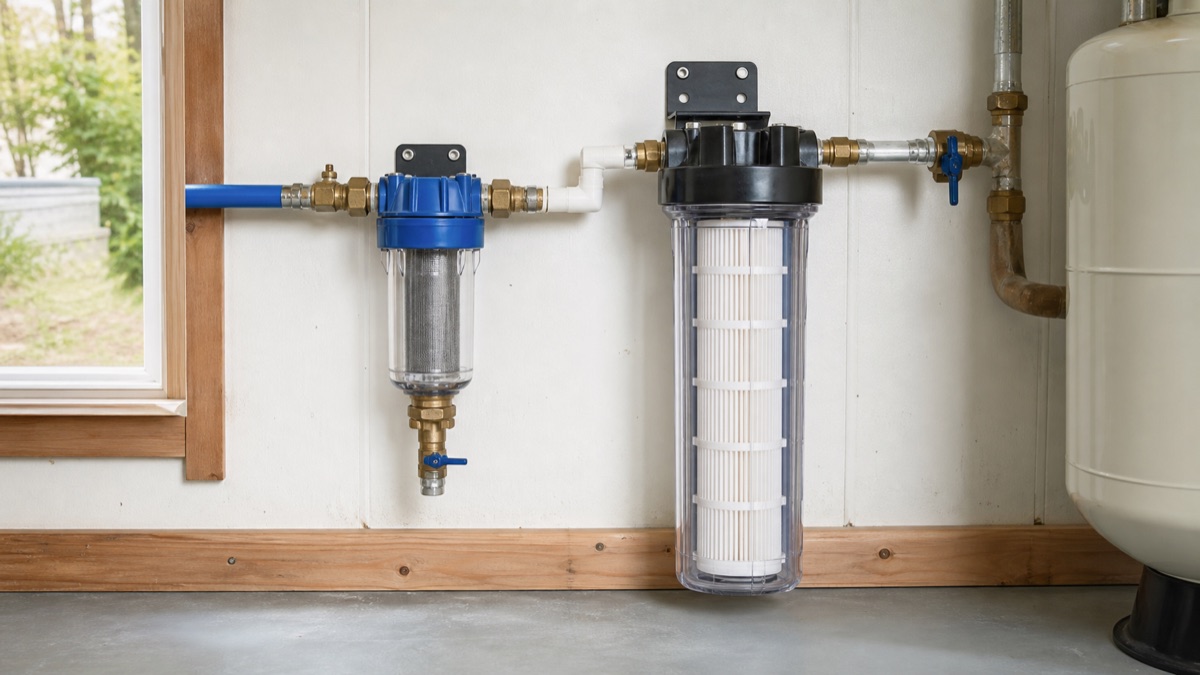
Choose a spin-down unit when the main problem is enough visible sand or grit to make routine flushing worthwhile. Choose a cartridge when you need a disposable or washable element that targets finer suspended material. Use a coarse-to-fine sequence when a fine cartridge alone plugs too quickly. None of these choices replaces private-well testing, and none should be selected from the filter label without checking the housing, element, flow, pressure, and maintenance instructions.
The useful question is not which category wins. Ask what material arrives, how much arrives, what pressure loss the household can tolerate, where flush water can go, and how often someone will actually service the equipment. A cheap reusable screen can be a poor value if the sediment is too fine; a high-capacity cartridge can be wasteful if coarse grit fills it in days.[1][4]
How each filter works
A typical spin-down filter directs water through a screened element and collects heavier particles in a lower bowl. Opening its flush valve sends accumulated material to an appropriate drain or container. Design details vary: screen construction, flow direction, purge method, pressure limits, and whether the element must be removed for full cleaning all depend on the model. Treat flushing as maintenance, not proof that the screen has returned to new condition.
A cartridge housing channels water through a replaceable element. Pleated, depth, string-wound, and melt-blown cartridges hold particles differently and can have different dirt capacity at the same labeled size. The cartridge and housing work as a system; port diameter alone does not establish service flow. Compare a documented flow curve, materials, seal compatibility, and element availability before relying on an online micron headline.[6][5]
Sediment load and particle size
Particle size decides what can pass, while sediment load decides how soon maintenance arrives. Coarse grains that settle rapidly are plausible candidates for screening. Persistent haze may need a deeper or finer cartridge after coarse particles are controlled. Rust flakes can originate in household equipment or plumbing, and a slimy deposit can point toward a different biological or chemical problem. A clear jar observation helps describe the symptom but cannot identify drinking-water safety.
Sudden load changes matter. EPA advises testing when water quality changes or after events such as flooding, well work, or nearby disturbance. If a system that ran for months begins filling a filter in days, do not solve the spreadsheet by ordering cartridges in bulk. Record the timing and ask whether well construction, pump position, corrosion, or source-water conditions changed.[2][3]
Flushing versus cartridge replacement
A spin-down screen can reduce consumable cost when flushing removes the captured material effectively. The tradeoff is a recurring task and a safe destination for purge water. A cartridge usually makes removal straightforward: isolate pressure as instructed, replace the element and seal if needed, clean the housing according to the manual, and check carefully for leaks. It also creates recurring purchase and disposal work.
Estimate annual effort honestly. Use actual cartridge life or a conservative scenario, not the seller's most favorable capacity. Include replacement elements, O-rings, lubricant approved by the manufacturer, water used for flushing, and the time required to depressurize and restart the system. If no one will perform a weekly purge, a theoretically reusable design may fail in practice; if cartridge supply is unreliable, a proprietary size can become a resilience weakness.[6][5]
Flow and pressure
Every filter adds resistance, and that resistance usually grows as material accumulates. Evaluate flow while several realistic fixtures operate, not at one slow faucet. Gauges on each side of the filter can make a trend visible, provided readings are taken under comparable flow. The equipment manual, rather than a generic web threshold, should define maximum pressure, permissible differential pressure, and service limits.
Downstream backwashing treatment deserves special attention. An iron filter or softener may require a substantial flow for regeneration. An upstream sediment stage that looks acceptable during ordinary use could starve that cycle after partial loading. Verify pump capacity, pressure-tank behavior, pipe size, treatment demand, and drain capability as one system. Water Systems Council materials emphasize that well-system components must be considered with system demand and well capacity.[6][5]
Staged-system examples
For heavy visible sand, a plausible sequence is a documented coarse spin-down stage followed by a large-area cartridge that captures finer carryover. For light, consistent sediment, one appropriately sized cartridge may be simpler. If rust appears only downstream of an old tank or pipe, correcting corrosion can be more sensible than adding stages. These are diagnostic patterns, not installation prescriptions; testing and equipment requirements can reverse or eliminate a proposed stage.
Add only one level of complexity at a time where possible. Establish a baseline, install the defined control, then record pressure and maintenance. That reveals whether a finer stage is justified. Installing three unlabeled housings at once makes it harder to know which element is working, which is restricting flow, and whether the original problem came from the well at all.[1][3]
Installation location
Whole-house sediment equipment normally belongs where it can protect downstream plumbing without interfering with the pressure tank, pump controls, required sampling, or treatment backwash. The exact boundary is system-specific. Provide a stable mount, service clearance, freeze protection, drainage for spills or flushing, and a way to isolate and depressurize the housing according to its instructions. A clear bowl may have environmental limitations, including exposure to light or impact.
Do not relocate electrical controls, bypass safety devices, or alter a pressurized well system casually. If a branch serves irrigation or an exterior hydrant, decide deliberately whether filtering that high flow is useful. Preserve any sampling point needed to test untreated water. A well contractor or treatment professional can map the system before piping changes hide a diagnostic point or create an avoidable pressure problem.[2][4]
Cost-of-ownership factors
Compare five costs: installed equipment, consumables, water and drainage, maintenance time, and the consequence of restricted flow. Oversizing a housing may cost more initially but offer more element area and longer service. A flushable screen avoids routine cartridge disposal but still needs cleaning and seals. A staged system buys resilience only when each stage has a clear job and the household follows the service routine.
Availability matters during storms or supply disruptions. Record the exact cartridge size and keep a reasonable spare without hoarding elements beyond their storage guidance. For a spin-down unit, keep the manual and model-specific seal information. Consider leak detection and a drain pan where failure could damage finished space. These operational details usually matter more over several years than a small difference in purchase price.[4]
Mistakes to avoid
Avoid choosing the finest number available, assuming a clear bowl proves cleanliness, comparing only port size, or using a sediment device as a health-treatment claim. Do not flush into a place that creates erosion, freezing, septic overload, or a slip hazard. Do not keep tightening a leaking plastic housing beyond the manufacturer's method. And do not ignore sediment that appears suddenly after a flood or well-system change.
Another mistake is creating a maintenance stack that the household cannot sustain. A filter that needs frequent attention should be visible, accessible, and documented. Label the installation date and element. Keep a simple pressure and service log. If the log shows rapidly shortening intervals, investigate the source rather than continually moving to larger or more expensive filters.[2][3]
Professional triggers
Call a qualified well professional when sediment begins suddenly, contains persistent sand, accompanies pump noise or short cycling, follows flooding or well work, or overwhelms equipment rapidly. Use a treatment professional when multiple media tanks need coordinated flow and drain design. Use a certified laboratory and local health authority when the water-quality change could indicate contamination. These are different jobs, and no filter comparison replaces them.
For an ordinary replacement decision, bring the professional or supplier your water-test results, pressure observations, photos of the sediment, current filter life, pipe size, peak demand, and downstream equipment requirements. That evidence supports a defensible category choice and a service plan instead of a sales answer based only on the phrase private well.[1][2][4]
| Decision factor | Spin-down | Cartridge | Staged approach |
|---|---|---|---|
| Best starting load | Visible, flushable grit | Light to moderate finer material | Mixed or heavy coarse-to-fine load |
| Routine task | Flush and periodically inspect screen | Replace or clean the documented element | Maintain both stages and track pressure |
| Primary risk | Fine particles pass or screen fouls | Rapid loading and pressure loss | Added cost, fittings, and neglected maintenance |
| Evidence to collect | Purge frequency and carryover | Element life and differential pressure | Which stage captures what material |
Related reading and tools
Sources Used
- Private Drinking Water WellsU.S. Environmental Protection Agency
- Protect Your Home's WaterU.S. Environmental Protection Agency
- Potential Well Water Contaminants and Their ImpactsU.S. Environmental Protection Agency
- Wellcare Information SheetsWater Systems Council
- Sediment Cartridges Technical SheetPentair
- Spin-Down and Sediment Trapper GuideRusco
FAQ
Can a spin-down filter replace a cartridge?
Sometimes, when the problem is mainly coarse material and the screened rating is appropriate. Fine suspended sediment may pass, so verify water appearance, downstream loading, pressure, and the specific screen's documented performance.
Should a spin-down filter come before a cartridge?
Coarse-to-fine is a common staged logic because it protects the finer element, but the real layout must respect the pressure tank, sampling points, downstream backwash flow, drain routing, and equipment manuals.
Why does my new cartridge clog immediately?
Possible reasons include an element that is too fine for the load, an undersized housing, a sudden well change, corrosion debris, or unusually high demand. Record the material and timing, then investigate the source instead of assuming a different brand will cure it.
Related guides
Best Iron Filter for Well Water: A Testing-First Buying Guide
The right iron filter depends on whether the iron is dissolved, oxidized, bacterial, or mixed with manganese and sulfur odors. Start with a lab test and match equipment to the result.
Best Sediment Filter Micron Size for Well Water
There is no single best micron rating for every private well. Start with the material you can observe, confirm broader water-quality risks through testing, protect household flow, and use staged filtration when one element would otherwise clog too quickly.
Iron Filter vs Water Softener: Which One Does Well Water Need?
A softener handles hardness. An iron filter handles iron and manganese more directly. Many well homes need both, but order and sizing matter.