The blue bowl, the cartridge and the plumbing are different evidence
Write the housing's part number and port size separately from the cartridge model. Big Blue describes a housing family and cartridge form factor, not one universal hydraulic or treatment specification. A quotation that says only '20-inch filter' has not yet identified the two components you need to evaluate. Include the cartridge's filtration purpose as well: a sediment element and a carbon block can answer different water-quality questions despite fitting a similar-looking housing.
Pentek's housing sheet identifies 150233 as a 1-inch #20 housing with pressure relief, and lists an initial pressure-loss point of 1 psi at 15 gpm. That is housing data; it is not a tested claim for every cartridge someone could install. The same sheet's NSF/ANSI 42 statement concerns material and structural integrity. It does not certify that an assembled system removes every contaminant in a well-water report.[1]
Two sediment cartridges share a flow point, not a filtration rating
The DGD sheet lists DGD-5005-20, part 155358-43, at nominal 5 microns and less than 1 psi initial pressure drop at 20 gpm. The R-Series sheet lists R30-20BB, part 155430-43, at nominal 30 microns and also less than 1 psi at 20 gpm. Both sheets attribute these performance data to the manufacturer's internal testing; they are not our measurements.
This is a valid comparison of the published initial-loss bound at the stated flow, but it cannot rank their exact pressure losses. Less than 1 is not the same as exactly 1 or zero. Nor does the shared bound make a nominal 30-micron cartridge an equivalent substitute for a nominal 5-micron cartridge. Select the particle-control task first, then ask how each suitable candidate behaves at your required flow.
No full pressure-drop curve for these exact two cartridges was available in the reviewed sheets. We therefore show points and limits, not a reconstructed curve or a predicted dirty-cartridge lifespan. Ask the supplier for exact-model data at the proposed service flow and for the applicable servicing criteria. A larger-looking container is not a substitute for that evidence.[2][3]
| Exact component | Published point | What remains different |
|---|---|---|
| 150233 housing; 1-inch #20 | 1 psi at 15 gpm | Housing only; not the cartridge-plus-housing assembly |
| DGD-5005-20; 155358-43 | Less than 1 psi at 20 gpm | Nominal 5 microns; no full exact-model curve in the reviewed sheet |
| R30-20BB; 155430-43 | Less than 1 psi at 20 gpm | Nominal 30 microns; not equal filtration to DGD-5005-20 |
| EP-20BB; European sheet | 0.14 bar at 15.1 L/min | Carbon block; different flow and regional document |
Scroll sideways to read every column on smaller screens.
Do not convert a unit and accidentally erase the test conditions
The European EP-Series sheet gives EP-20BB a 0.14 bar initial drop at 15.1 L/min. It describes a carbon-block cartridge and uses a different flow from the US sediment examples. Converting bar to psi would not turn those products into a same-flow or same-purpose comparison. Keep the region, sheet revision and model attached when a supplier sends you an apparently better number.
A useful rejection rule for a shopping spreadsheet is: if either the component, flow or treatment purpose differs, do not sort by the pressure-drop column alone. Ask for the missing comparable information. In particular, do not add the 150233 housing's 15 gpm value to a cartridge's 20 gpm value and label the total 'system loss at 20 gpm.' The arithmetic is easy; the matching evidence is absent.[4][1]
A useful home record repeats the same operating condition
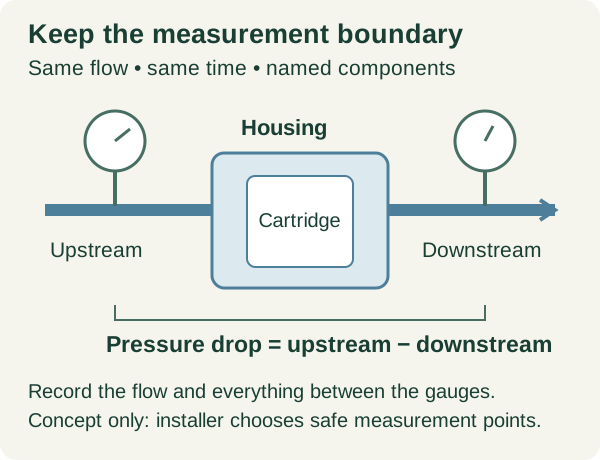
Have the installer identify safe, suitable upstream and downstream measurement points and a way to record the flow through the assembly. This is a measurement brief, not instructions for drilling pressure taps or opening a pressurized bowl. A static reading with no demand does not establish the operating pressure difference when the household is drawing water. Record both pressures during the same steady test condition, along with flow and which fixtures are operating.
After the correct clean cartridge has been installed and commissioned under its instructions, preserve that baseline. At later checks, use the same documented condition where practicable. Changing the number of open fixtures, reading the gauges at different moments or comparing a cartridge-only specification with a whole-plumbing measurement obscures what changed. Note gauge locations: any valve or other equipment between them is inside the measured boundary.
Hypothetical example: at a recorded 6 gpm, the upstream gauge reads 50 psi and the downstream gauge 47 psi, giving a 3 psi assembly differential. At a later matched 6 gpm check they read 49 and 41 psi, giving 8 psi. The increase prompts investigation under the system's service guidance; it is not proof that every cartridge must be replaced at 8 psi. Those numbers are invented to demonstrate a comparable record, not Pentek's performance data.[1][2]
| Field | Clean baseline | Later matched check |
|---|---|---|
| Housing and cartridge identity | Part numbers; installation date | Same parts? Record any substitution |
| Measurement boundary | Gauge locations; equipment between them | Same locations and installed equipment |
| Operating condition | Flow rate; fixtures on; date/time | Same flow or explicitly not comparable |
| Pressures and differential | Upstream minus downstream; units | Both readings, not just downstream pressure |
| Action criteria | Manufacturer/installer service instruction | Assessment and action taken; no invented threshold |
Scroll sideways to read every column on smaller screens.
Separate restriction from a weaker incoming supply
In another hypothetical record, the readings change from 50/47 psi to 40/37 psi while the same flow is maintained. The differential remains 3 psi, although the downstream reading is lower. That pattern alone does not identify the filter as the new restriction. Preserve both readings and ask the installer to assess the supply, controls and other equipment instead of replacing cartridges until a pressure number happens to improve.
Use the full record in a service request: exact housing and cartridge, installation date, flow, upstream/downstream values, fixture configuration, changes in water appearance and any maintenance already performed. If the system cannot reproduce the original flow, record that fact rather than inventing a comparable test. Never bypass treatment as a casual pressure experiment when water quality or system safety is uncertain.[1]
Lower resistance is not the same as safer water
Pentek's DGD certification statement is for material requirements only, not a contaminant-removal claim. The DGD and R sheets also warn against using microbiologically unsafe or unknown-quality water without adequate disinfection. A low pressure-drop number cannot establish drinking-water safety, dissolved-contaminant removal or the right filtration fineness for downstream equipment.
The practical purchase decision is therefore a pair of questions: does the cartridge meet the required treatment task, and can the complete assembly deliver the needed flow within the site's pressure budget? Keep both answers in the quotation. Use the micron-selection guide for particle-rating distinctions and the treatment-order guide for the wider system; this page supplies the missing comparison and maintenance record, not a universal filter recommendation.[2][3]
Related reading and tools
Choose the next step for your situation: measure, compare options, or maintain and verify.
- Compare your optionsSediment Filter Micron Size for Private Wells: A Selection Record
- Compare your optionsSpin-Down vs Cartridge Sediment Filter for Private Wells
- Compare your optionsWhole-House Well Water Filter Order: Sediment, Iron, Softener, UV, and RO
- Maintain and verifyWell Water Treatment Maintenance Costs: A Five-Year Worksheet
How this guide was checked 2026-10-23T00:00:00.000Z
Guides are built from official sources, product documentation, manufacturer manuals, and practical homeowner decision criteria. We do not claim hands-on product testing unless a page explicitly says a product was tested.
- Source-backed editorial review
- 4 cited source records
- Private well owners should test before buying treatment. Odor, stains, and taste are not complete safety assessments.
Ready Home Systems is educational and not a substitute for local code officials, licensed trades, medical providers, water labs, or mitigation professionals.
Read review methodologySources and manuals
- Big Blue heavy-duty housing specification, 310053 Rev F JA23Pentair Pentek
- DGD cartridge specification, 310061 Rev E JA23Pentair Pentek
- R-Series cartridge specification, 310066 Rev D MY15Pentair Pentek
- EP carbon-block European technical sheet, MKT-TS-037-EN-DPentair Europe
Keep a copy for reference or share the guide. Check the online version for later updates.
Ready Home Systems · https://readyhomesystems.com/big-blue-filter-cartridge-pressure-drop/
Planning guidance, not a professional assessment. Check the online guide and cited sources for updates.