Before you buy or hire
Quick comparison
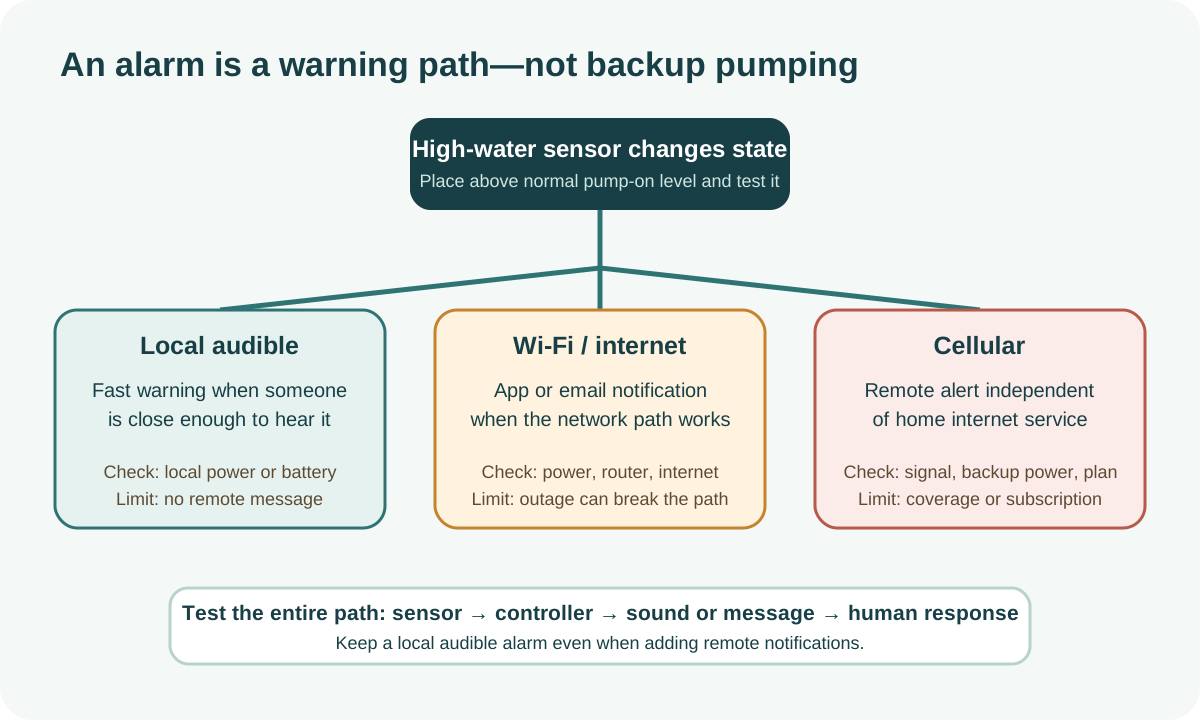
This comparison is Ready Home Systems editorial failure-mode synthesis, not a capability or service claim for every connected alarm. Choose the notification path around who needs to hear it and which failures are likely. A local audible alarm can work without an account but helps only within hearing range. Wi-Fi adds a possible remote path but can depend on power, router, internet, vendor cloud, phone settings, and the selected product's current service. Cellular or auto-dialer equipment has a different dependency chain that must be verified from its documentation, including signal, supported networks, service status, power, and any recurring fee.
Do not confuse notification with water removal. FEMA's urban-flooding guide asks homeowners to consider both battery backup and an alarm because they solve different problems. The pump manages water within its capacity; the alarm tells someone that water reached an abnormal level. A complete design also needs a person who knows what to do when the alert arrives.[2][3]
Why an alarm complements rather than replaces backup pumping
High water can mean power loss, a failed primary pump, stuck float, blocked discharge, inflow above capacity, or a backup system that is already struggling. An alarm buys response time but does not stop the rise. Conversely, a backup pump may operate without anyone knowing that the primary system failed. Pairing the two exposes a failure while preserving some pumping capacity.
Set response expectations before the storm. A nearby adult might safely verify power and call a plumber; an absent homeowner may need a trusted contact; rapidly rising water or electrical hazards may require emergency services and keeping out of the basement. Never enter floodwater around electrical equipment to silence an alarm.[2][1]
Local audible alarms
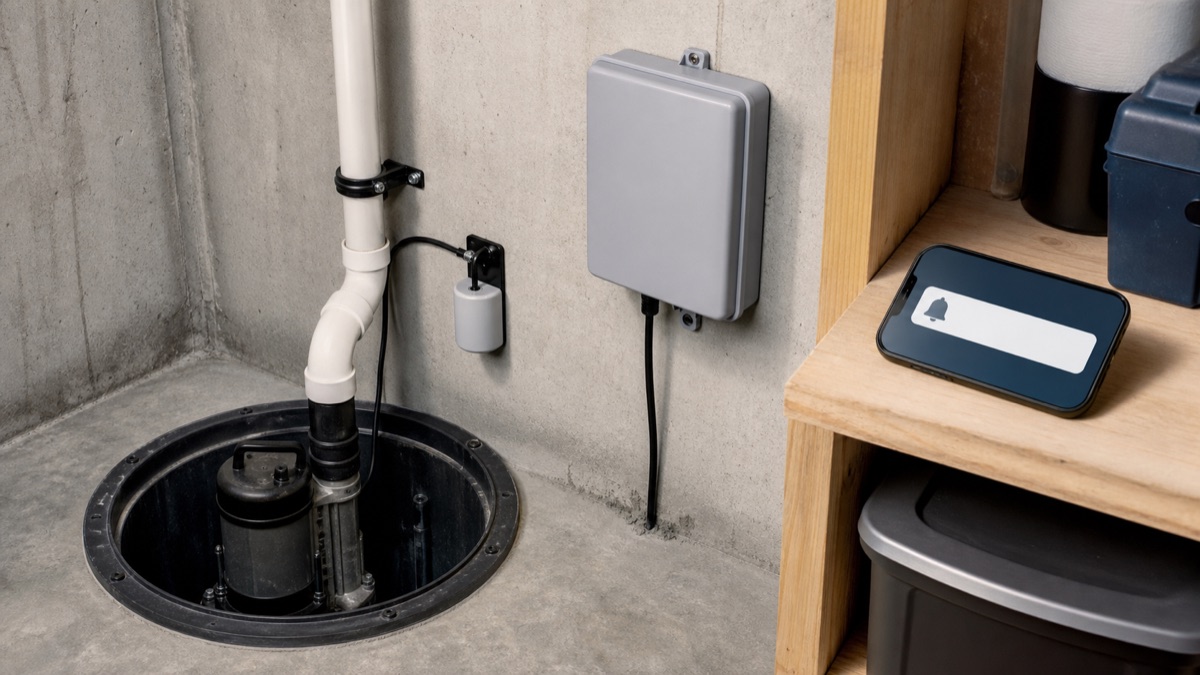
A local alarm offers the shortest path: sensor changes state and the unit sounds or flashes. Compare sound level at the occupied floor, separate power or battery capability, low-battery indication, test control, sensor cable length, enclosure rating, and whether the horn resets automatically. Mount it where sound is not buried behind a closed mechanical-room door.
Liberty's ALM-Series manual documents audible and visual behavior, a backup 9V battery, low-battery chirp, and test procedure for covered models. Those details cannot be assigned to every alarm. Verify the exact manual, especially for outdoor use, auxiliary contacts, sewage applications, and how long a silence command persists.[4]
Wi-Fi notifications
The following dependency review is Ready Home Systems editorial failure-mode synthesis, not a capability claim about every connected alarm. A Wi-Fi product may deliver push, email, or text-style notifications depending on its documented service. Verify whether alerts require a cloud account, who can receive them, whether history is retained, and what happens when the device loses Wi-Fi. A phone image in marketing does not establish delivery during a neighborhood outage.
List the dependency chain: alarm power, backup battery if present, Wi-Fi radio, router, modem or fiber terminal, internet provider, vendor cloud, phone service, app permissions, and the recipient noticing the alert. Put critical network devices on suitable backup power if remote notice depends on them, then test by deliberately interrupting each allowed link.
Cellular and auto-dialer paths
The following network checklist is Ready Home Systems editorial failure-mode synthesis, not a promise that a named alarm includes cellular service. A cellular communicator can reduce dependence on the home's router, but still requires verified signal, a supported carrier and network, active service, adequate backup power, configured recipients, and successful end-to-end testing. A landline or monitoring-panel auto-dialer has a different dependency chain.
Liberty's general FAQ supports only the stated ADC-1 auto-dialer product fact: it can dial listed phone numbers when used with a compatible alarm or control panel with auxiliary contacts. The separate ALM manual documents model-specific auxiliary-contact ratings. Those facts do not support universal cellular, monitoring, subscription, or delivery claims, and contact wiring belongs with a qualified installer.[4][5]
Power and connectivity failure modes
Test beyond the happy path. What happens when utility power fails, the alarm battery is low, Wi-Fi disappears, the internet remains down, the app is logged out, the phone is in focus mode, or the cellular subscription lapses? Does the local horn still work? Is a trouble notification distinct from high water? Can another person receive alerts? Document the answers.
Separate alarm power from pump power where the installation and code permit so one failed circuit does not silently remove both functions. Do not improvise electrical changes. Inspect cords and receptacles from a dry area and use qualified help for circuit or contact wiring. Federal flood guidance emphasizes avoiding floodwater hazards; notification hardware is not worth entering an energized wet space.[1][4]
Sensor placement
Place a high-water sensor above the normal primary-pump activation level but low enough to warn before overflow. It must not tangle with either pump float, rest against the pit wall in a way that prevents movement, or sit where turbulence creates nuisance alarms. Preserve service access and follow the sensor orientation and mounting instructions.
Liberty's cited sump sensor instructions place the alarm activation point slightly higher than the pump activation point for those models and describe the physical mark used during testing. That is a useful principle with a model-specific implementation. In a crowded or unusually shaped pit, have the installer prove that primary float, backup float, and alarm sensor can move independently.[4]
Notification testing
Use the manual's test control or a controlled water test. Confirm the local horn and light, every configured remote recipient, timestamps, recovery message, low-battery warning, and behavior after silence. Liberty's current ALM-Series manual tells owners of covered units to test every six months; use that interval only for those units and follow another product's schedule when it differs.
Record date, tester, result, battery change, app or account change, and corrective action. Repeat testing after replacing a router, phone, alarm battery, controller, sensor, or monitoring service. A successful app setup months ago is not current evidence. Avoid merely lifting an unfamiliar float by hand when its manual specifies a different safe test.[4]
Privacy and subscription considerations
This privacy and lifecycle checklist is Ready Home Systems editorial failure-mode synthesis for comparing connected services. A service may store account identity, device location, status history, phone numbers, or home-occupancy signals. Read the selected vendor's current privacy and security documentation for the actual data collected, account protections, retention, sharing, and deletion process; do not infer those facts from pump or alarm hardware documentation.
Price the full ownership period: hardware, cellular or monitoring subscription, replacement batteries, network backup, and service life. Ask whether core local alarming continues if a subscription ends and whether the device depends on a cloud platform that could be retired. A simple local alarm with a separate monitored contact may be more durable in some homes than a feature-rich single service.
Selection table
This selection method is Ready Home Systems editorial failure-mode synthesis rather than a ranking derived from the cited alarm manuals. Score choices against actual occupancy. If someone is nearly always home and the alarm is clearly audible, local notification may cover the principal need. Frequent travel increases the value of a tested remote path and a local responder. Unreliable broadband makes a Wi-Fi-only design weak. Poor cellular signal makes a cellular-only claim weak. Layering paths can be more resilient than buying the most elaborate label.
Before purchase, verify sensor type, pit compatibility, power source, backup behavior, local sound, remote channel, recurring fees, supported phones or networks, contact outputs, enclosure location, warranty, and test instructions. Then write the response list: who receives the alert, who can enter safely, which contractor is called, and where the pump and discharge information is stored.[2][4]
Professional triggers
Use an installer when the pit is crowded, floats interfere, wiring or auxiliary contacts are needed, a separate circuit is considered, local code governs the work, or sewage rather than clear sump water is involved. Call service when high water recurs, the pump runs without lowering the pit, a breaker trips, the discharge may be blocked, or the alarm cannot be tested reliably.
During active flooding, prioritize people. Stay out of water near electrical equipment, follow local instructions, and call emergency help when conditions are dangerous. Afterward, preserve event times and alerts; they can show whether power, pump, discharge, inflow, or notification failed first. That evidence improves the next repair instead of treating the horn as the root problem.[1][2]
| Type | Works best when | Key dependencies | Test |
|---|---|---|---|
| Local audible | A responder is within hearing range | Alarm power, sensor, sound path | Hear it from occupied rooms |
| Wi-Fi | Broadband and network backup are reliable | Power, router, internet, cloud, phone | Interrupt network and verify trouble behavior |
| Cellular | Signal and service are dependable | Power, carrier, subscription, phone | Verify signal and every recipient |
| Monitored contact | A supported monitoring system and responder exist | Compatible wiring, panel, monitoring account | End-to-end dispatch test |
Related reading and tools
Sources Used
- FloodsReady.gov / Federal Emergency Management Agency
- Urban Flooding: Guidance for Homeowners and RentersFederal Emergency Management Agency
- Five Facts to Help New Homeowners Protect Against Water DamageNational Flood Insurance Program
- ALM-Series Indoor Alarms Installation ManualLiberty Pumps
- FAQ - GeneralLiberty Pumps
FAQ
Is a Wi-Fi sump alarm enough without a backup pump?
No. It can report high water but cannot move it. Use notification as one layer alongside a maintained primary pump, an appropriate backup strategy, a clear discharge, and a response plan.
Where should the high-water float be installed?
Generally above normal primary activation and below overflow, with clear movement and no interference. The exact orientation and activation mark come from the sensor manual and the geometry of the installed pit.
Does cellular always work during a power outage?
No. The alarm needs backup power, local cellular service must remain available, the subscription must be active, and the recipient's phone must receive the message. Test the complete path under allowed simulated failures.
Related guides
Best Sump Pump Battery Backup: How to Choose Before the Storm
The best backup sump pump is the one that moves enough water for your pit, runs long enough for your outage risk, and alerts you before the basement becomes a claim.
Primary and Backup Sump Pump Maintenance Checklist
Maintain the sump system as one chain: pit, primary pump and float, backup pump and float, battery and controller, alarm, check valves, discharge, power, and the person who responds. Use installed manuals for intervals and procedures.
How Often Should a Sump Pump Backup Battery Be Replaced?
Replace a backup battery according to its system manual and condition, not a universal calendar. Age is one input; warnings, test performance, chemistry, charging, temperature, terminal condition, and the home's storm exposure determine how much margin remains.