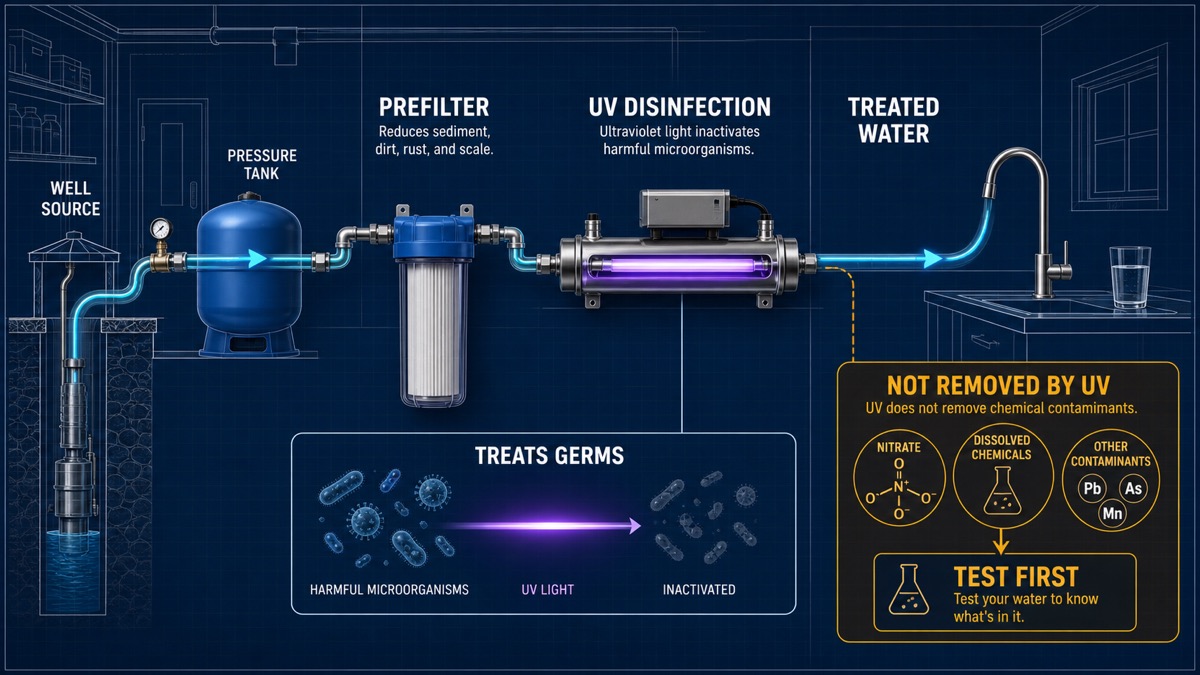
What UV is designed to do
Ultraviolet treatment exposes flowing water to germicidal light inside a reactor. CDC describes UV systems with prefiltration as capable of removing or reducing parasites, bacteria, and viruses; the practical point is disinfection, not broad filtration. Water must receive the required dose at the real flow rate and through the real water quality. The chamber, lamp, sleeve, power supply, sensor, and plumbing arrangement work as one system, so a lamp marketed with a large number is not enough to establish protection.
UV is attractive because it can disinfect without adding a continuous chemical residual or changing taste. That same lack of residual means it does not continue protecting water from contamination that occurs downstream in tanks, dead legs, fixtures, or damaged plumbing. A system should therefore follow a sanitary well and sound plumbing, not substitute for repairing a compromised cap, casing, drainage problem, cross-connection, or recurrent source of contamination.[1]
What UV does not remove
CDC explicitly separates germs from chemicals: UV with prefiltration can address listed microbial categories, but it does not remove chemicals. Nitrate, arsenic, lead, pesticides, volatile organic compounds, dissolved salts, hardness minerals, iron, manganese, and many taste or odor compounds require contaminant-specific evaluation. Sediment may be trapped by upstream filtration, yet a sediment cartridge does not by itself prove that the clear water is microbiologically or chemically safe.
That boundary changes the buying process. If a lab report shows a chemical problem, do not buy UV as the primary remedy. If it shows coliform bacteria, investigate the well and plumbing source before treating the symptom indefinitely. Multiple problems may require staged equipment, but every stage needs a defined job, verified claim, service flow, pressure budget, drain or waste plan, and maintenance procedure. A vendor should be able to map each component to a measured result.[1][2]
Why testing and source repair come first
Test at a state-certified laboratory before designing treatment. The report should identify the microbial result and relevant water-quality factors, while a well professional checks construction and contamination pathways. A loose cap, damaged casing, poor surface drainage, nearby septic failure, or recent repair can allow repeated entry. Disinfecting every gallon while leaving an obvious pathway open is less resilient than correcting the pathway and then deciding whether ongoing UV provides a useful additional barrier.
When harmful germs or chemicals are present, CDC advises using bottled water or another safe source until the water has been treated and testing confirms that the response worked. Do not use a consumer UV purchase as permission to ignore an active advisory. Health departments can define immediate use restrictions, disinfection steps, sampling intervals, and the parameters needed after repair. The laboratory result and well assessment should become part of the system specification.[3][2]
Document readiness against the exact UV system
Complete the readiness side of the record before selecting a reactor. Name the target germ question and current laboratory result; list peak household flow, turbidity or clarity, sediment, hardness, iron, manganese, and any other inlet limit required by the exact product. Identify the pretreatment stage responsible for each condition and the sample or measurement that will confirm the handoff. CDC notes that UV with prefiltration works better than UV without it and that UV does not remove chemicals.
Match the required dose or validated performance basis to the product's published flow table rather than using one headline gallons-per-minute value. VIQUA's VH410 product page, for example, publishes different flows at different UV doses and lists its alarm features. Those values belong to that exact product and configuration; they do not establish the flow, dose, certification, or alarm behavior of another reactor.
Include electrical supply, installation orientation, drain or service clearances, isolation and sample points, lamp and sleeve parts, and the exact manual revision in the readiness record. If any required inlet value or product document is missing, keep the design unresolved. Do not install a generic sediment cartridge and assume every UV inlet condition or validated claim has been satisfied.[1][5][3]
Size by peak flow and validated conditions
Whole-house UV must treat the maximum flow that can pass through it, not the family's average daily use. List simultaneous fixtures, pump capacity, pressure range, pipe size, and any high-flow appliance. Compare that peak with the reactor's validated flow under the stated water-quality conditions and required dose. A nominal gallons-per-minute label without the dose and test conditions is incomplete. Oversizing plumbing around a small reactor can permit flow above its validated capacity.
Check electrical supply, alarm behavior, lamp-out response, sensor cleaning, replacement access, bypass design, heat when water is stagnant, and whether a shutoff prevents untreated flow during a fault. A bypass used during maintenance can also send untreated water through the home if left open. The installer should label valves and explain the safe restart and disinfection procedure after service or an extended outage.[1][2]
Prewrite the alarm response and validation record
Copy each controller indication from the exact manual into an alarm-response card: normal status, lamp-life notice, lamp failure, sensor or low-UV condition if equipped, power loss, and any connected shutoff behavior. Assign who receives the alarm, which water uses stop, which known-safe source is used, and who services the unit. A muted alarm, illuminated display, or running lamp is not by itself a laboratory result or evidence that untreated chemical contaminants were removed.
After installation or corrective service, record reactor identity, lamp and sleeve identity, pretreatment status, settings, sample locations, commissioning observations, and the laboratory plan supplied by the health department or qualified provider. CDC advises testing after treatment to verify that treatment worked before drinking or using contaminated well water. Keep the result with the installation record and repeat testing on the locally advised schedule and after relevant events.
Do not improvise lamp, quartz-sleeve, electrical, or pressurized-chamber service. Follow the manual's shutdown, cooling, depressurization, cleaning, replacement, and return-to-service instructions or use qualified service. If the system is alarming, lacks power, has exceeded a documented service limit, or cannot maintain required inlet conditions, follow the alternate-water plan until the exact response and validation steps are complete.[5][2][3]
Questions for an installer
Ask which laboratory results justify UV, what source defects were ruled out, which organisms and dose claim the selected model covers, and at what peak flow and inlet-water conditions. Request the pressure-loss curve, required prefilter, lamp and sleeve schedule, alarms, fail-safe behavior, electrical load, parts availability, warranty, and post-installation sample plan. A useful proposal identifies assumptions instead of promising that one device makes every well safe.
Call a qualified well or treatment professional when the well has flooded, tests remain positive, vulnerable occupants need a more conservative barrier, the proposed flow exceeds residential equipment, or the installation requires plumbing and electrical changes outside your competence. Keep alternate safe water available until the responsible authority or laboratory process confirms acceptable operation. UV can be a strong microbial barrier, but only inside a maintained, tested, correctly designed system.[1][2]
| Record block | Evidence to attach | Acceptable outcome | Stop boundary |
|---|---|---|---|
| Readiness | Target germ result, pretreatment values, peak flow | All exact-model inlet and flow limits documented | Missing condition remains unresolved |
| Alarm | Manual indication and configured recipient | Safe-use response assigned and tested as permitted | Do not infer safety from a display |
| Maintenance | Lamp, sleeve, sensor, parts, and schedule | Exact procedure and responsible person | No improvised electrical or pressure-vessel work |
| Validation | Commissioning record and laboratory plan | Required post-treatment result is acceptable | Use known-safe water while result is unsafe or uncertain |
| Chemical scope | Separate chemical results and treatment claims | Every named chemical has its own evidence | UV does not establish chemical removal |
Scroll sideways to read every column on smaller screens.
Before you buy or hire
Related reading and tools
Choose the next step for your situation: measure, compare options, or maintain and verify.
- Explore the topicWell Water Treatment
- Measure with a toolWell Water Lab Report Decision Helper
- Compare your optionsWhole-House Well Water Filter Order: Sediment, Iron, Softener, UV, and RO
- Compare your optionsSediment Filter Micron Size for Private Wells: A Selection Record
- Compare your optionsSpin-Down vs Cartridge Sediment Filter for Private Wells
How this guide was checked
Guides are built from official sources, product documentation, manufacturer manuals, and practical homeowner decision criteria. We do not claim hands-on product testing unless a page explicitly says a product was tested.
- Source-backed editorial review
- 5 cited source records
- Private well owners should test before buying treatment. Odor, stains, and taste are not complete safety assessments.
Ready Home Systems is educational and not a substitute for local code officials, licensed trades, medical providers, water labs, or mitigation professionals.
Read review methodologySources and manuals
- About Home Water Treatment SystemsCDC
- Guidelines for Treating Well WaterCDC
- Protect Your Home's WaterU.S. EPA
- What to Do With Your Private Well After a FloodU.S. EPA
- VH410 Whole Home UV System product documentationVIQUA
FAQ
Does UV make any well water safe to drink?
No. UV is a microbial treatment category and does not remove chemicals. The well must be tested, defects corrected, inlet conditions met, and performance verified.
Do I need a sediment filter before UV?
CDC says UV systems with prefiltration work better. The exact filter and rating must follow measured water quality, flow, pressure loss, and the UV manufacturer's requirements.
Can I rely on the green light on the controller?
No. It is useful operational information, but it does not prove water quality. Maintain the system and use certified laboratory testing after installation and on the ongoing well schedule.