Before you buy or hire
Immediate safety note
A well system combines electricity, water, stored pressure, and moving equipment. Do not remove a pressure-switch cover, touch wiring, drain or pressurize a tank, or open plumbing unless you are qualified and have followed the equipment procedure. Keep clear of wet electrical areas. If there is arcing, a hot electrical smell, a leaking tank, a rapidly chattering control, or water near energized equipment, stop using the system when it is safe to do so and call a qualified contractor.
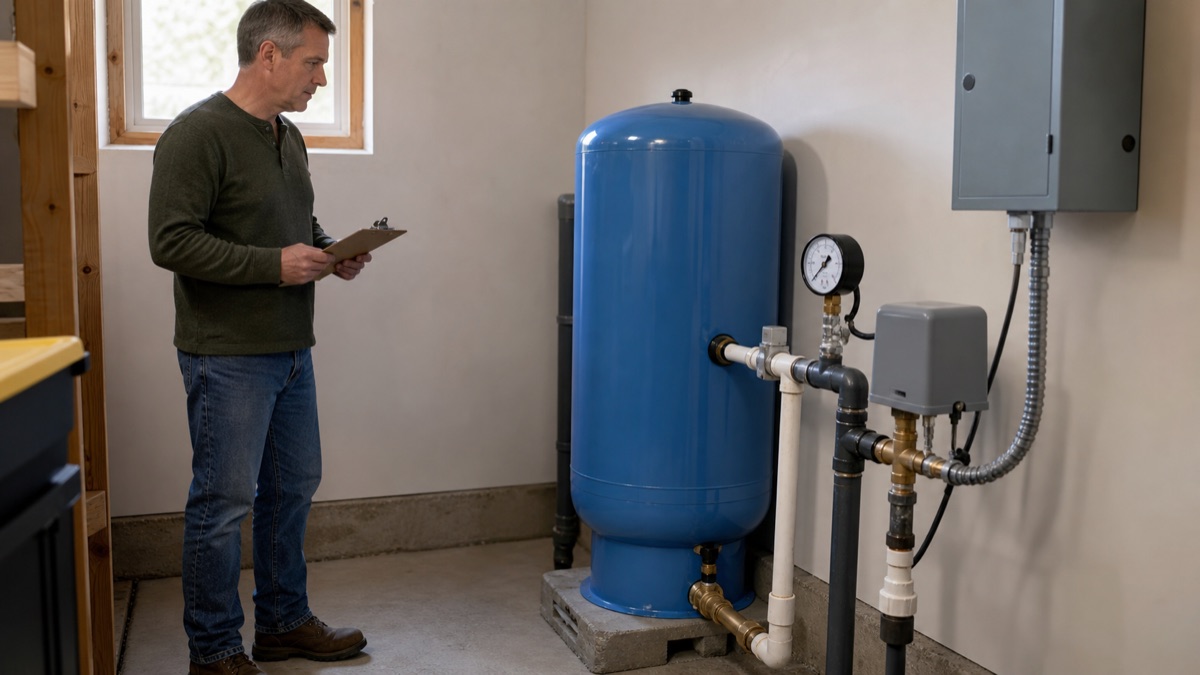
Observation is useful and low risk when done from a dry location. Note what fixture is running, how long the pump runs, the indicated cut-in and cut-out pressures, and whether the gauge moves smoothly. Do not assume the gauge is accurate or use repeated cycling as an experiment. Rapid starts can stress pump equipment; the Water Systems Council identifies prevention of rapid cycling as one of a pressure tank's functions.[4]
What short cycling looks and sounds like
The pattern is repeated pump starts and stops during a demand that should produce a longer run, such as a shower or hose. Some systems naturally cycle more often than others, and variable-speed controls behave differently from a conventional pressure-switch system. Establish what changed: a new sound, a shorter interval, pressure pulses at fixtures, or a pump that begins cycling even when no water should be used.
Record a short video or written timeline without entering a hazardous area. Include the fixture, approximate flow, gauge readings, start and stop times, and any simultaneous appliance use. A single brief observation does not diagnose a tank. It gives the contractor evidence to distinguish a reduced tank drawdown from a leak, a control problem, a restricted line, a failing valve, or a mismatch between pump output and system demand.[4][3]
Symptom checklist
Look for changes that can be observed without dismantling: pulsing flow, frequent clicks near the control, a gauge that jumps, pump starts with all fixtures closed, a tank with visible corrosion or leakage, new sediment, air at faucets, or a recent plumbing repair. Note whether the issue occurs throughout the home or on one fixture. Confirm that automatic water users such as toilets, treatment regeneration, humidifiers, and irrigation are not creating hidden demand.
Separate the symptom from its timing. Continuous cycling only during high demand suggests a different set of questions from cycling at rest. A recent filter installation can introduce restriction; a running toilet can create steady demand; a failed check valve can allow pressure to fall when no fixture is open. These are possibilities to report, not conclusions to test by adjusting controls.[3]
The pressure tank's role
A conventional pressure tank stores water under pressure so fixtures can receive some water between pump cycles. The Water Systems Council also describes the tank as helping protect pump life by preventing rapid cycling and providing additional pressurized storage. Usable drawdown is not the tank's outside volume. It depends on tank design, system pressures, and correct setup, which is why selecting a tank requires information about system demand, pump capacity, and well capacity.
Loss of the intended air cushion, a damaged internal bladder, incorrect pre-charge, or inadequate tank size can reduce drawdown and shorten a cycle. Those conditions cannot be confirmed reliably by knocking on the tank or watching one pressure swing. Tank testing and adjustment require isolation, depressurization, accurate instruments, and model-specific instructions. Give that work to a well contractor when you are not trained for pressurized systems.[4]
Pressure switch, check valve, leak, flow, and pump possibilities
The pressure switch senses system pressure in many conventional installations, but debris, damaged contacts, a blocked sensing path, incorrect settings, or wiring problems can affect operation. A leaking check valve or underground line may let pressure fall after the pump stops. A household leak can create the same visible effect. A restricted filter may make fixture pressure poor without being the original cycling cause. Variable-speed systems add controllers and sensors that need their own diagnostic process.
Well yield and pump selection also matter. The Council's sizing guidance treats demand, pump capacity, and well capacity as connected inputs. A contractor may need to measure pump flow, pressure, electrical performance, tank drawdown, and the rate at which the well recovers. Avoid buying a larger tank or a new switch until those relationships are understood; replacing one component can temporarily mask a leak or leave the pump mismatch unchanged.[4][3]
Observations a homeowner can safely record
Write down the controller or pump model, tank model and labeled capacity, pressure-switch label if readable without opening anything, gauge readings, filter service date, and recent work. Count cycles from a safe distance during one normal task and note its duration. Check the water meter if the property has one, and listen for toilets or appliances that may be drawing water. Photograph visible leaks, corrosion, and gauge readings without touching equipment.
Keep water-quality observations separate but include them. EPA recommends testing when color, taste, odor, or well conditions change. New sand or cloudy water alongside cycling can justify both mechanical inspection and water testing. Tell the contractor about flooding, excavation, lightning, power trouble, well work, filter changes, or long periods when the system was unused. Context often shortens diagnosis more than an improvised adjustment.[2]
Actions not to improvise
Do not bridge switch contacts, change pressure settings, add air to an unknown tank, defeat a low-pressure cutoff, repeatedly reset an overload, or keep running a pump that chatters or overheats. Do not trust an online pre-charge number without identifying the tank and switch arrangement. Do not drain pressurized equipment toward electrical components. These steps can damage equipment or expose a person to electrical, pressure, or flooding hazards.
Avoid using a shutoff as a long-term way to hide cycling while the household depends on the well. If shutting power or water is necessary for immediate safety, follow the installed system's procedure and arrange prompt service. A contractor should verify that controls, relief provisions, tank, pump, and piping operate together. Local electrical and plumbing requirements may affect replacement work.[3][4]
Contractor information checklist
Prepare the address and well history, pump and tank labels, known well depth and yield records, recent water tests, pressure readings, cycle timeline, recent repairs, and a list of treatment equipment. State whether cycling happens with no apparent demand, one small fixture, high flow, or treatment regeneration. Mention loss of pressure, air, sediment, discoloration, breaker trips, or controller fault indicators.
Ask the contractor to explain the measured cause and the evidence for the recommendation. Useful outputs include tank drawdown, verified pre-charge under the correct isolated condition, switch operation, leak or check-valve findings, pump performance, system demand, and well capacity where relevant. A replacement should be sized from those facts and supported by a service record, not only matched to the physical size of the old tank.[4]
Professional triggers
Arrange urgent service for electrical odor or arcing, controls that chatter, a pump that will not stop, loss of water, visible tank rupture, major leakage, repeated breaker trips, or a flooded equipment area. Stop approaching equipment when standing water could be energized. Sudden sediment or quality changes warrant testing and well inspection as well as mechanical diagnosis, especially after flooding or construction.
Routine but prompt service is appropriate when cycle intervals shorten, fixture pressure pulses, the pump starts at rest, or the tank and pump no longer meet household demand. A qualified well professional can work across the pump, tank, controls, piping, and well. A certified laboratory and local health authority address water safety. Keeping those roles distinct prevents a mechanical symptom from obscuring a water-quality issue.[2][3]
| Observed pattern | Possible category | Safe record | Next step |
|---|---|---|---|
| Rapid cycling during steady fixture flow | Reduced drawdown, control behavior, or pump-demand mismatch | Cycle time, pressure readings, fixture and filter state | Well-system diagnosis |
| Pump starts when no water is expected | Hidden demand, leak, or pressure loss | Time, gauge trend, automatic water users | Leak and check-valve evaluation |
| Poor flow after filter work | Restriction or installation issue | Filter model, service date, pressure under flow | Verify filter and system flow requirements |
| Cycling plus new sediment or color | Mechanical and source-water change | Samples, event history, photos | Well inspection and certified testing |
Related reading and tools
Sources Used
- Private Drinking Water WellsU.S. Environmental Protection Agency
- Protect Your Home's WaterU.S. Environmental Protection Agency
- Wellcare Information SheetsWater Systems Council
- Sizing a Pressure TankWater Systems Council
FAQ
Does short cycling always mean the pressure tank is bad?
No. Reduced tank drawdown is one common category, but leaks, check valves, switches, sensors, controllers, restrictions, pump sizing, and well conditions can create similar patterns. Measurements are needed before replacement.
Can I check pressure-tank pre-charge myself?
The correct procedure requires identifying the tank and control arrangement, isolating power, draining water pressure, and using accurate tools. Because electricity and stored pressure are involved, use the manufacturer procedure and a qualified contractor unless you are trained.
Will a larger pressure tank stop short cycling?
A correctly sized tank can provide more drawdown in a conventional system, but a larger tank will not repair a leak, failed bladder, faulty control, check-valve problem, or pump issue. Diagnose first, then size from demand, pump capacity, and well capacity.
Related guides
Best Iron Filter for Well Water: A Testing-First Buying Guide
The right iron filter depends on whether the iron is dissolved, oxidized, bacterial, or mixed with manganese and sulfur odors. Start with a lab test and match equipment to the result.
Best Sediment Filter Micron Size for Well Water
There is no single best micron rating for every private well. Start with the material you can observe, confirm broader water-quality risks through testing, protect household flow, and use staged filtration when one element would otherwise clog too quickly.
Iron Filter vs Water Softener: Which One Does Well Water Need?
A softener handles hardness. An iron filter handles iron and manganese more directly. Many well homes need both, but order and sizing matter.