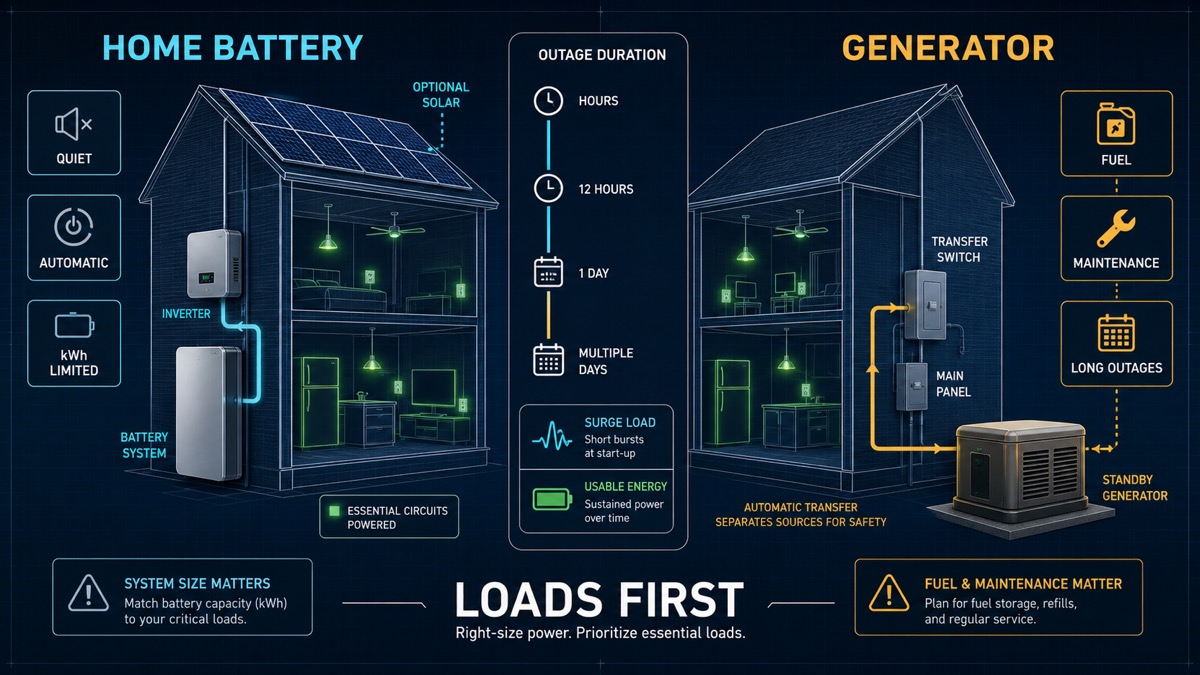
Build the critical-load and outage-duration comparison first
Start with the household functions that must continue, not the phrase whole house. For each exact load, record its purpose, running watts or kilowatts, startup or surge demand, automatic restart behavior, expected duty cycle, required hours, connection path, and whether it can be shed. EIA distinguishes power in watts from energy over time in watt-hours; a design must pass both tests.
Make duration scenarios that reflect the local outage decision: a short unattended interruption, one overnight period, and a longer event that may disrupt fuel delivery or solar recharge. For batteries, calculate usable kilowatt-hours after reserve and conversion loss, then document recharge conditions. For generators, document compatible continuous and startup capacity, expected fuel use from exact manufacturer data, on-site fuel constraints, safe refueling, maintenance, and resupply rather than treating fuel as unlimited.
DOE resilience material frames technology around sustaining a site's critical load through an outage. Apply that idea as an editorial worksheet, not a household guarantee: list which loads remain off in each mode, how occupants know capacity is being approached, and what event triggers load shedding, recharge, refueling, service, or relocation.[5][6][2]
Battery backup characteristics
DOE describes battery storage as quiet and odorless, with capacity that can be scaled to the need. A permanently installed system can detect an outage and transfer selected loads quickly without someone handling fuel. It can also support time-of-use management in some utility programs. There is no exhaust at the home, although installation, thermal management, electrical protection, equipment clearances, fire-code requirements, and end-of-life handling still need professional attention.
Runtime is finite and transparent: usable stored energy divided by average protected load, adjusted for conversion losses and reserve settings. High loads shorten it quickly. A battery that supports a refrigerator, lights, internet, and controls for many hours may support whole-home air conditioning for far less time. Warranty throughput, usable capacity, continuous and surge output, recharge rate, cold or hot temperature limits, standby losses, and service support belong in the comparison.[1][2]
Generator characteristics
A generator converts stored fuel into electricity and can continue through a long outage as long as safe fuel is available and the machine remains serviceable. Portable generators often cost less initially but require manual deployment, outdoor operation, cords or approved connection equipment, refueling, and theft/weather planning. Standby generators can transfer automatically and power selected or broad loads, but require permanent installation, fuel supply, exercising, maintenance, and periodic service.
Combustion risk is decisive. CPSC says portable generators must be used outside only, at least 20 feet from homes, with exhaust facing away. Working battery-operated or battery-backup CO alarms belong on every level and outside sleeping areas. A garage, basement, carport, porch, shed, or open doorway is not a safe shortcut. Fuel storage, hot refueling, leaks, fire separation, noise, and local rules can make a theoretically capable generator impractical.[1][4]
Solar does not automatically mean outage power
Most ordinary grid-connected solar systems shut down during a utility outage to protect workers and equipment. DOE explains that outage operation requires a properly configured inverter and storage system capable of intentional islanding. A rooftop array by itself should not be counted as daytime backup. Ask the installer exactly which loads remain energized, how the system disconnects from the grid, whether it can black-start, and how it behaves when the battery is empty.
Solar can extend battery duration when production exceeds protected loads and the system is designed to recharge during an outage. Weather, snow, smoke, season, roof orientation, and shading make daily production variable. Use conservative production assumptions and preserve a minimum state of charge for overnight critical loads. A hybrid generator may provide long-duration insurance, but integration must be explicitly supported rather than created with improvised connections.[2][3][1]
Compare complete operating modes, not product categories
For every option, trace grid loss through detection, transfer equipment, protected panel or direct load, startup demand, steady operation, energy or fuel supply, and return to utility power. A battery may transfer quickly but remains bounded by usable energy and recharge. A generator may extend duration while compatible fuel and maintenance are available but adds combustion, deployment or standby-service, noise, and carbon-monoxide controls.
A designed hybrid can use battery energy for a transition or quiet interval and a generator or outage-capable solar path for replenishment, but only when the inverter, charger, generator, transfer controls, grounding, protection, and warranties are engineered to work together. Ordinary grid-tied solar does not automatically provide islanded outage power. Do not connect components because their nameplate numbers appear compatible.
Put lifecycle tasks beside the duration result: battery reserve settings and capacity checks, generator exercise and service, fuel rotation or utility-fuel assumptions, transfer testing, alarm response, seasonal temperature limits, and qualified repair. Compare proposals against the same critical-load and outage-duration record so a larger nameplate does not hide a missing transfer path or an unserved essential load.[1][2][4][6]
Hybrid and critical-load designs
A critical-load panel can reduce required power and energy by isolating circuits that matter. A battery can provide immediate transfer and quiet overnight operation; solar can recharge when available; a generator can cover extended low-sun periods or recharge supported systems. This layered architecture can be more resilient than oversizing one technology, but control compatibility, grounding, neutral switching, charging limits, and manufacturer approvals require an experienced designer.
Define operating modes on paper: normal grid, short outage, overnight, extended outage, low battery, generator recharge, fuel shortage, equipment fault, and return to grid. For each mode, state which loads run and who acts. Test the system under supervision after commissioning. Confirm that pumps and motors start, load shedding behaves as promised, monitoring remains available without internet, and the household knows the shutdown and emergency procedures.[2][3]
Proposal checklist
For batteries, compare usable—not nameplate—energy, continuous and surge output, protected circuits, transfer behavior, islanding, recharge, solar operation, reserve settings, warranty, temperature, installation location, code, monitoring, service, and replacement. For generators, compare rated and surge output, fuel at full and partial load, transfer equipment, outdoor location, exhaust, noise, maintenance, exercise, cold start, fuel availability, CO safety, warranty, and service response.
Ask every bidder to show a load calculation and an outage-duration scenario rather than saying whole house without conditions. A licensed electrician should design permanent wiring and transfer equipment; qualified installers should handle fuel and battery systems. Medical-device users should confirm backup requirements with the device supplier and healthcare team. No residential backup system removes the need for CO alarms, evacuation plans, surge protection, equipment maintenance, and a destination when conditions exceed the design.
Request a commissioning report that records protected circuits, measured transfer, motor starts, battery reserve or fuel assumptions, alarm behavior, and operator training. Revisit the load list after major appliance changes. A system designed around the old furnace or an unused well pump may no longer protect the household priorities it was purchased to serve.[1][4][3]
| Decision field | Battery record | Generator record | Hybrid boundary |
|---|---|---|---|
| Power | Continuous and surge kW for protected loads | Continuous and startup capacity | Controls must coordinate transfer and load shedding |
| Duration | Usable kWh, losses, reserve, recharge | Fuel rate, storage, refueling and resupply | Each operating mode has a stated endpoint |
| Connection | Listed inverter, protected panel and transfer path | Inlet or standby connection and transfer equipment | Qualified design; no improvised interconnection |
| Lifecycle | Capacity checks, software, temperature, service | Exercise, maintenance, fuel and exhaust | One failed layer must not silently disable the other |
Scroll sideways to read every column on smaller screens.
Before you buy or hire
Related reading and tools
Choose the next step for your situation: measure, compare options, or maintain and verify.
- Explore the topicHome Power Backup
- Measure with a toolPortable Power Station Runtime Calculator
- Measure the problemHow to Estimate Portable Power Station Runtime Conservatively
- Measure the problemSolar Generator for Refrigerator Backup: Size Watts and Runtime
- Compare your optionsGenerator Transfer Switch vs Extension Cords: Safe Power Paths
How this guide was checked
Guides are built from official sources, product documentation, manufacturer manuals, and practical homeowner decision criteria. We do not claim hands-on product testing unless a page explicitly says a product was tested.
- Source-backed editorial review
- 6 cited source records
- Follow device manuals and carbon-monoxide safety guidance. Generators must stay outdoors and away from openings; medical-device users should confirm backup plans with providers.
Ready Home Systems is educational and not a substitute for local code officials, licensed trades, medical providers, water labs, or mitigation professionals.
Read review methodologySources and manuals
- The Road to Resilience with Rooftop SolarU.S. Department of Energy
- Solar and Resilience BasicsU.S. Department of Energy
- Solar Integration: Inverters and Grid Services BasicsU.S. Department of Energy
- Carbon Monoxide Information CenterU.S. CPSC
- Electricity Explained: Measuring ElectricityU.S. Energy Information Administration
- Distributed Energy Resources for ResilienceU.S. Department of Energy
FAQ
Is a battery sized in kilowatts or kilowatt-hours?
Both matter. Kilowatts describe simultaneous and startup power; usable kilowatt-hours, losses, reserve, load profile, and recharge determine duration.
Does a generator provide unlimited outage duration?
No. Duration still depends on compatible load, fuel supply and storage, refueling safety, maintenance, environmental conditions, access, and mechanical availability.
Will ordinary rooftop solar recharge a home battery during an outage?
Only a system designed for islanded operation with compatible inverter, controls and storage can do so. Ask the installer to demonstrate the exact outage mode and protected loads.
What should bids use as the common comparison?
Give every bidder the same critical loads, startup demands, duration cases, shed list, transfer requirements, site constraints, and acceptance tests.