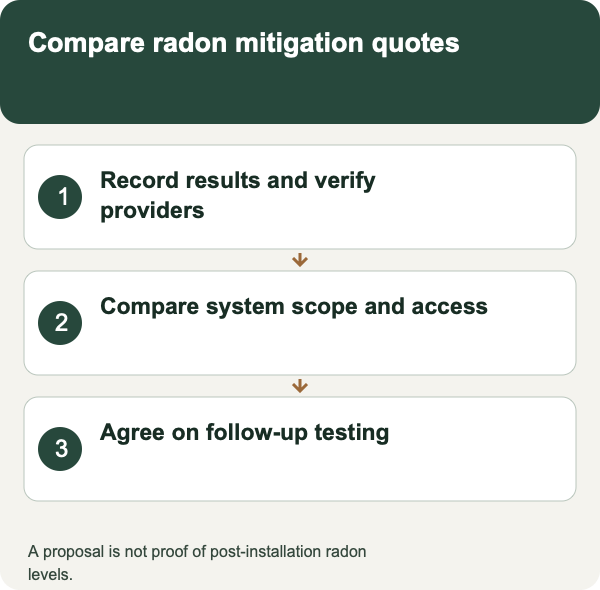
Give every bidder the same measurement file
Send the full radon report rather than a cropped number. Include measurement dates, device or laboratory details, test location, duration and any recorded conditions. EPA's home-buyer guidance recommends that the mitigation contractor review measurement results before work begins. Ask whether the evidence is adequate for the decision or whether a qualified tester should resolve a missing or questionable result first.
Describe the home's foundation areas, known additions and any existing radon system. Note which rooms you currently use and any planned renovation. Keep these facts in one versioned brief shared with every bidder. The purpose is comparable proposals, not remote diagnosis. EPA recommends fixing homes at 4 pCi/L or above and notes that lower levels still carry risk; neither a quote nor a contractor's target should be presented as a promise of zero risk.[3]
Verify the person and the applicable requirements
EPA directs consumers to their state radon contact to check local requirements and also identifies private national proficiency programs. Record the actual individual's name, credential number, current status and the registry you checked. Do not confuse a company advertisement, a training certificate and a credential appropriate to the proposed work. Requirements differ, so ask the state office which checks apply to your location.
Ask who will design the system, who will work onsite and who is responsible for the completed installation. EPA maintains a current standards-of-practice directory alongside historical material. Request the standard and applicable edition the contractor intends to follow, plus responsibility for local requirements. 'EPA approved' without an identifiable credential, scope or applicable requirement is not enough information to compare a proposal. This is a verification checklist, not a legal determination.[1][2]
Ask for a site-based scope and diagnostic assumptions
Arrange a visit so the contractor can assess the actual building. Minnesota's health department recommends site-based proposals and questions about diagnostics; its licensing rules are Minnesota-specific, but the procurement questions are useful elsewhere. Ask what inspection or diagnostic work is included, what it is expected to resolve and whether additional investigation has a separate price. A telephone estimate should be labeled preliminary when the final scope depends on unseen conditions.
Minnesota describes foundation-dependent professional selection among mitigation approaches. Ask the bidder to identify which foundation areas the proposal covers and how other areas are addressed or excluded. Do not prescribe suction locations, fan sizes or pipe dimensions from this worksheet. Instead, ask for the design rationale in plain language and a written change process if the initial assessment reveals something different during the work.[6][5]
Describe the visible work and affected household systems
Request a marked sketch or photographs showing the proposed route, equipment location and areas needing access. Record what the contractor plans to seal, cover or penetrate and which finishes will be restored. Minnesota's system description identifies elements such as a fan, vent piping and an operating indicator. Those components are useful quote categories; the professional must determine the appropriate arrangement for this home.
Our editorial scope record also includes noise concerns, appearance preferences, access to stored belongings and future service access. If there is a sump, crawlspace cover or another existing system in the work area, ask how access and function will be preserved. Document responsibility for electrical work, permits where required, cleanup and any outside trade. Do not let an attractive route drawing stand in for a written account of what the total price includes.[5][6]
Separate installation price from outcome and warranty terms
EPA's consumer guide recommends a written contract describing the work, costs and any negotiated reduction guarantee. Ask what happens if the first valid post-installation result does not meet the agreed target. Record the correction process, response period, included adjustments and circumstances that trigger extra charges. A performance undertaking should be specific enough that both parties know the next action after an unsatisfactory result.
Distinguish equipment warranty, workmanship coverage and performance terms in your comparison. Ask about transfer to a future owner and exclusions associated with later building changes. Keep deposits, payment milestones and optional service plans visible. For an original planning exercise, compare the same base scope across bidders, then add clearly separated options. A longer warranty or a lower initial price is not, by itself, evidence that the proposed system fits the building.[4][6]
Put post-installation testing on the calendar before signing
Name who arranges and pays for the post-mitigation radon measurement, who receives the complete report and who reviews it against the agreed target. EPA's 2025 consumer guide places the test within 30 days of installation, but no sooner than 24 hours after the system is operating. Have the tester specify the appropriate method, duration, placement and building conditions for the situation, including applicable state requirements.
EPA's home-buyer guide recommends an independent qualified tester after mitigation. If the installer also performs a check, clarify whether independent verification is included or separately arranged. A pressure indicator or running fan does not report an indoor radon concentration. Use the separate radon-test-after-mitigation guide for the full verification workflow; this quote checklist's job is to assign the task, cost, timing and response to the result before work starts.[4][3][5]
Ask what the owner receives and must keep doing
Request a handover folder with the final system description, equipment information, written operating instructions, warranty documents, contractor contacts and measurement reports. Have the contractor show you the normal operating indication and explain which changes require a service call. Ask for an accessible record of that explanation so another household member can respond when the original contact is unavailable.
EPA advises regular checks of the warning device, occasional maintenance and radon retesting at least every two years. Put responsibility for those actions in the household calendar. If the contractor offers ongoing service, identify which visits and tests are actually included. An original ownership-cost record can list quoted electricity assumptions, future testing and possible service charges without pretending that a generic market average predicts this particular home's costs.[5][7]
Resolve differences before choosing the contractor
Use four status labels for each bid: included, excluded, conditional or unresolved. A conditional item needs a trigger and an authorization process. An unresolved item needs a written answer. Send the same follow-up questions to each contractor so one proposal does not quietly gain scope while another remains a bare installation price. Keep revisions dated, and ask the selected contractor to incorporate agreed clarifications into the final contract.
For example, if one bid includes independent testing and another provides only an installer check, request comparable test arrangements before declaring a saving. If one covers an additional foundation area, ask the other bidder to explain its different assessment rather than assuming either is correct. Our recommended decision output is a signed scope, a known responsible professional and a scheduled verification path. The indoor-air hub and testing-device comparison provide context without replacing that home-specific professional work.[1][3]
| Decision item | Evidence to request | Hold point |
|---|---|---|
| Qualifications | Named professional and current registry check | Resolve the applicable state requirements |
| Site assessment | Foundation coverage and diagnostic assumptions | Clarify unseen conditions and added-work approval |
| Installed scope | Route, included trades and restoration | Identify exclusions before comparing totals |
| Performance terms | Agreed target and correction procedure | Separate results from hardware warranty |
| Verification | Tester, timing, cost and report recipient | Assign independent measurement explicitly |
| Handover | Instructions, contacts and future checks | Make ongoing owner responsibilities clear |
Before you buy or hire
Related reading and tools
Choose the next step for your situation: measure, compare options, or maintain and verify.
- Explore the topicIndoor Air, Radon, and Mold
- Measure the problemDigital Radon Detector vs Charcoal Kit: Which Test Should You Use?
- Measure the problemBest Radon Test Kit: Short-Term, Long-Term, or Digital Monitor?
- Maintain and verifyRadon Testing After Mitigation: When and How to Retest
How this guide was checked
Guides are built from official sources, product documentation, manufacturer manuals, and practical homeowner decision criteria. We do not claim hands-on product testing unless a page explicitly says a product was tested.
- Source-backed editorial review
- 7 cited source records
- Radon and mold decisions can affect health. Follow EPA/CDC guidance and use qualified mitigation or remediation pros when levels, area, or symptoms justify it.
Ready Home Systems is educational and not a substitute for local code officials, licensed trades, medical providers, water labs, or mitigation professionals.
Read review methodologySources and manuals
- How Can You Find a Qualified Radon Service Provider in Your Area?U.S. Environmental Protection Agency
- Radon Standards of PracticeU.S. Environmental Protection Agency
- Home Buyer's and Seller's Guide to Radon, March 2024U.S. Environmental Protection Agency
- Consumer's Guide to Radon Reduction, 2025U.S. Environmental Protection Agency
- Radon Mitigation SystemsMinnesota Department of Health
- Find a Radon Mitigation ProfessionalMinnesota Department of Health
- How Do I Know If My Radon Mitigation System Is Working Properly?U.S. Environmental Protection Agency
FAQ
Does the lowest radon mitigation quote represent the same job?
Not necessarily. Compare foundation coverage, diagnostic work, electrical scope, restoration, testing and outcome terms. Ask for written clarification rather than assuming a higher price is better or a lower price includes every missing item.
Does a national credential replace a state license?
Do not assume so. EPA directs homeowners to the state radon office for requirements and also identifies private proficiency programs. Verify what applies to the named professional and the work in your location.
Can I accept a working fan instead of a post-installation test?
No. Operation of a component and indoor radon measurement answer different questions. Include a properly conducted radon test in the project and a written response if its result does not meet the agreed target.
Related guides
Air Purifier vs Dehumidifier for Mold: Different Jobs, Different Limits
Compare HEPA air cleaners and dehumidifiers for mold: one reduces airborne particles while the other controls humidity, but neither repairs moisture sources.
Basement Condensation vs. Water Seepage: How to Sort the Clues
Compare condensation, seepage, and plumbing-leak clues before buying basement equipment. Record weather and moisture patterns, and know when to call a pro.
Dehumidifier Running but Not Lowering Humidity: What to Check
Check airflow, condensate, room temperature, settings, and incoming moisture when a dehumidifier runs without lowering humidity. Know the service stop points.