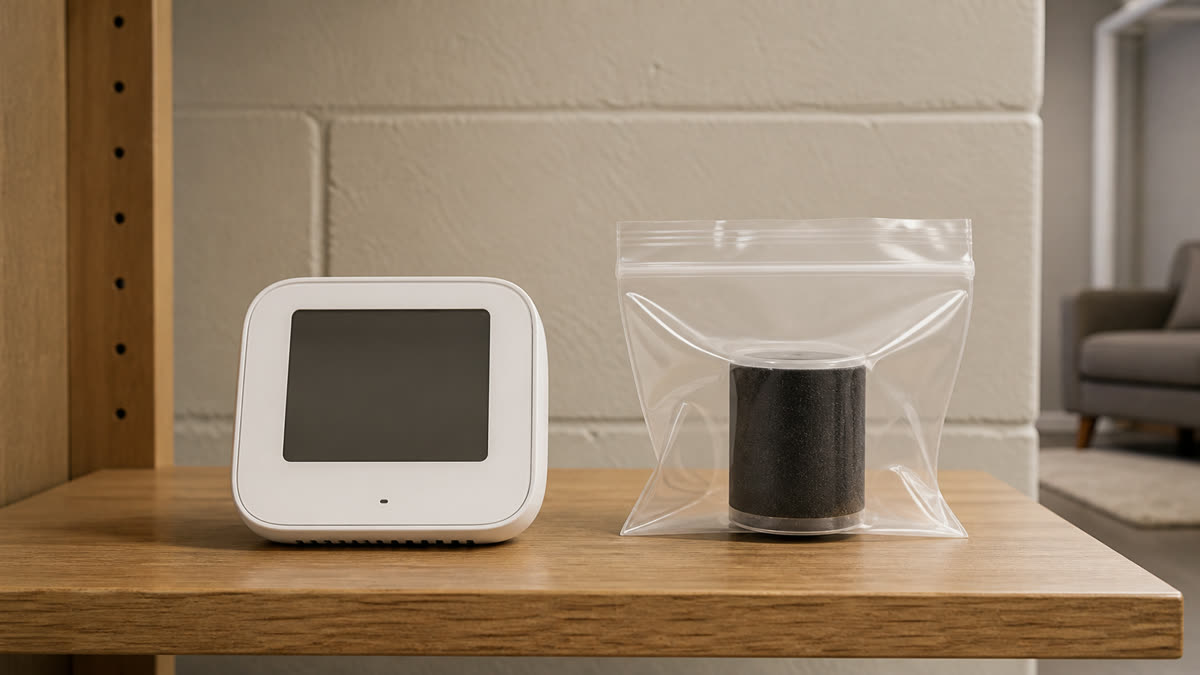
Compare two measurement workflows, not two price tags
A charcoal device is passive: expose it for its specified window, seal it, and ship or deliver it to the named laboratory. A continuous radon monitor is active: it needs power and repeatedly records radon or decay-product measurements, often producing a time-based report. EPA recognizes both passive and active device categories. That does not mean every retail charcoal pouch or digital display has the qualification, documentation, or protocol needed for every decision.
Define the task first. One baseline screen, a time-sensitive transaction, investigation of changing conditions, long-term household awareness, and post-mitigation verification demand different evidence. A cheap kit can be the more disciplined choice when the lab and return process are sound. A reusable monitor can be the more useful learning tool when its quality program is documented. Neither format excuses incorrect placement, an incomplete window, or a missing follow-up plan.[1][3]
Match the measurement window to the question
EPA's current real-estate guide classifies short-term testing as two to 90 days and requires at least 48 hours for all radon tests, with some devices requiring longer. A charcoal device is commonly used for a defined short exposure, while a continuous monitor can also run a qualifying short test when the device and protocol permit. Compare the exact minimum, maximum, activation, and reporting window; do not assume every charcoal kit is a 48-hour device or every digital average is a completed test.
Long-term testing lasts more than 90 days and is more likely to represent the year-round average because radon varies by day and season. Some active monitors can remain in place for ongoing awareness, while alpha-track devices are a common passive long-term method. A digital product showing a seven-day average is still not a more-than-90-day long-term test. Conversely, waiting months may be inappropriate when a valid short-term result is needed for a transaction or timely mitigation decision.[1][5]
Value continuous feedback without chasing hourly readings
Continuous devices can record changes during a test and may produce a report that helps a qualified tester recognize unusual swings or possible interference. For a homeowner, trends can also reveal that the number changes with time rather than remaining fixed. That feedback is valuable for maintaining interest, comparing completed periods, and noticing a mitigation-system question. It does not turn a single hour, app alert, or lowest daily value into EPA's completed test result.
Before purchase, learn which averages the display reports, how much early data the device withholds, whether history can be exported, what happens during a power or network loss, and whether settings can be changed without losing comparability. Keep the device in one protocol-compliant place through the intended window. Moving it room to room may answer a different investigation question, but it breaks the continuity needed to compare one complete period with another.[1][3]
Treat charcoal handling as part of the measurement
A charcoal result depends on more than the material inside the package. Confirm the kit is within its allowed use date, the package is intact, analysis and any laboratory fee are clear, and return shipping can reach the laboratory within the stated time. Record the device number, location, start, stop, and required conditions. At completion, reseal it exactly as directed and return it immediately to the specified laboratory. Delayed or untracked shipping can turn a low-cost purchase into no usable result.
Ask what the laboratory report includes and what conditions make a sample invalid. Do not open the package early, extend exposure because shipping is inconvenient, or substitute a different carrier procedure without checking instructions. A retailer's delivery estimate is not the laboratory turnaround time. For a deadline, count kit arrival, the full exposure, pickup schedule, transit, analysis, and report release. This workflow cost belongs beside the shelf price when comparing charcoal with a reusable monitor.[1]
Examine calibration, quality assurance, and proficiency
EPA's standards page distinguishes residential measurement practice, instrument performance, and measurement-system quality assurance. Ask a digital-device maker or measurement provider what calibration or performance verification applies to the exact model, how drift or failed quality checks are handled, and whether the report identifies the instrument. For a charcoal kit, verify the analysis laboratory and its current qualification or state acceptance. A generic accuracy percentage without the test conditions and quality path is not enough.
Professional services add another layer: state licensing, certification, registration, onsite documentation, and reporting requirements may apply. EPA advises contacting the state radon contact and lists recognized national proficiency programs for places without a state pathway. Verify current status rather than accepting a logo in an old advertisement. A consumer monitor can still be useful outside a professional transaction, but describe it as a device with documented limits, not as a self-declared reference instrument.[3][2]
Apply the same placement and closed-building discipline
Both formats need representative placement. EPA says to use the lowest level that could be used regularly and to avoid closets, stairs, hallways, crawlspaces, and enclosed high-humidity or high-air-velocity areas. Its short-test directions place the device at least 20 inches above the floor, away from drafts, high heat, high humidity, exterior walls, and disturbance. A power outlet that forces a digital monitor beside a window is not automatically better than a passive kit placed correctly.
Short-term tests require closed-building conditions, and tests shorter than four days require those conditions for at least 12 hours beforehand. Keep exterior windows and doors closed except normal entry and exit, follow normal-operation instructions, and avoid severe storms or high winds for those short tests. Log interruptions. Continuous environmental or motion records can help evaluate conditions, but they do not authorize an invalid location or deliberate ventilation change.[1][3]
Calculate total cost and reuse honestly
Charcoal usually has the lower upfront cost, but add laboratory fee, return shipping, expedited processing, a second device when the protocol calls for one, and another kit for future retesting. Its simplicity can be an advantage: there is no app, account, display interpretation, or long-term storage decision. The tradeoff is that it provides one exposure result after laboratory handling and cannot show feedback while the test is underway.
A digital monitor carries a higher upfront cost but may be reusable for repeated household observation. Add any calibration service, subscription, battery replacement, connectivity, data export, and replacement horizon. Reuse has value only when the device remains supported and the household follows consistent placement and windows. A professional continuous-monitor service may cost more than a self-test because qualification, onsite controls, custody, interpretation, and a defensible report can be part of the service—not merely use of electronics.[1][2]
Build confirmation and mitigation into the comparison
Before testing, write what follows a low, borderline, elevated, conflicting, or invalid result. For a household short-term screen, EPA and state guidance can determine whether another short test or a more-than-90-day long-term test is the appropriate confirmation. For the transaction options in EPA's guide, two simultaneous or sequential short tests or a qualifying continuous-monitor test have defined interpretation. Do not combine an old charcoal result and a new app average as though they were one protocol.
EPA recommends fixing at 4 pCi/L or higher and considering reduction between 2 and 4 pCi/L; follow the jurisdiction governing the test. Contact the state program and a qualified mitigator when action is indicated. After work, complete a post-mitigation test and retain routine retesting. The right comparison is therefore not digital forever versus charcoal once. It is the least complicated qualified sequence that yields a valid result, a confirmation path, and action without repeated shopping or unsupported brand rankings.[1][5][2][4]
| Factor | Charcoal kit | Continuous detector | Verification |
|---|---|---|---|
| Result path | Seal and send to qualified laboratory | Recorded electronic measurement | Check device and report qualification |
| Feedback | None during exposure | Trends and possible condition records | Interpret completed window, not one hour |
| Cost | Low upfront plus lab and shipping | Higher upfront plus support or calibration | Compare full repeat-testing cost |
| Real estate | May fit approved passive options | May fit approved active option | Follow state, contract, and professional protocol |
Before you buy or hire
Related reading and tools
How this guide was checked
Guides are built from official sources, product documentation, manufacturer manuals, and practical homeowner decision criteria. We do not claim hands-on product testing unless a page explicitly says a product was tested.
- Source-backed editorial review
- 5 cited source records
- Radon and mold decisions can affect health. Follow EPA/CDC guidance and use qualified mitigation or remediation pros when levels, area, or symptoms justify it.
Ready Home Systems is educational and not a substitute for local code officials, licensed trades, medical providers, water labs, or mitigation professionals.
Read review methodologySources and manuals
- Home Buyer's and Seller's Guide to Radon, March 2024U.S. Environmental Protection Agency
- How can you find a qualified radon service provider in your area?U.S. Environmental Protection Agency
- Radon Standards of PracticeU.S. Environmental Protection Agency
- EPA Map of Radon Zones and Supplemental InformationU.S. Environmental Protection Agency
- A Citizen's Guide to RadonU.S. EPA
FAQ
Is a digital radon detector more accurate than charcoal?
Format alone does not establish accuracy. Compare the exact device's qualification, performance and quality program, the charcoal laboratory's qualification, and whether each is used under the required protocol.
Why does my digital radon reading change?
Radon changes over time, and continuous devices reveal that variability. Interpret the completed average required for the decision rather than reacting to one hourly value.
Can I use a charcoal kit during a home sale?
It may be part of an accepted short-term option, but state rules, contract terms, qualified-provider requirements, interference controls, exposure, shipping, and report timing all matter.
Should I confirm a high digital reading with charcoal?
Use the follow-up method specified by current EPA and state guidance for the decision. Do not improvise an average between unlike tests; preserve the completed monitor report and ask the state program or a qualified tester when results conflict.
Which option costs less over several years?
Charcoal spreads cost across individual kits, laboratory processing, and shipping. A digital monitor concentrates cost upfront and may add calibration, support, or subscription costs. Compare the full required testing sequence, not only purchase price.
Related guides
Air Purifier vs Dehumidifier for Mold: Different Jobs, Different Limits
Compare HEPA air cleaners and dehumidifiers for mold: one reduces airborne particles while the other controls humidity, but neither repairs moisture sources.
Best Radon Test Kit: Short-Term, Long-Term, or Digital Monitor?
Compare radon tests by measurement window, qualified lab or device, closed-building rules, placement, follow-up, and real-estate timing.
Ideal Basement Humidity to Prevent Mold: Targets and Troubleshooting
Use a hygrometer, drainage fixes, ventilation, and dehumidification to keep basement humidity in a practical range and address the moisture source behind mold.