Start with the result the system must deliver
Write the treatment objective above the budget: the measured contaminant, its reported concentration, the water uses affected and the verification plan. A staining problem, a hardness problem and a microbial concern are not interchangeable purchases. CDC describes different functions for softeners, filtration and ultraviolet treatment. A low ownership estimate is not useful if it prices a system that does not address the documented problem.
Use the well-water lab report helper to organize results before comparing proposals, and return to the well-water treatment hub if the treatment objective is unclear. This worksheet starts after that evidence-gathering step. It compares the cost of keeping an appropriately specified system in service; it does not select a treatment technology or establish that water is safe. Keep well repair and household plumbing repair on separate lines when they are also needed.[5]
Define the boundary of each competing quote
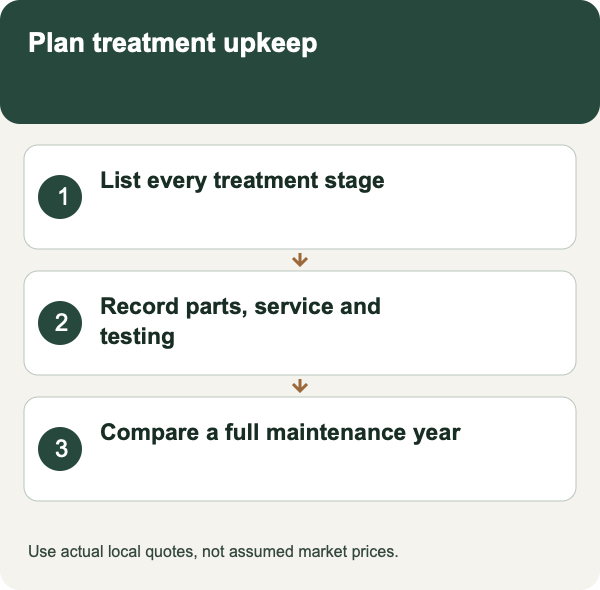
Give each proposal a name and a dated equipment list. Record which fixtures it serves, the pretreatment included, installation labor, startup consumables, commissioning and any separately quoted plumbing or electrical work. CDC distinguishes treatment at one use point from whole-home treatment. Comparing their totals without describing that different coverage would make the cheaper number misleading.
Our editorial comparison rule is to mark every item included, excluded, allowance or unresolved. An allowance is an estimate with an adjustment process, not a fixed price. Ask the supplier to identify its basis and who authorizes additional work. For example, write 'drain changes excluded, separate contractor quote pending' rather than entering zero. Add an expiry date to the proposal so an old parts quote does not silently become next year's budget.[3][2]
Build a maintenance register by component
Create a separate record for every component in the treatment train. Include its exact model, replacement part number, maintenance trigger, responsible person, parts supplier and service access requirements. Penn State Extension recommends understanding maintenance responsibilities before purchasing. A package described as annual service still needs an itemized list: inspection, cleaning, replacement parts, laboratory work and travel may be separate charges.
For cartridge, media, membrane or other replacement entries, copy the schedule and operating conditions from the actual product documentation. Do not apply one calendar interval to every device. CDC says filters need maintenance according to manufacturer recommendations. In your register, distinguish a required interval from an estimated interval and from an unresolved supplier question. If the maintenance trigger depends on measured conditions or treated volume, record how that trigger will be observed.[2][3]
Price consumables without inventing replacement life
For each recurring item, multiply the current quoted unit cost by the documented number expected during the budget period. Keep shipping, tax and service labor visible. If salt or another consumable is relevant, ask for the consumption assumption and the water conditions behind it rather than borrowing another household's usage. Enter unknown consumption as a question to resolve, not as a free resource.
A manufacturer-specific example shows why the register matters. VIQUA says continuously operated systems need annual lamp replacement and that quartz sleeves require attention when fouled. A lamp that remains visibly lit is not a reason to delete the scheduled replacement. This is an example for those systems, not a universal UV schedule. Price the correct lamp and the quoted cleaning or sleeve-replacement work separately, using the installed model's instructions.[4]
Keep testing and service visits in the operating budget
EPA recommends annual private-well testing for total coliform bacteria, nitrate, total dissolved solids and pH, with additional testing informed by local conditions. Changes in water quality, flooding and well-system repair are also reasons to test. Ask a certified laboratory and local health department which samples and parameters belong in your plan. A treatment maintenance visit and an appropriate laboratory result are different deliverables.
Budget the laboratory fee, collection arrangements and any professional interpretation separately from routine equipment service. For treated-water verification, ask where samples should be taken and who will review results against the original treatment objective. For your own worksheet, label each visit scheduled, event-triggered or optional. This keeps a first-year commissioning test from being counted every year and prevents a necessary recurring test from disappearing after installation.[1]
Use an auditable five-year cash worksheet
Choose one common period for every quote. Five years is a comparison window here, not a prediction of equipment life. Use this arithmetic: planned five-year cash cost equals startup cost plus year-one through year-five operating costs plus specifically scheduled replacements. Keep a repair reserve outside that total until you decide whether you are displaying expected cash spending or money set aside. Adding both a reserve and the same anticipated repair would double count it.
Use a year-by-year list when expenses are uneven. A part included at installation should not also appear as an extra purchase on that date. Count future replacements only when their documented schedule falls within your selected dates. Electricity and water entries should state quantities and the rates or supply costs used. Private-well water is not a municipal water bill; do not invent a per-gallon charge when the relevant pumping or wastewater costs remain unknown.[2]
Test the assumptions that could change the decision
Make a base case using confirmed schedules and dated quotes, then create a clearly labeled planning scenario. Change one unresolved variable at a time: an extra service visit, a supplier-confirmed shorter part interval, a shipping charge or a changed unit price. The difference shows how sensitive your comparison is to that assumption. These scenarios are your planning choices, not forecasts or published market ranges.
Keep the workload beside the cash total. Record who orders parts, who notices an alarm and who can attend service appointments. An inexpensive owner-maintained package may not fit a household unable to perform the required tasks. Conversely, a service plan should identify what it actually transfers to the provider. Ask about cancellation terms, excluded parts and whether missed owner tasks affect coverage before assigning value to the plan.[2][3]
Close the purchase with a usable ownership file
Save the original lab report, final equipment list, manuals, maintenance register, invoices and follow-up results together. At each service event, record what was actually replaced and why. At the annual budget review, replace estimates with invoices but preserve the original assumptions. That lets you distinguish a changed price from changed water conditions, different usage or a task omitted from the original quote.
Use the testing-schedule guide for future sampling questions and the filter-order guide if a supplier proposes adding another stage. A new component should update both the treatment objective and every downstream budget assumption. Do not postpone a required maintenance task merely to keep the spreadsheet under budget; ask the provider and local health authority how to manage water use when treatment performance is uncertain.[1][5]
| Budget line | Evidence to attach | Entry rule |
|---|---|---|
| Startup scope | Dated installation quote and exclusions | Count once; identify included first-use parts |
| Consumables | Correct part number, unit price and schedule | Quantity multiplied by quoted unit cost |
| Service visits | Written task list and labor terms | Separate planned visits from callouts |
| Laboratory testing | Laboratory panel and collection quote | Separate recurring and event-triggered samples |
| Utilities | Documented consumption and applicable rates | Show unknown inputs rather than zero |
| Major replacements | Model-specific schedule or explicit scenario | Assign to the year expected to be paid |
| Repair reserve | Your chosen planning allowance | Keep separate from predicted spending |
Before you buy or hire
Related reading and tools
Choose the next step for your situation: measure, compare options, or maintain and verify.
- Explore the topicWell Water Treatment
- Measure with a toolWell Water Lab Report Decision Helper
- Measure the problemHow Often Should You Test Well Water? A Practical Schedule
- Compare your optionsWhole-House Well Water Filter Order: Sediment, Iron, Softener, UV, and RO
- Compare your optionsUV Water Purifier for Well Water: What It Treats and What It Misses
How this guide was checked
Guides are built from official sources, product documentation, manufacturer manuals, and practical homeowner decision criteria. We do not claim hands-on product testing unless a page explicitly says a product was tested.
- Source-backed editorial review
- 5 cited source records
- Private well owners should test before buying treatment. Odor, stains, and taste are not complete safety assessments.
Ready Home Systems is educational and not a substitute for local code officials, licensed trades, medical providers, water labs, or mitigation professionals.
Read review methodologySources and manuals
- Protect Your Home's WaterU.S. Environmental Protection Agency
- Tips for Buying Water Treatment EquipmentPenn State Extension
- About Choosing Home Water FiltersCenters for Disease Control and Prevention
- UV System MaintenanceVIQUA
- About Home Water Treatment SystemsCenters for Disease Control and Prevention
FAQ
What is a normal annual well-water treatment maintenance cost?
There is no useful universal figure for an unspecified treatment train. Request model-specific parts, service and testing quotes, then calculate the annual items and separately scheduled replacements. This guide intentionally supplies no unsupported market average.
Does a five-year total predict when the equipment will fail?
No. It is a common comparison window. A scheduled replacement, a chosen repair allowance and a prediction of failure are different things. Preserve those labels so the budget does not imply certainty that the supplier has not provided.
Can I remove testing from the budget once treatment is installed?
Do not treat installation as permanent proof of water quality. Keep the laboratory and local health department's sampling plan in the budget, including the parameters needed to assess the original treatment objective and relevant event-triggered tests.
Related guides
Best Iron Filter for Well Water: A Testing-First Buying Guide
Compare well-water iron filters by lab results, iron form, pH, manganese, service flow, backwash demand, maintenance, and verified media limits.
Best Sediment Filter Micron Size for Well Water
Choose a sediment filter micron size for well water by particle load, pressure loss, filter design, and water testing instead of relying on one universal rating.
Iron Filter vs Water Softener: Which One Does Well Water Need?
Compare iron filters and water softeners by mechanism, lab results, hardness, iron form, manganese, sulfur, treatment order, maintenance, and cost.