Quick answer: protect people before appliances
A hurricane power outage checklist is not a promise that a house can ride out every storm. Evacuation orders, flood risk, structural damage, fire, carbon monoxide alarms, and urgent medical needs come before saving food or keeping ordinary appliances running. Decide in advance who can drive, where you can go, how pets travel, which medications must stay within a specified temperature range, and how every household member will receive local alerts when mobile service is unreliable.
The Atlantic hurricane season officially runs from June 1 through November 30, and National Hurricane Center climatology places the typical activity peak around September 10. That makes preparation an ongoing seasonal job, not something to begin when wind arrives. Review this list at the start of the season and again when a watch is issued. Finish only tasks that can be done without delaying an evacuation or entering floodwater, touching damaged wiring, or operating equipment in unsafe weather.[1][2]
Assign the hurricane phase checklist before conditions deteriorate
Create rows for routine readiness, watch or early warning, warning or evacuation order, active outage, and safe return. Each row needs an official trigger, responsible person, deadline, location, dependency, and fallback. Evacuation orders and local emergency instructions outrank appliance protection; do not delay departure to deploy a generator, charge a battery, or finish a checklist.
Before weather worsens, identify exact medical devices and supplier or clinician continuity plans, battery-powered critical loads and reserve, communication and charging, refrigerator and freezer thermometers, alternate safe food and water, sump or well dependencies, and the safe location for any portable generator. FEMA's checklist supports a family plan, go bag, medical equipment and backup batteries; it does not promise that shelter, roads, fuel, cellular service, or utility restoration will remain available.
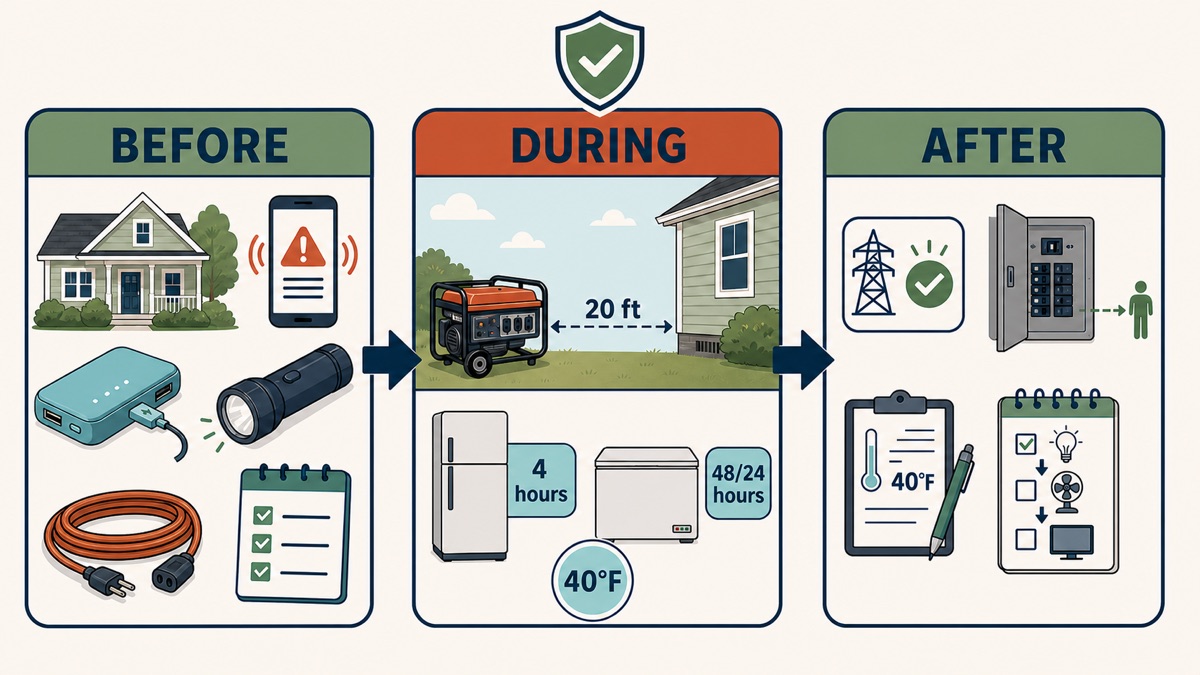
During and after the event, keep generators outdoors at least 20 feet away with exhaust directed away, keep refrigerator doors closed, use measured time and temperature for food decisions, stay away from floodwater and wet electrical equipment, and restore loads in the approved sequence only after authorities and the equipment condition support it. Record any damaged cord, alarm, trip, wet equipment, or changed medical-device setting for qualified follow-up.[2][5][3][4][6]
24 hours before: charge, cool, and stage
Charge power stations, approved medical-device batteries, phones, radios, and tool batteries according to their manuals, then keep them dry, ventilated, and accessible. Do not cover charging equipment or assume every battery can remain connected indefinitely. Confirm the exact outage mode for a CPAP, oxygen system, monitor, or other medical equipment with its manufacturer, supplier, and clinician rather than adapting a general-purpose connector.
Lower refrigerator and freezer temperatures within their normal safe settings, freeze water containers with expansion space, and group frozen packages. Put an appliance thermometer in each compartment. USDA guidance uses 40°F or below for refrigerated food and 0°F or below for a freezer before an outage. Group frequently needed food so doors open briefly, and stage separate coolers when medication instructions require different temperature or contamination controls.
Only while conditions are safe, clear the generator location, point exhaust away from the house, and measure at least 20 feet from every door, window, and vent. Bring loose items inside and raise vulnerable equipment. Finish early enough to evacuate; a watch or warning is not a reason to work on live wiring or test equipment in heavy rain.[2][3][4][5]
During the outage: control carbon monoxide and electrical risk
Treat every fuel-burning engine as a carbon monoxide source. CDC says a generator belongs outdoors at least 20 feet from windows, doors, and vents. A garage is unsafe even with its door open, and a porch or shed can trap exhaust. Keep a battery-powered or backup carbon monoxide alarm near sleeping areas. If it sounds, or anyone develops headache, dizziness, weakness, nausea, chest pain, or confusion, move to fresh air and seek emergency help.
Keep the generator and connections dry without enclosing the engine. Never handle plugs in water, route cords through puddles, or connect a generator to a wall receptacle. Use installed transfer equipment as designed or correctly rated outdoor cords for individual loads. Let the engine cool before refueling. Gas ovens, charcoal grills, camp stoves, and vehicle engines are not indoor heat or power sources.
Run only planned loads and watch for heat, overloads, smells, damaged cords, or unstable output. Preserve battery reserve for communication and life safety. If rising water, damage, an alarm, an evacuation order, or a worsening medical condition changes the situation, leave when safe instead of protecting equipment.[3]
Protect food without guessing
Keep refrigerator and freezer doors closed and write down the outage start time. USDA says an unopened refrigerator keeps food safely cold for about 4 hours. A full freezer holds temperature for about 48 hours, while a half-full freezer is closer to 24 hours when the door remains closed. These are planning windows, not guarantees. Room temperature, appliance condition, how often a door opens, food placement, and the starting temperature all matter, so the thermometer and actual time record govern the decision.
After about 4 hours without refrigeration, move perishable food to a cooler only if enough ice or cold packs can hold it at 40°F or below. Do not taste food to decide whether it is safe, and do not rely on smell or appearance. After restoration, food that still contains ice crystals or measures 40°F or below may generally be refrozen or cooked under USDA guidance. Perishable refrigerated food that has been above 40°F for more than 2 hours should be discarded. When records are uncertain, choose safety over the value of the food.[4]
Protect medical devices and essential loads
A general runtime estimate cannot approve a power source for a medical device. FDA preparedness material advises users to document the device, model, supplier, health-care contacts, medicines, and outage instructions before an emergency. Ask how the exact device indicates low power, whether settings change consumption, whether a humidifier or heater can be disabled safely, which batteries and adapters are approved, how long those batteries are expected to last, and what alternative location or clinical plan applies if power cannot be maintained.
Keep the written plan with the device and give a copy to a caregiver. Register for any utility medical-baseline or priority-notification program available locally, while understanding that it may not guarantee faster restoration. Protect equipment from floodwater, unusual heat, humidity, contamination, and unstable power. If a device fails, a battery swells or overheats, required therapy cannot continue, or the user's symptoms change, follow the clinician's emergency instructions and contact emergency services rather than experimenting with an inverter, extension, or unapproved battery.[5]
After power returns: restore in a controlled order
Do not assume the first flash of power means conditions are stable. Check local notices for flood, water, gas, and re-entry hazards. From a dry location, look and smell for evidence of damage without touching wet equipment, downed conductors, or a panel that has been exposed to water. Leave damaged electrical systems off for a licensed electrician. Turn off and cool a portable generator before changing connections, then follow the transfer-equipment instructions so utility and generator sources cannot be connected incorrectly.
Restore one planned circuit or load at a time. Start with safety, communication, refrigeration, and approved medical-device needs; delay large motors and heating loads until the supply is stable. Record the restoration time, refrigerator and freezer temperatures, and which food was moved. Inspect cords, plugs, batteries, and appliances for heat or water damage before reuse. Replenish fuel and batteries only after the emergency, using their storage rules, and schedule service for equipment that overloaded, flooded, or ran outside its normal limits.
Within a week, compare estimated runtime with actual use, record which alerts worked, and correct unsafe cord routes or inaccessible shutoffs. Replace used food, medicines, batteries, and first-aid supplies. If a pump, refrigerator, CPAP backup, or generator was the weak point, use the site's load-specific guide instead of buying a larger system without measurements.[3][4][5]
Printable hurricane power outage checklist
Print or save this checklist before the season. Add household-specific evacuation routes, utility numbers, medical instructions, and equipment manuals. The short boxes are reminders for a plan you have already verified; they are not permission to remain in an unsafe building or ignore local officials. Assign each line to a person, add a deadline, and mark it complete before weather makes outdoor or electrical work dangerous.
Keep one copy near the emergency kit and another with the person most likely to coordinate an evacuation. Review it after every outage and at least annually. When equipment, medication, household members, pets, or the home's flood exposure changes, revise the checklist instead of assuming last year's plan still fits.[2][5]
| Phase | Assigned decisions | Evidence | Stop or fallback |
|---|---|---|---|
| Routine | Medical plan, loads, alarms, supplies, evacuation route | Contacts, manuals, test dates | Unresolved continuity before storm season |
| Watch or warning | Charge, cool, stage and leave by deadline | Official alerts and owner initials | Evacuation order controls |
| Outage | Reserve, food time/temperature, safe generator, communications | Logged readings and events | CO alarm, floodwater, wet or damaged equipment |
| Return | Inspect, restore loads and verify devices | Authority notice and equipment checks | Qualified inspection when condition is uncertain |
Scroll sideways to read every column on smaller screens.
Before you buy or hire
Related reading and tools
Choose the next step for your situation: measure, compare options, or maintain and verify.
- Explore the topicHome Power Backup
- Measure with a toolPortable Power Station Runtime Calculator
- Measure the problemCPAP Battery Backup for Power Outages: What to Check First
- Measure the problemSolar Generator for Refrigerator Backup: Size Watts and Runtime
- Compare your optionsHow Far Should a Generator Be From the House? Portable vs. Standby
- Compare your optionsGenerator Transfer Switch vs Extension Cords: Safe Power Paths
- Compare your optionsChoosing a Sump Pump Battery Backup: Capacity, Duration and Failure Checks
How this guide was checked
Guides are built from official sources, product documentation, manufacturer manuals, and practical homeowner decision criteria. We do not claim hands-on product testing unless a page explicitly says a product was tested.
- Source-backed editorial review
- 6 cited source records
- Follow device manuals and carbon-monoxide safety guidance. Generators must stay outdoors and away from openings; medical-device users should confirm backup plans with providers.
Ready Home Systems is educational and not a substitute for local code officials, licensed trades, medical providers, water labs, or mitigation professionals.
Read review methodologySources and manuals
- Tropical Cyclone ClimatologyNOAA National Hurricane Center
- How to Prepare for a HurricaneFederal Emergency Management Agency
- What to Do to Protect Yourself During a Power OutageCenters for Disease Control and Prevention
- Keeping Food Safe During an EmergencyUSDA Food Safety and Inspection Service
- Home Health and Consumer DevicesU.S. Food and Drug Administration
- CPSC Warns of Generator, Carbon Monoxide and Fire Hazards Ahead of Hurricane SeasonU.S. Consumer Product Safety Commission
FAQ
When should I finish generator placement?
Before hazardous weather. Do not deploy or refuel during unsafe conditions, and never delay an evacuation order to protect appliances.
Can the runtime calculator decide which loads are critical?
No. The household, provider, supplier and emergency plan define critical functions. The tool only compares documented stored-energy inputs for the battery-powered subset.
How should food safety be tracked?
Keep doors closed, record outage time and appliance temperature, and apply current FoodSafety.gov or USDA item-specific guidance rather than taste or smell.
What changes after flooding?
Treat water near electrical equipment and damaged cords as stop points. Follow local authorities and qualified electrical inspection before reconnecting affected equipment.