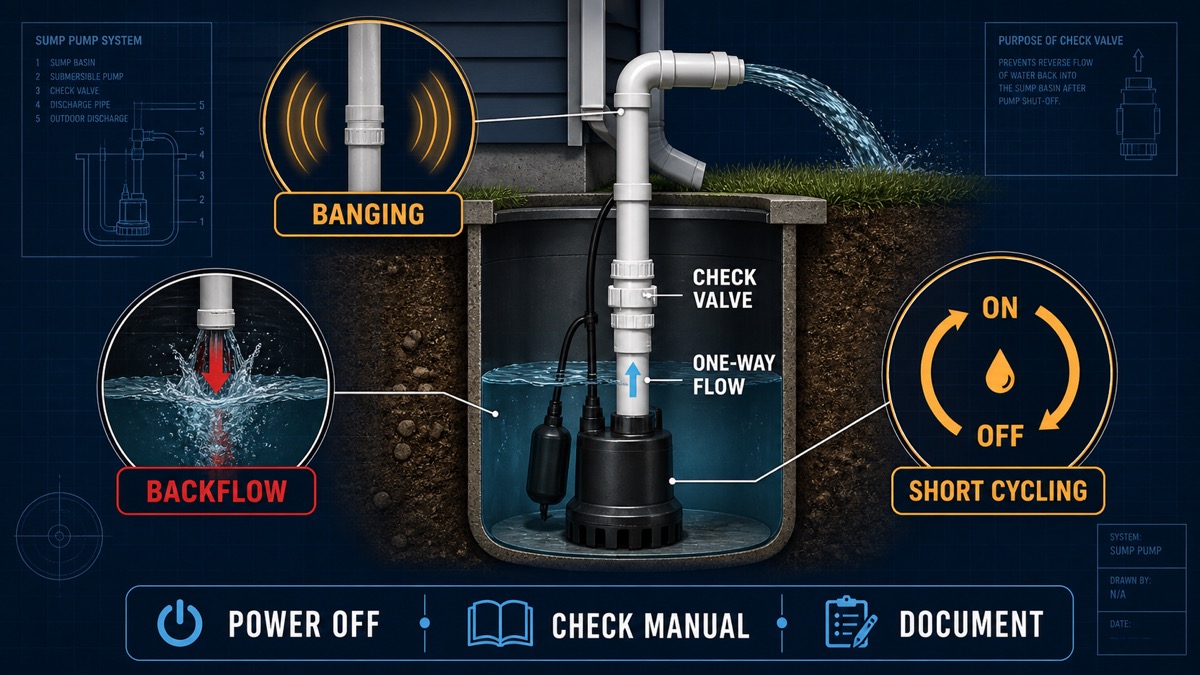
What the valve does
A sump check valve is a one-way valve in the discharge line. While the pump runs, water moves out through the valve. When the motor stops, the valve closes so the water column above it does not drain back into the basin. Pentair notes that this avoids pumping the same water again and can reduce unnecessary cycles. The idea is simple, but valve type, orientation, pipe diameter, vertical distance, solids, and installation details must match the pump and local requirements.
Some water below the valve naturally remains near the pump, and a small change in pit level is not automatically a failure. The useful question is whether a meaningful volume returns from the discharge line, forces another start, or produces an abnormal impact or leak. Establish what normal operation looks like during a controlled water test before a storm, then record changes instead of diagnosing only from a single sound.[1][3]
Water rushes back after shutdown
If water visibly or audibly pours back into the pit immediately after shutdown, the valve may be absent, stuck open, obstructed, damaged, installed backward, or leaking. A long vertical discharge holds more water, so a failed valve can cause a pronounced level rise. That return can trigger the float again, creating a repeat cycle even though no new groundwater entered. Record the start level, stop level, return level, and time to the next cycle.
Do not assume the valve is the only explanation. Water may be returning from an exterior line with poor slope, a fitting may leak, or the float range may be too narrow. Compare visible arrows and orientation with the exact valve manual from a dry position. If inspection requires loosening a pipe that holds a water column, isolate power and have a plumber control the water safely; an unexpected release can flood the area or contact electrical equipment.[1][2]
Banging and water hammer
A sharp bang just after the pump stops is often described as check-valve slam or water hammer. Pentair's troubleshooting guidance notes that a fast-moving water column can slam the valve closed and that excessive pump horsepower may contribute. The sound is a symptom, not a remote diagnosis. Valve design, closing speed, pipe support, flexible connections, lift, discharge velocity, and the mass of water above the valve can all change the event.
Watch for pipe movement, loose supports, repeated impact, leaks, or a change in sound. Do not add random restrictions or drill holes based on generic advice; pump manuals use specific air-lock provisions and discharge requirements. A quiet-check valve or layout change may help in a suitable system, but a plumber should verify that any change preserves required flow, service access, freeze protection, and local code.[2]
Short cycling is a system symptom
Backflow through a failed valve can produce an obvious pattern: pump starts, lowers the water, stops, water returns, and the pump starts again. Yet short cycling can also come from a small basin, constrained float travel, high inflow, an oversized pump, a stuck float, a plumbing leak, or incorrect on/off settings. Pentair cautions that oversizing and undersizing can reduce pump life through short cycling or continuous operation.
Measure before replacing parts. During a safe controlled test, note the basin diameter, water-level change between on and off, pump run time, pause between cycles, outlet flow, and whether the level rises with no new inflow. Photograph the pipe and valve labels. These observations help distinguish returned discharge volume from ongoing groundwater entry and give a contractor evidence that is more useful than saying the pump runs too much.[1][2]
Leaks, debris, and installation clues
Inspect from a dry area with good lighting. Look for drips at clamps, unions, threaded fittings, and the valve body; corrosion; cracked rubber connectors; unsupported pipe; an arrow pointing the wrong direction; or a valve buried where it cannot be serviced. The cited Flotec pre-plumbed model illustrates that check valves are integrated with specific pipe sizes and connector arrangements. Its dimensions are an example, not a universal prescription.
Sump pumps normally handle relatively clean groundwater. Debris, laundry discharge, or softener waste can foul the pump, float, or valve; Pentair advises against sending laundry or softener water into a sump basin. Keep the pit covered where appropriate and clear of loose objects without reaching into an energized wet basin. If sewage, floodwater, or unknown contamination is present, stop and use qualified cleanup and plumbing help.[3][1]
Use the check-valve symptom and diagnosis boundary record
From a dry position, record the exact sequence: pump starts, visible level falls or does not, pump stops, sound occurs, water returns, level rebounds, and another cycle begins or does not. Add where leakage is visible, whether the outlet flows, whether the symptom changed after service or freezing, and which primary or backup pump was operating. Video or timed notes can preserve timing without opening piping.
Keep diagnosis boundaries beside the symptoms. A return rush can involve a leaking, missing, obstructed, or incorrectly installed check valve, but a second cycle can also reflect a small basin, float spacing, high inflow, shared discharge behavior, or pump selection. Banging can involve valve closing and pipe movement, but sound alone does not specify the safe repair or justify a brand or style change.
Stop before loosening a wet or pressurized connection, reaching into an energized pit, defeating a float, or assuming a quiet line is empty. Give the record and exact model or installation documents to a plumber or pump professional. After work, require a controlled automatic cycle that documents water removal, stop, backflow amount, pipe support, leaks, repeat cycling, and outlet flow.[1][2][3][4]
Repair and replacement questions
Before buying a replacement, identify discharge diameter, valve type, pump flow at actual lift, vertical and horizontal run, solids allowance, access space, connector type, and local code. Ask whether a full-port, spring-assisted, flapper, quiet-closing, union, or combination design is approved for the system. A valve that fits the pipe but creates excessive loss or cannot be serviced is not a sound match.
Have a plumber assess repeated cycling, severe water hammer, leakage, frozen or buried discharge, failed testing, or any work near wet electrical equipment. After repair, repeat the controlled water test and record the new baseline. Check both primary and backup paths: some combined systems have separate checks or a supplied tee arrangement. One working valve does not prove that the other pump can discharge without recirculation or interference.[1][3]
| Observed sequence | Possible branches | Safe evidence | Diagnosis boundary |
|---|---|---|---|
| Return rush after stop | Valve leakage, installation, retained water | Time and level change from a dry location | Do not open wet or pressurized piping |
| Immediate second cycle | Backflow, small cycle volume, high inflow, float layout | Start/stop timing and water trend | A valve is not the only possible cause |
| Bang or pipe movement | Closing event, support, velocity, layout | Sound timing and visible movement | Sound does not prescribe a valve type |
| Runs but level does not recover | Restriction, pump capacity, valve, discharge | Outlet flow and installed route | Treat rising water as urgent; diagnosis follows safety |
Scroll sideways to read every column on smaller screens.
Before you buy or hire
Related reading and tools
Choose the next step for your situation: measure, compare options, or maintain and verify.
- Explore the topicSump Pump Backup
- Compare your optionsChoosing a Sump Pump Battery Backup: Capacity, Duration and Failure Checks
- Maintain and verifyPrimary and Backup Sump Pump Maintenance Checklist
- Maintain and verifySump Pump High-Water Alarm: Local, Wi-Fi, or Cellular?
- Maintain and verifyHow to Keep a Sump Pump Discharge Line From Freezing
How this guide was checked
Guides are built from official sources, product documentation, manufacturer manuals, and practical homeowner decision criteria. We do not claim hands-on product testing unless a page explicitly says a product was tested.
- Source-backed editorial review
- 4 cited source records
- Backup pump sizing depends on pit inflow, lift height, discharge path, battery age, and local flood risk. Check manufacturer instructions and local code.
Ready Home Systems is educational and not a substitute for local code officials, licensed trades, medical providers, water labs, or mitigation professionals.
Read review methodologySources and manuals
- Sump Pump Info FAQPentair
- Sump Pump Troubleshooting FAQPentair
- Flotec FPZS50RP Pre-Plumbed Sump PumpPentair
- Urban Flooding: Guidance for Homeowners and RentersFEMA
FAQ
Does water returning after shutdown prove the check valve is bad?
It is a useful symptom, not a complete diagnosis. Valve condition, installation, pipe layout, float spacing, basin size, inflow, and shared discharge behavior can overlap.
What should I record before calling a plumber?
Record start, water-level change, stop, sound timing, return flow, repeat cycle, visible leaks, outlet flow, active pump, recent service or freezing, and safe photos or video.
Can I loosen the valve to inspect it?
Not from this guide. Wet or pressurized piping and energized equipment require safe isolation and qualified diagnosis. Do not assume a quiet line is empty.
How is a repair verified?
Use a controlled automatic cycle to confirm water removal, stop, limited backflow consistent with the design, no leaks or abnormal movement, no immediate repeat cycle, and flow at the intended outlet.