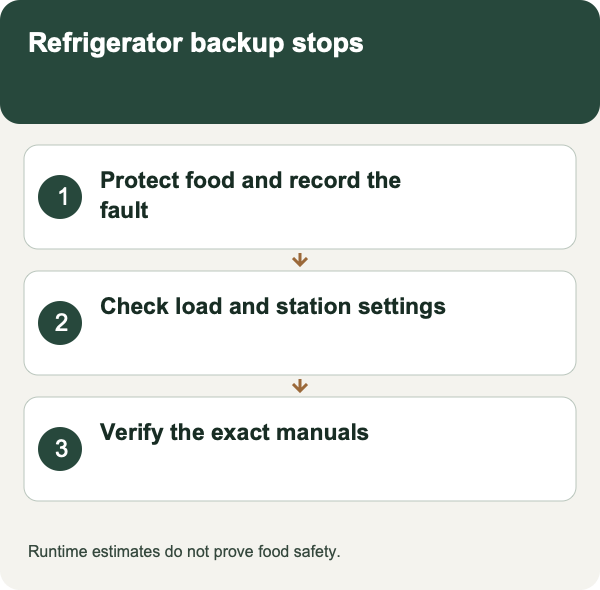
Protect the food and capture the symptom first
Keep the refrigerator door closed while you investigate, and note when cooling power was last known to be available. FoodSafety.gov says an unopened refrigerator generally keeps food safe for about four hours during an outage. That is not permission to ignore measured food temperature or an earlier interruption. Use an appliance thermometer and the official food-by-food chart when deciding what must be discarded; never taste food to determine safety. The chart generally calls for discarding perishable foods such as meat, milk, and leftovers after more than two hours at 40°F or above; individual food categories have specific instructions.
Before resetting anything, photograph the power-station display and note the time, battery percentage, output status, warning icon, other connected devices, and what the refrigerator was doing. If the display itself is asleep, wake it using the documented control without deliberately cycling AC output. Your first task is to preserve evidence, not make the warning disappear.[6][1]
Decide whether the refrigerator stopped or its power source stopped
A silent compressor does not necessarily mean a power failure. GE explains that refrigerator compressors and fans may pause during defrost, and a compressor can delay restarting after an interruption while the refrigeration system equalizes. Your refrigerator’s controls and manual determine what is normal. Avoid repeatedly opening the door just to check the lamp; one observation combined with the station display is more useful.
Create two separate notes: AC output available or unavailable, and refrigerator cooling confirmed or unconfirmed. A lit station screen is not proof that its AC receptacles are enabled. Equally, a lit refrigerator is not proof that its compressor is cooling. If power remains available but temperature rises outside the appliance’s expected behavior, the investigation may belong with an appliance technician rather than the battery manufacturer.[5][1]
A cutoff after a quiet interval suggests an idle-output setting
Some stations switch off AC after low or zero demand persists. That can conflict with an appliance that cycles. EcoFlow’s DELTA 2 manual specifically warns that intermittent refrigerator loads can trigger its AC timeout and directs users needing continuous availability to set that timeout to never. Treat that as a documented example, not a button sequence or default shared by every brand.
Look in your exact-model manual for AC timeout, ECO mode, power saving, or low-load shutdown. Distinguish display sleep from output shutdown. Save a screenshot of the existing setting before changing only the documented control relevant to refrigeration. If the manual does not explain the behavior, ask manufacturer support. Do not add a heater or another artificial load simply to keep the outlet awake.[1][2]
An immediate cutoff at compressor start suggests a load problem
Check whether an overload warning appears exactly when the compressor attempts to start. Jackery’s support guidance explains why motor-driven equipment may trigger protection even when its running power appears acceptable: startup demand and other simultaneous loads matter. A station’s watt-hours describe stored energy, not the maximum appliance load it can start. Compare the station’s continuous output and supported surge behavior with documentation for the refrigerator.
Remove nonessential loads using their normal controls before any manufacturer-permitted retry. Do not assume a generic startup multiplier proves compatibility, and do not substitute a marketing boost number for the applicable motor-load rating. The BLUETTI AC200L manual, for example, restricts its Power Lifting feature to specified resistive loads. A refrigerator compressor is not automatically covered by a mode intended for heating appliances.[3][2]
A later cutoff needs battery and temperature context
Write down whether shutdown occurs near the same displayed battery level, after extended use, or when a temperature warning appears. Check any user-configured discharge reserve or operating limit in the actual product documentation. Do not assume a percentage still showing on the screen means all of that energy is available to the refrigerator under current conditions.
Use the station only within its documented operating environment, with unobstructed ventilation and separation from heat or water. If temperature protection activates, stop using the affected setup and follow the manual’s recovery directions; do not defeat sensors, put the station in a refrigerator, or cool it with water. A repeated warning in suitable conditions needs manufacturer evaluation. A damaged, wet, swollen, smoking, or unusually hot battery product is not a candidate for another household troubleshooting run.[4][2]
Check the power path without working on electrical parts
List the components between the station and refrigerator: direct plug, permitted cord, adapter, power strip, or other equipment. Compare that list with both manuals. This guide covers an appliance plugged into an approved portable station, not a connection to household wiring. Never feed a wall outlet from the station or use an improvised adapter to make an unsuitable connector fit.
Inspect accessible plugs and cords visually from a dry location. Do not open the refrigerator’s electrical compartment, use live probes, replace protective devices, or alter grounding. If a connector is scorched or a cord is damaged, stop use and obtain qualified help. When ordinary utility power is available and safe, a normal manufacturer-approved appliance connection can help a technician distinguish a refrigerator problem from a station-specific interruption; document the result without repeatedly forcing compressor starts.[4][5]
Verify the intended operating mode before depending on it
A refrigerator running while the station is plugged into the wall does not establish how it behaves on battery. Conversely, a successful battery start does not prove an advertised backup or pass-through mode will meet every requirement. Read the documented changeover and restart behavior, and ask support which settings remain active in each mode. Do not discover an undocumented recovery requirement during a long absence.
For an otherwise safe setup, use the manufacturer’s recommended compatibility check under supervision. Observe more than the first successful start: the important question is whether cooling resumes after an ordinary idle interval and whether output remains available. Keep food temperature monitoring separate from the station’s estimated runtime display. Stop the check if protection trips again, the refrigerator behaves abnormally, or the instructions leave a material compatibility question unanswered.[1][2][6]
Use the symptom record for the next decision
Send support the station model, firmware version if visible, refrigerator model, warning photo, operating mode, loads, and sequence of events. A useful report reads: AC output switched off after an idle period, battery still displayed a charge, and no overload icon appeared. That is more actionable than saying the battery cannot run a fridge. Do not invent an error code or infer a failed component from a single symptom.
If the answer is insufficient output capability, return to the refrigerator sizing guide. If the system operates normally but energy runs out too soon, use the portable power-station runtime tool with measured or clearly identified estimated consumption. If AC remains available but cooling does not resume normally, arrange appliance service. No calculator establishes food safety, startup compatibility, or unattended reliability.[3][5][6]
| Pattern | Evidence to check | Next step |
|---|---|---|
| Compressor quiet; AC still enabled | Controls, temperature, and documented defrost or restart behavior. | Observe within manual limits; arrange service if cooling fails. |
| AC switches off after inactivity | Idle timeout or low-load shutdown setting. | Use the documented intermittent-load configuration. |
| AC trips when compressor starts | Overload indication and other connected loads. | Check exact startup compatibility; stop repeated trips. |
| Later shutdown with battery or heat warning | Charge state, reserve, environment, and error record. | Follow recovery directions or contact support. |
Before you buy or hire
Related reading and tools
Choose the next step for your situation: measure, compare options, or maintain and verify.
- Explore the topicHome Power Backup
- Measure the problemSolar Generator for Refrigerator Backup: Size Watts and Runtime
- Measure with a toolPortable Power Station Runtime Calculator
- Maintain and verifyHurricane Power Outage Checklist: Before, During, and After
How this guide was checked
Guides are built from official sources, product documentation, manufacturer manuals, and practical homeowner decision criteria. We do not claim hands-on product testing unless a page explicitly says a product was tested.
- Source-backed editorial review
- 6 cited source records
- Follow device manuals and carbon-monoxide safety guidance. Generators must stay outdoors and away from openings; medical-device users should confirm backup plans with providers.
Ready Home Systems is educational and not a substitute for local code officials, licensed trades, medical providers, water labs, or mitigation professionals.
Read review methodologySources and manuals
- DELTA 2 User ManualEcoFlow
- AC200L User ManualBLUETTI
- Can this portable power station run my air conditioner, refrigerator, or water pump?Jackery
- Explorer 5000 Plus User ManualJackery
- Refrigerator — Does Not Run or CoolGE Appliances
- Food Safety During Power OutageFoodSafety.gov
FAQ
Will a larger battery fix an overload?
Not necessarily. Extra stored energy can extend operation but does not automatically increase the inverter’s supported starting load. Confirm the precise station and expansion-system specifications before treating added capacity as a compatibility fix.
Should I immediately unplug and reconnect the refrigerator?
Avoid repeated rapid power cycling. Some refrigerators have automatic compressor restart protection, and manual intervention may be unnecessary. Preserve the station error first, follow both manuals, and keep the food-temperature plan active while investigating.
Does one successful start prove the setup is ready for an outage?
No. The setup also needs to resume after normal cycling, remain within operating limits, and provide the intended duration. A supervised observation gives useful evidence, but it is not a certification or guarantee of unattended service.
Related guides
CPAP Battery Backup for Power Outages: What to Check First
Plan CPAP backup with the exact machine manual, compatible adapter, measured settings load, humidifier and heated-tube choices, testing, and provider escalation.
Generator Transfer Switch vs Extension Cords: Safe Power Paths
Compare a professionally installed generator transfer switch with direct appliance extension cords, and understand why backfeeding is never an acceptable shortcut.
Home Backup Power Load Checklist: Build a Critical-Loads Inventory
List critical appliances, running watts, startup demand, operating hours and connection needs before selecting home backup power. Includes transparent example math.