The first decision is about food, not the appliance
Keep the doors closed while you establish when cooling stopped. CDC's simple outage rule is to discard refrigerated perishables after four hours without power or another cold source. If safe cooling has been maintained with ice, use temperature evidence rather than assuming the outage duration alone settles the question. Never taste food to decide whether it is safe; uncertainty is not a reason to serve it.
This page helps organize that decision. It is not a certification of the contents of your refrigerator. Flood contact, a product recall, infant feeding and refrigerated medicines introduce different questions; the ordinary refrigerator timeline is not permission to ignore those instructions. Follow local emergency directions before trying to protect groceries.[1][3]
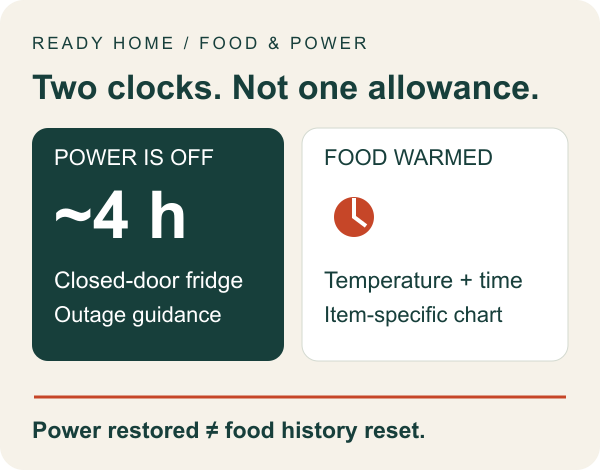
Two clocks that should not be added together
One clock starts when the power fails. The approximately four-hour refrigerator window assumes the door stays closed; it is not four hours of permission for food to remain warm. A different clock concerns actual exposure to elevated temperatures. FoodSafety.gov's refrigerated-food chart uses exposure at 40°F (4°C) or above for more than two hours and lists what to discard or keep by food category.
Do not add those two windows into a six-hour allowance. Nor should a brief return of electricity reset your notes. The useful record is continuous: when cooling stopped, what cold source was available, what was measured and when. If you returned home after an unknown interruption, a cold reading after the compressor has restarted cannot reconstruct the missing interval.[2]
| Situation | Use this evidence | Do not assume |
|---|---|---|
| Known outage; doors closed | Outage duration and any thermometer readings | Four hours is permission for four hours of warm food |
| Ice or cooler maintained cooling | Temperature and transfer record | The presence of ice alone proves every item stayed cold |
| Known warm exposure | FoodSafety.gov's item-specific temperature/time chart | Every food has the same keep-or-discard rule |
| Unknown overnight interruption | Available timeline; conservative action when uncertain | A cold reading after restart proves the earlier interval |
Scroll sideways to read every column on smaller screens.
Move food while there is still a cold-storage plan
CDC advises moving refrigerated perishables to a cooler with ice or frozen packs when the outage reaches four hours, if those supplies are available, and keeping them at 40°F or below. Plan the destination before opening the refrigerator. A cooler without enough cold material is a container, not evidence of temperature control.
For household coordination, assign one person to note the transfer time and thermometer reading. Keep that note with the cooler so a second person does not mistake the transfer for the start of the outage. This is an organizational suggestion, not a new food-storage limit. Do not move food into a questionable temperature history and label it safe merely because it now feels cold.[1]
Make the keep-or-discard decision item by item
The FoodSafety.gov chart distinguishes categories that a blanket 'empty the fridge' rule misses. Under its stated warm-exposure condition, examples marked discard include milk, eggs, cooked leftovers and cut produce; examples marked keep include butter, hard cheese and uncut produce. Those are examples, not a substitute for finding the exact item in the linked chart. Shredded cheese and a block of hard cheese, for example, are not interchangeable entries.
Use the full official chart through the source link below for exceptions and mixed dishes. Appearance, a normal smell and tasting do not establish safety. Cooking is not a rescue plan for food that was inadequately refrigerated: FDA warns it can still cause illness even after thorough cooking. Do not donate food you cannot establish is safe.[2][3]
The freezer is a separate decision
FDA describes approximate closed-door cold-holding windows of 48 hours for a full freezer and 24 hours for a half-full one. These are planning estimates, not a promise for a freezer that was opened repeatedly. Check the remaining ice crystals and measured temperature, then consult the official frozen-food chart for the particular food. Ice cream has a different chart entry from meat; do not refreeze everything under one rule.
Our suggested record uses a separate line for each appliance. A refrigerator-freezer combination can have different conditions in its two compartments. Label the location of each observation so 'the thermometer said 38' does not become evidence for food in another compartment. Record units as well as the number.[3][2]
A short outage note is more useful than a reassuring guess
Here is an illustrative record, not a household test: 'Kitchen refrigerator; power loss noticed 7:10 a.m.; last known powered 6:50 a.m.; door stayed closed; no ice added; checked at 9:00 a.m.; thermometer location and reading recorded.' The twenty-minute uncertainty remains visible. Do not rewrite it as a precisely timed 7:10 outage just because that makes the decision easier.
A useful note separates what you observed from what you inferred. 'Power station display was on' is an observation about the power source; 'food stayed cold overnight' needs different evidence. A smart-plug event log can help establish interruption times, but it is not a food thermometer. Leave unknowns marked unknown and use the conservative official guidance when the record cannot resolve them.
- Appliance and compartment: identify where each reading came from.
- Timeline: last known cooling, failure noticed, transfer and restoration.
- Cold source and access: ice, cooler and significant door openings.
- Decision: item, evidence used, discard or retain, and who checked.
Use the next outage to test the plan—not questionable food
Before another interruption, obtain appliance thermometers and make a workable cooler-and-ice plan. If you are adding backup power, the separate refrigerator-backup guide addresses electrical sizing; the shutdown guide addresses a power station that stops running the refrigerator. Neither gives a food-safety guarantee.
In your critical-load inventory, write the actual objective: maintain verified cold storage, or transfer food before that cannot be maintained. That phrasing forces the plan to include a thermometer, an alternative destination and a person responsible for acting. Buying a larger battery alone does not complete those decisions.[3]
Related reading and tools
Choose the next step for your situation: measure, compare options, or maintain and verify.
- Explore the topicHome Power Backup
- Measure the problemSolar Generator for Refrigerator Backup: Size Watts and Runtime
- Measure the problemHome Backup Power Load Checklist: Build a Critical-Loads Inventory
- Maintain and verifyPortable Power Station Refrigerator Shuts Off: A Troubleshooting Guide
- Maintain and verifyHurricane Power Outage Checklist: Before, During, and After
How this guide was checked
Guides are built from official sources, product documentation, manufacturer manuals, and practical homeowner decision criteria. We do not claim hands-on product testing unless a page explicitly says a product was tested.
- Source-backed editorial review
- 3 cited source records
- Follow device manuals and carbon-monoxide safety guidance. Generators must stay outdoors and away from openings; medical-device users should confirm backup plans with providers.
Ready Home Systems is educational and not a substitute for local code officials, licensed trades, medical providers, water labs, or mitigation professionals.
Read review methodologySources and manuals
- Keep Food Safe After a Disaster or EmergencyCenters for Disease Control and Prevention
- Food Safety During Power OutageFoodSafety.gov
- Food and Water Safety During Power Outages and FloodsU.S. Food and Drug Administration
FAQ
Does turning on a generator make the food safe again?
No. Restoring electricity can resume cooling but cannot establish or undo the earlier temperature history. Resolve the food decision separately from the backup-power decision.
Can I rely on the refrigerator's set temperature?
The setting is what the appliance is trying to achieve, not a record of what happened during the outage. FDA recommends appliance thermometers. Note when and where an actual reading was taken.
Should I taste a small amount before throwing food away?
No. CDC says never to taste food to check its safety. Use the official time, temperature and food-category guidance; discard when uncertainty cannot be resolved.