Before you buy or hire
Warning signs
A pump that runs longer, a pit that falls slowly, unusual vibration, discharge noise inside the basement, repeated backup operation, or an alarm during freezing weather can indicate a restricted outlet. From a safe exterior location, look for an ice plug, buried outlet, crushed extension, or water returning toward the foundation. Do not wait for the pump to overheat or the pit to overflow.
If water is already rising, keep away from wet electrical equipment and call qualified help. An alarm does not establish that the line is frozen; a failed pump, stuck float, closed valve, failed check valve, separated pipe, or inflow above capacity can look similar. Record temperature, pump behavior, outlet condition, and whether water leaves the property.[1][2]
Why discharge lines freeze
Water freezes where it remains exposed long enough below freezing. The Town of Guilderland advises using natural slope and a cold-climate freeze-relief air gap; flat sections and dips work against that drainage and can leave water exposed to freezing. Repeated pump cycles can add water behind a partial restriction until the path closes.
A check valve limits water returning to the pit, which is why the exterior routing must follow an approved freeze-protection design. Zoeller's cited manual explicitly says discharge piping used with a check valve must be protected from freezing and illustrates one model-specific frost-line approach. Pipe size, route, lift, local frost, and code still require project-specific design.[4][6]
Slope and standing-water principle
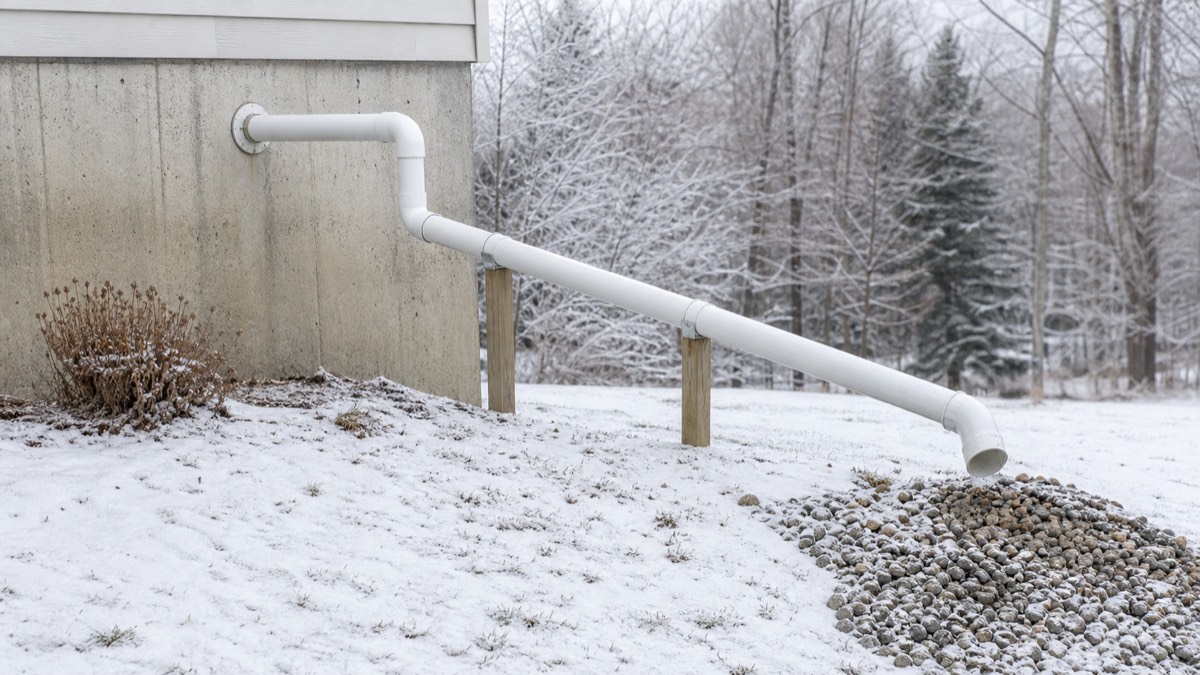
The Town of Guilderland advises using natural slope to move sump discharge away from the foundation. As a conservative drainage check, look for flat sections, dips, or displaced supports that leave visible water after a cycle. Where permitted, support exterior piping to preserve its intended route after soil settlement, snow loading, or movement.
This is a drainage principle, not a universal construction specification. Required diameter, burial, air gap, frost-line protection, storm connection, and outlet location vary with local rules and equipment. Zoeller's example applies to its named drain-pump arrangement; a plumber or drainage contractor should verify the actual pump head and route.[4][6]
Temporary extension-hose risks
The City of Superior advises disconnecting flexible corrugated sump-pump discharge hose during winter to prevent freezing and pump seizure. Flexible extensions can also kink, move, or create dips. Snow and landscaping can obstruct an outlet that was clear during summer.
Before freezing conditions, follow the municipality and installer guidance for the property rather than leaving an improvised extension in place. Never route water onto a sidewalk, neighboring property, septic component, foundation, or prohibited destination. Confirm that removing a hose will not direct water immediately back toward the house.[5]
Exterior outlet inspection
Inspect from a safe, dry route before storms and cold snaps. Guilderland's guidance emphasizes moving discharge away from the foundation by natural slope. Check that the outlet is visible, supported, not submerged, and not directing water toward the foundation or a nuisance area.
Run a controlled water test according to the pump manual and watch the outlet. Confirm that both primary and backup pumps have a viable path. If the pipe flexes, leaks, separates, or the pit does not fall, stop the test and obtain service. Keep hands away from moving floats and energized equipment.[4][3]
Freeze-relief approaches
The Town of Guilderland recommends a cold-climate air gap where the discharge exits the house so the pump has a relief path if the exterior line freezes. Zoeller instead illustrates a model-specific below-frost-line routing approach. These are direct examples of different strategies, not interchangeable instructions or endorsements for every house.
Have a qualified installer choose an accepted air gap, frost-protected route, or other relief arrangement using pump capacity, head, pipe route, local code, and the equipment instructions. Any overflow point must remain visible and send water to a safe location without flooding the foundation or creating a prohibited connection.[4][6]
What not to do
This is Ready Home Systems conservative safety synthesis: do not use an open flame, torch, or uncontrolled high heat on plastic pipe. Do not pour chemicals into the sump or discharge unless the pump manufacturer and local rules explicitly allow them. Do not seal an approved air gap, defeat an alarm, run the pump repeatedly against a suspected blockage, or enter standing water near electrical equipment.
Do not assume heat cable is a universal repair. It must be listed for the pipe and environment, installed with required electrical protection, and kept away from water hazards. Buried, concealed, or inaccessible freezes need professional diagnosis. The durable fix usually removes trapped water or corrects routing rather than continually heating a flawed path.[1][4]
Thaw and flood response
When a line is suspected frozen, limit pump damage and protect people. Call a plumber or pump professional, monitor the pit only from a dry safe area, and use temporary water removal only with equipment and electrical protection appropriate to the environment. If water reaches outlets, panels, appliances, or cords, stay out and follow emergency guidance.
After a safe thaw, inspect for split pipe, loose joints, failed check valve, displaced supports, and water discharged near the foundation. Test primary, backup, and alarm through documented procedures. Record where ice formed; Guilderland's slope and air-gap guidance can then inform a local professional's correction before the next freeze.[1][4]
Local-code and professional triggers
Use a professional when permanent pipe changes, burial, storm-sewer connection, heat cable, an air gap, sewage handling, or electrical work is involved. Local authorities determine allowed discharge destinations and frost-related construction. Manufacturer guidance sets pump head, pipe, check-valve, and test requirements. Both boundaries matter.
Seek prompt service when the pump runs without lowering water, a line repeatedly freezes, the outlet cannot be located, discharge returns to the foundation, check valves slam, backup runtime is being consumed, or any electrical area becomes wet. Repeated freezing is a design signal, not normal winter maintenance.[4][6]
Seasonal checklist
Before freezing weather, locate and photograph the outlet, remove snow or debris, verify continuous support and positive slope, follow local instructions for flexible hoses, run a water test, confirm alarm delivery, and review battery status. Repeat the exterior check after snow, landscaping work, or a thaw-freeze cycle.
During travel, arrange a responder who can enter safely and understands that a high-water alert requires action, not merely silencing. After spring thaw, inspect supports and joints disturbed by frost. Keep the results with the pump, battery, alarm, and discharge service log so recurring patterns are visible.[4][5][3]
| Observation | Likely risk | Safe next check |
|---|---|---|
| Sag or uphill exterior run | Standing water | Have slope and support corrected |
| Outlet buried by snow | Blocked termination | Clear safely and test discharge |
| Pump runs but pit stays high | Blocked line or pump-system failure | Stop repeated testing and call service |
| Recurring freeze at same location | Persistent design defect | Professional routing or relief review |
Related reading and tools
Sources Used
- FloodsReady.gov / Federal Emergency Management Agency
- Urban Flooding: Guidance for Homeowners and RentersFederal Emergency Management Agency
- AquaNot Key ProPak Installation InstructionsZoeller Pump Company
- Residential Stormwater Management: Sump Pumps and Roof DrainsTown of Guilderland, New York
- Sewer Smarts and Plumbing BasicsCity of Superior, Wisconsin
- Zoeller Drain Pump Installation InstructionsZoeller Pump Company
FAQ
Will insulation keep a sump line from freezing?
Insulation can slow heat loss but cannot reliably protect water trapped in a poorly drained exposed line. Correct slope, support, outlet, and an approved relief strategy are more fundamental.
Can I thaw the line with a torch?
No. Open flame and uncontrolled heat can damage pipe and create fire or burn hazards. Use qualified service and a method appropriate to the pipe and wet electrical environment.
Should I disconnect the outside hose for winter?
If it is a temporary extension that traps water, it may need removal or replacement, but first confirm the remaining outlet sends water safely away and complies with local rules.
Related guides
Best Sump Pump Battery Backup: How to Choose Before the Storm
The best backup sump pump is the one that moves enough water for your pit, runs long enough for your outage risk, and alerts you before the basement becomes a claim.
Primary and Backup Sump Pump Maintenance Checklist
Maintain the sump system as one chain: pit, primary pump and float, backup pump and float, battery and controller, alarm, check valves, discharge, power, and the person who responds. Use installed manuals for intervals and procedures.
How Often Should a Sump Pump Backup Battery Be Replaced?
Replace a backup battery according to its system manual and condition, not a universal calendar. Age is one input; warnings, test performance, chemistry, charging, temperature, terminal condition, and the home's storm exposure determine how much margin remains.