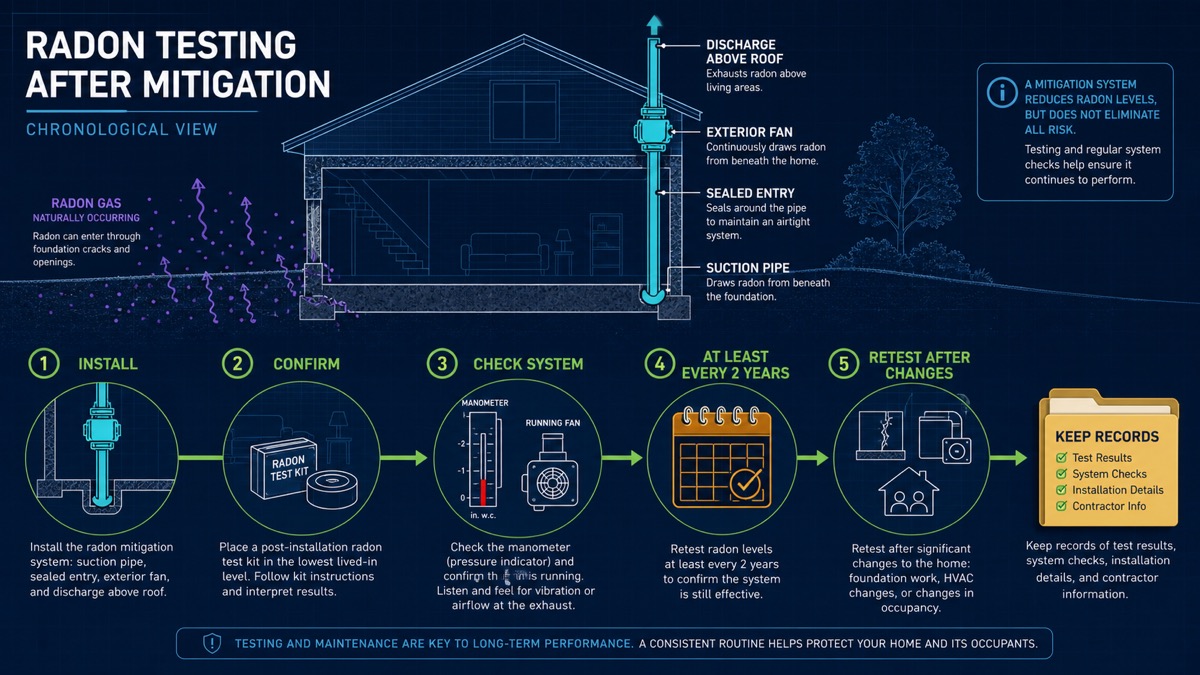
Create the commissioning and retest record before installation closes
Open one commissioning and retest record with the pre-mitigation report, contractor and credential check, final system description, startup date and time, fan or passive status, warning-device baseline, operating instructions, warranty, agreed performance response, tester, device or laboratory, placement, test duration, closed-house plan, report recipient, and action owner. Assign the measurement before final payment or handoff makes the responsibility ambiguous.
EPA's current consumer guide says the post-mitigation radon test should begin no sooner than 24 hours after the system is operating and should occur within 30 days of installation. It recommends a two-to-seven-day measurement for effectiveness and an independent follow-up measurement to reduce conflict of interest. Applicable state requirements and current device instructions may add conditions; record them rather than inventing a local rule.
Keep the system operating normally during the test and record any deviation in doors, windows, severe weather, device movement, fan status, power loss, HVAC operation, or test timing. Do not hide an incident or average a suspect run into an acceptance result. Ask the qualified tester or state radon program whether the event invalidates the measurement and whether a new test is required.[2][1][3]
Separate system indicators from radon verification
Record the normal warning-device or manometer indication at handoff and check it at the interval given by the contractor and system instructions. A changed indicator, stopped fan, unusual noise, damage, condensate issue, or loss of power is a service signal. A warning device or indicator does not measure room radon concentration and is not a radon test.
After commissioning, schedule the next radon measurement at least every two years, then add earlier event rows for major renovation, a new foundation area, changed HVAC or mitigation equipment, new occupancy of a lower level, system shutdown or repair, or other state-program triggers. Use the test location and conditions appropriate to the decision; copying the old device location without reviewing changed use can miss the relevant occupied area.
If a valid follow-up result does not meet the agreed target or is at or above EPA's action level, give the full record to the qualified mitigator and follow the contract response and state guidance. Do not adjust the fan, close combustion or makeup air, alter piping, or represent one lower display reading as proof for the whole building.[1][2]
Retest at least every two years
EPA describes retesting at least every two years as a good idea for checking that levels remain low. Put the reminder on your calendar and keep the completed result with the commissioning report. Equipment inspections and radon measurements should have separate entries so that a service visit is not mistaken for a completed test.
Moving regular activities into a previously unoccupied basement, renovating or changing the tested area can create a reason to test sooner. Ask the state radon program or your mitigator about the appropriate timing after a repair or system fault. Treat the calendar reminder as a routine check, not a guarantee that one interval fits every home.[1][4]
Testing conditions still matter
Place the detector according to its instructions—away from drafts, high heat, high humidity, exterior walls, and locations that do not represent occupied air. Maintain required closed-building conditions for short-term tests and operate the mitigation system normally unless the test protocol says otherwise. Do not open windows, move the device, or change fan operation to influence the result. Note unusual storms or conditions requested by the laboratory.
Continuous monitors are convenient but need correct placement, calibration or quality procedures, and an understanding of daily variability. A single hourly peak is not interpreted like a completed EPA test. Charcoal or other laboratory devices need correct activation, sealing, and prompt shipping. For real-estate, legal, or disputed results, use a qualified independent measurement professional according to state requirements.[3][2]
Maintenance and expected service
EPA compares radon systems with furnaces or chimneys that need occasional maintenance and notes that fans may last five years or more, while warranties often do not exceed five years. That is context, not a fixed replacement interval. Keep the fan model, warranty, installer, circuit, disconnect, pipe labels, exhaust location, indicator baseline, and service records. Do not wait for a real-estate test to discover that a fan stopped months earlier.
Inspect visible piping, supports, seals, labels, electrical components, exterior exhaust, and condensation management without disassembling the system. Do not enter crawlspaces or roofs unsafely, open energized fan wiring, or redirect exhaust. A failed fan should be replaced with a compatible unit selected for the designed suction and foundation, not merely the cheapest fan that fits the pipe. Retest after repair.[1][2]
Building changes can change performance
Finishing a basement, adding rooms, changing doors, sealing crawlspaces, installing powerful exhaust appliances, replacing HVAC equipment, modifying a sump cover, or opening foundation slabs can change air pressure and radon entry. Notify the mitigator before consequential work when possible and protect system piping. After the work, inspect indicators and perform a new radon test rather than assuming the original design covers the altered building.
Energy improvements can also change infiltration and pressure. Air sealing is valuable, but it should not be used as the only radon remedy and may require retesting. Keep radon-system penetrations sealed as designed and do not use its pipe for other drainage or ventilation. If a new addition creates another foundation zone, the suction field may need evaluation by a qualified mitigator.[2][3]
Responding to a high follow-up result
Confirm test quality and call the mitigator or state radon program. Provide the original pre-mitigation tests, system design, commissioning result, current indicator, maintenance, building changes, and new test. The professional may examine fan operation, pressure-field extension, seals, exhaust, foundation zones, and competing air systems. Do not disable the fan while deciding unless an electrical or mechanical emergency requires shutdown.
Radon reduction lowers risk but does not create a zero-risk certificate. Continue the routine test cycle after corrective work. During a sale, disclose records as required and avoid presenting an old result as a lifetime guarantee. A durable system is one whose operation is visible, maintenance is documented, building changes trigger review, and measured indoor radon remains the final performance check.
Create a one-page handoff for the property: system type, fan and circuit, normal indicator, installer, warranty, exhaust location, prohibited alterations, commissioning result, next test date, and state radon contact. Give it to future occupants and contractors before roofing, electrical, sump, HVAC, or foundation work. Protecting this information is part of keeping the mitigation system effective over the life of the home.
If monitoring suggests a failure, reduce time in the affected area when practical while arranging guidance, but do not invent an emergency threshold from a single device reading. Confirm conditions using the proper test process and follow health-agency advice. The durable response is measured verification and qualified correction, not alarm fatigue or repeated relocation of a consumer monitor.[2][3][1]
| Record stage | Required evidence | Decision | Boundary |
|---|---|---|---|
| Startup | Date, final system, indicator baseline, instructions | System is ready for verification | Indicator is not a radon measurement |
| Commissioning test | No sooner than 24 hours, within 30 days, method and conditions | Valid independent result and response | Document incidents; do not accept a suspect test |
| Routine retest | At least every two years and applicable state schedule | Confirm levels remain reduced | One commissioning result is not permanent clearance |
| Change event | Renovation, occupancy, HVAC or mitigation work | Qualified placement and earlier retest | Old location may not answer the new use |
Scroll sideways to read every column on smaller screens.
Before you buy or hire
Related reading and tools
Choose the next step for your situation: measure, compare options, or maintain and verify.
- Explore the topicIndoor Air, Radon, and Mold
- Measure the problemChoosing a Radon Test: Match the Kit and Protocol to Your Decision
- Measure the problemDigital Radon Detector vs Charcoal Kit: Which Test Should You Use?
- Measure the problemMold Test Kit for Home: When Testing Helps and When It Distracts
- Measure the problemIdeal Basement Humidity to Prevent Mold: Targets and Troubleshooting
How this guide was checked
Guides are built from official sources, product documentation, manufacturer manuals, and practical homeowner decision criteria. We do not claim hands-on product testing unless a page explicitly says a product was tested.
- Source-backed editorial review
- 4 cited source records
- Radon and mold decisions can affect health. Follow EPA/CDC guidance and use qualified mitigation or remediation pros when levels, area, or symptoms justify it.
Ready Home Systems is educational and not a substitute for local code officials, licensed trades, medical providers, water labs, or mitigation professionals.
Read review methodologySources and manuals
- How do I know if my radon mitigation system is working properly?U.S. EPA
- Consumer's Guide to Radon Reduction (2025)U.S. EPA
- A Citizen's Guide to RadonU.S. EPA
- How often should I test/retest my home for radon?U.S. EPA
FAQ
When should the first post-mitigation test begin?
EPA says no sooner than 24 hours after the system is operating and within 30 days of installation. Follow current state and device requirements as well.
Does a normal manometer mean the radon level is low?
No. It indicates a system pressure condition, not indoor radon concentration. Only a valid radon measurement verifies the result.
Who should perform the verification?
EPA recommends an independent follow-up measurement. Assign the qualified tester, device, cost, report recipient and response before the project closes.
When should I retest later?
EPA advises at least every two years and after relevant changes such as renovation, changed lower-level occupancy or system work. State guidance may be more specific.