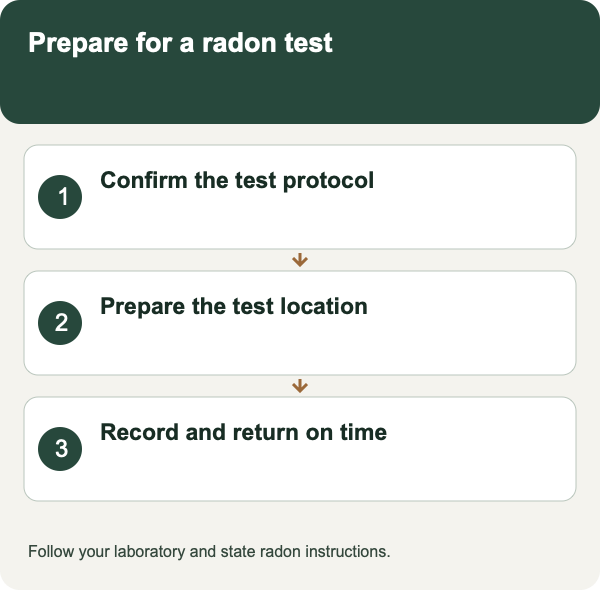
Start by naming the decision the test must support
Write one sentence at the top of your notes: this test is for ordinary household screening, a home purchase, a planned basement conversion, or checking an installed mitigation system. Those purposes are not interchangeable. CDC identifies renovations and changes that increase time spent on a lower level as reasons to test. For a transaction, ask the responsible tester which protocol applies before choosing the date or room.
This checklist assumes you already have a device or testing appointment. It does not rank kits or decide which model to buy. If that choice is still unresolved, use our radon test-kit guide first. For preparation, the useful deliverable is a complete test record that another person can understand without guessing what happened in the house.[3][2]
Read the entire instruction sheet before opening anything
Find the required exposure period, activation method, placement directions, expiration information if provided, laboratory address, registration requirements, and return deadline. A charcoal kit and a digital monitor do not share one universal start procedure. Short-term testing can cover different durations; use the instructions for the actual device rather than assuming every kit runs for two days.
Prepare the administrative pieces while the detector remains unopened: a pen, calendar reminders, device identification, laboratory contact details, and a place to store the report. Check who will be present at the finish. If you cannot complete the paperwork or arrange return shipment on the intended day, choose another start date instead of trying to reconstruct the timing later.[3][4]
- Record the kit or monitor identification exactly as printed.
- Photograph the instructions so they remain available after the return package is sealed.
- Write down the laboratory’s question channel before the test begins.
Choose the room and a stable placement location
EPA’s ordinary homeowner guidance places a test on the lowest regularly lived-in level, in a frequently used room rather than a kitchen or bathroom. Its citizen guide specifies at least 20 inches above the floor, away from drafts, exterior walls, high heat, and high humidity. Follow the device instructions and any applicable measurement protocol if they require a more specific location.
For a purchase, the relevant level may instead be the lowest area that could be used regularly, even if the current owner rarely enters it. Decide that question with the tester. Mark the chosen spot in your notes, photograph its surroundings, and explain to everyone at home that the device must remain there. A convenient shelf is not suitable merely because it keeps the kit out of sight.[1][2]
Arrange closed-house conditions without compromising safety
For EPA’s two- or three-day short tests, windows and exterior doors should be closed at least 12 hours before starting and kept closed during the test, apart from ordinary entry and exit. Do not treat this as a rule only for the room containing the detector. Avoid scheduling these very short tests during unusually severe storms or unusually high winds.
Normal heating and cooling need not simply be switched off. EPA distinguishes recirculating equipment from equipment that brings outside air inside, and an existing radon-reduction system should remain operating. If you cannot identify how a ventilation system works, ask the tester rather than changing its controls. Never block combustion-air openings or compromise safe temperatures to preserve a test; pause planning and obtain situation-specific directions.[1][2][6]
Use a household handoff note and an incident log
An effective household note answers four questions: where is the test, when does it end, what conditions must stay unchanged, and whom should someone contact if a problem occurs? Give the same information to cleaners, visitors, contractors, and anyone who might open windows or move furniture. Explain the purpose plainly; the note is coordination, not a substitute for the laboratory’s protocol.
At the start, record the actual date and time, not the time you expected to begin. During testing, note any known disturbance, prolonged open window, severe weather, power interruption affecting an electronic device, or change to the mitigation system. Do not edit an inconvenient observation out of the record. Ask the lab or tester whether the event affects interpretation or requires a new test; there is no responsible universal correction factor.[2][4]
Close the test carefully and protect the record
At the instructed finish, record the actual stop time and complete the device’s sealing and return steps. EPA advises sending a completed lab-analyzed kit promptly. The package instructions control the acceptable shipment window and handling method. Keep a copy of the identifying information and submission details so you can match the eventual report to the correct room and exposure period.
Use a simple editorial filing system: one folder for instructions, placement photo, start and stop times, disturbance notes, return confirmation, and the final report. Assign one household member to check that the result arrives. A kit dropped in the mail is an unfinished decision until the report has been reviewed. If the laboratory rejects the sample, preserve its explanation and correct that specific preparation problem before repeating.[1][4]
Give each household task an owner
The following is an editorial coordination example, not an additional testing standard. Put three names or initials on the calendar: the person preparing the house, the person recording the start, and the person ending and returning the test. They may all be you. Assigning the jobs makes it easier to spot a practical gap before the device is exposed, especially when work schedules, travel, or property access are involved.
Beside those names, add a short question list for the laboratory: which room fits this purpose, which ventilation controls need discussion, how quickly must the sample arrive, and what should we report if conditions change? Keep the answers with the instruction sheet. This approach avoids passing an incomplete verbal message between household members. It also leaves a clear place to record an unresolved question rather than quietly replacing the laboratory’s directions with a remembered internet tip.[4]
Plan the follow-up before the number arrives
A short-term screening result is not an annual exposure measurement. CDC distinguishes short tests from tests lasting more than 90 days, which better represent longer-term conditions. Follow the applicable guidance for confirmation rather than declaring the home safe or unsafe from an isolated display reading. Keep units, test duration, and any laboratory qualifications attached to the number.
EPA recommends fixing homes at 4 pCi/L or above and considering reduction between 2 and 4 pCi/L; it does not describe lower results as risk-free. Initial short-test follow-up is part of the decision pathway. For elevated results, a disputed or interrupted test, unusual building layouts, or a time-sensitive transaction, contact the state radon program or a qualified measurement professional. Ask about required qualifications locally rather than assuming a generic certificate answers every jurisdiction’s requirements.[3][5][4]
| What is unresolved? | Next action | What not to assume |
|---|---|---|
| Test purpose or room | Confirm screening versus transaction instructions before placing the device. | The lowest currently occupied room fits every purpose. |
| Exposure or return timing | Choose dates that fit the actual instructions and laboratory arrangements. | Longer exposure automatically repairs a missed deadline. |
| Required conditions cannot be maintained safely | Ask the tester for another schedule or method. | Testing takes priority over safe indoor conditions. |
| Device moved or conditions changed | Preserve the event record and ask the laboratory or tester. | A result can be corrected by an invented percentage. |
Before you buy or hire
Related reading and tools
Choose the next step for your situation: measure, compare options, or maintain and verify.
- Explore the topicIndoor Air, Radon, and Mold
- Measure the problemBest Radon Test Kit: Short-Term, Long-Term, or Digital Monitor?
- Measure the problemDigital Radon Detector vs Charcoal Kit: Which Test Should You Use?
- Maintain and verifyRadon Testing After Mitigation: When and How to Retest
How this guide was checked
Guides are built from official sources, product documentation, manufacturer manuals, and practical homeowner decision criteria. We do not claim hands-on product testing unless a page explicitly says a product was tested.
- Source-backed editorial review
- 6 cited source records
- Radon and mold decisions can affect health. Follow EPA/CDC guidance and use qualified mitigation or remediation pros when levels, area, or symptoms justify it.
Ready Home Systems is educational and not a substitute for local code officials, licensed trades, medical providers, water labs, or mitigation professionals.
Read review methodologySources and manuals
- A Citizen’s Guide to RadonU.S. Environmental Protection Agency
- Home Buyer’s and Seller’s Guide to RadonU.S. Environmental Protection Agency
- Testing Your Home for RadonCenters for Disease Control and Prevention
- Find a Radon Test Kit or Measurement and Mitigation ProfessionalU.S. Environmental Protection Agency
- What is EPA’s Action Level for Radon and What Does it Mean?U.S. Environmental Protection Agency
- Protocols for Radon and Radon Decay Product Measurements in Homes, Section 2.3.2U.S. Environmental Protection Agency
FAQ
Can we stay home during a radon test?
Yes, ordinary occupancy and brief entry or exit are compatible with EPA’s closed-house guidance. Coordinate household activity and follow the applicable instructions. A radon test is not a reason to ignore an emergency or remain in unsafe indoor conditions.
Should I use the same room as my previous test?
Keep prior room information available, but first confirm the purpose of this test. A planned basement bedroom, renovation, transaction, or post-mitigation check can change the appropriate measurement plan. Ask a qualified tester when comparability and the correct location appear to conflict.
Can I decide that an interrupted test is invalid myself?
Tell the laboratory or responsible tester what happened and when. Preserve the report and disturbance notes. They can explain whether their protocol permits interpretation, requires a qualification, or calls for a repeat; this checklist cannot certify a test.
Related guides
Air Purifier vs Dehumidifier for Mold: Different Jobs, Different Limits
Compare HEPA air cleaners and dehumidifiers for mold: one reduces airborne particles while the other controls humidity, but neither repairs moisture sources.
Basement Condensation vs. Water Seepage: How to Sort the Clues
Compare condensation, seepage, and plumbing-leak clues before buying basement equipment. Record weather and moisture patterns, and know when to call a pro.
Dehumidifier Running but Not Lowering Humidity: What to Check
Check airflow, condensate, room temperature, settings, and incoming moisture when a dehumidifier runs without lowering humidity. Know the service stop points.