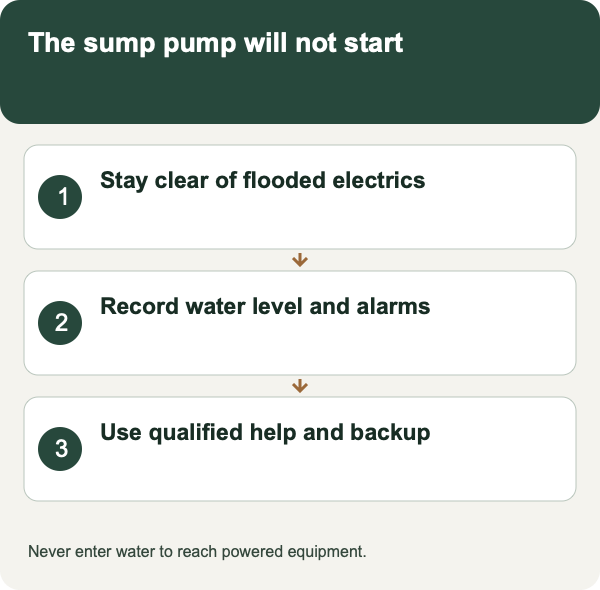
Treat rising water and electrical exposure as the first decision
Do not enter standing water to reach a pump, receptacle, breaker panel, battery controller, or extension cord. CDC says never operate electrical controls or appliances while standing in water. If access is wet, stay out and contact an electrician or emergency services as appropriate to the danger. Do not assume a submersible pump makes every nearby electrical connection safe underwater.
From a dry location, identify whether water is contained in the basin or escaping across the floor, and whether its level is rising. If an alarm is sounding or water is approaching electrical equipment, call for urgent assistance while following your established flood plan. The purpose of observation is to communicate the situation, not to earn permission to enter a hazardous basement.[1]
Confirm that the pump should be running at this water level
A sump pump does not normally run whenever any water is visible. Its control starts it at a particular level and stops it at a lower one. Liberty Pumps’ troubleshooting instructions include insufficient water to activate the switch among explanations for a pump that does not start. The applicable level depends on the exact pump and switch arrangement; no universal number of inches fits every basin.
Use previous normal operation, installation records, and the exact-model manual to identify the expected starting point. If you have none of those, describe the current water level relative to visible landmarks rather than guessing. Do not add water to an already high or actively rising pit as an experiment. A routine controlled test belongs in the maintenance workflow after the immediate risk has been resolved.[2]
Distinguish a house outage from a pump-specific power problem
Check information already available from safe locations: are other household circuits operating, does the pump controller show AC power, and has a utility outage been reported? If the receptacle and surrounding area are unquestionably dry and safely accessible, visually confirm that the existing plug has not been displaced. Do not unplug unknown devices or assume two cords in the pit serve the same pump.
Record any tripped breaker or GFCI indication for the electrician. Do not repeatedly reset protection, replace it with a different rating, bypass grounding, or move the pump to an unprotected outlet to keep it running. The cited Campbell Hausfeld manual directs electrical issues to qualified help and identifies both a faulty pump and a faulty GFCI as possible causes of a trip. A trip therefore does not by itself identify which component failed.[3]
Observe the float without reaching into an energized pit
If the float is visible without opening a sealed cover or entering an unsafe area, note whether a cable, basin wall, debris, or nearby equipment appears to restrict it. A pump may have shifted since its last normal run. Take a photograph from a stable, dry position if possible. Apparent obstruction is a useful lead, not proof that the switch or motor is otherwise healthy.
Do not reach into the basin, push the float with a stick, pull on a cord, bypass a piggyback switch, or run the motor by defeating its control. This guide intentionally stops at observation. A service technician can isolate the correct power sources and determine whether the issue is clearance, a defective switch, wiring, or the pump itself. Backup equipment adds another power source that makes assumptions about isolation particularly risky.[2][3][5]
Use the sound and recent history to narrow the report
Completely silent, humming without moving water, and running without lowering the level are different symptoms. Tell the technician which one you observed and when it began. A pump that hums is not the same troubleshooting problem as a controller that never commands a start. Avoid moving closer to listen if doing so takes you into water or near exposed electrical equipment.
Some pump motors have thermal protection and may restart automatically after cooling. The Campbell Hausfeld manual expressly warns about unexpected restart. Do not treat a quiet motor as disconnected or safe to handle. If the pump ran heavily before going silent, record that history and any visible warning; it supports the technician’s investigation but does not prove overheating or justify repeated restart attempts.[3][2]
Check the discharge clue from outside, if access is safe
NDSU Extension advises checking for a frozen or plugged discharge and verifying that water is directed away from the house. During an active problem, restrict yourself to a safe visual look at an accessible outlet. Record visible ice, a crushed hose, snow burial, or water returning toward the foundation. Do not climb into floodwater or handle energized outdoor equipment to obtain a better photograph.
A blocked discharge more directly explains a pump that runs without moving water, but the recent sequence matters if the pump later stops. Report both observations. Leave thawing, pipe disassembly, check-valve work, and rerouting to an appropriate professional. Do not detach a line to dump water beside the foundation or improvise a sewer connection; the immediate symptom does not establish a safe discharge design.[4][3]
Read the backup system as a separate system
If you already have a battery backup, identify its controller and status lights without assuming a green light means every part works. Record AC status, battery warning, float fault, and whether the backup is actually lowering the water. Zoeller’s backup manual distinguishes these failure paths and notes that a weak battery can recharge yet provide insufficient useful service; charging status is not a capacity test.
Use only the ordinary user controls documented for your installed system, and do not open battery cases, bridge terminals, replace fuses by guesswork, or disconnect leads during an emergency. If the backup is carrying the load, contact service for the failed primary pump rather than waiting for the backup to be exhausted. Ask the technician what continued monitoring is necessary while you wait.[5]
Call the right professional with a concise evidence packet
A rising pit with no effective pump, recurrent electrical trips, damaged wiring, uncertain electrical safety, or a pump that will not start at its documented level is a stop point. Electrical supply and protection problems need an electrician; pump controls, pump replacement, and discharge problems generally need an appropriate pump or plumbing professional. If the cause is uncertain, explain the symptom and let the service provider coordinate the necessary trade.
Prepare the model number from existing records, time first noticed, water-level trend, visible indicators, previous unusual sounds, backup performance, and any safe photographs. State explicitly what you did not check because it was inaccessible or unsafe. Ask the provider to confirm both water removal and automatic restart/stop behavior after repair. Silence ending once is not the same as reliable automatic operation.[1][2][4]
After repair, close the monitoring gap
Move scheduled testing and cleaning back into the separate primary-and-backup maintenance checklist. Ask the technician to document the normal activation level, identify each cord and controller, and explain any alarm. If nobody was alerted until the pit was nearly full, use the high-water alarm guide to assess the warning gap rather than assuming the replacement pump alone solves it.
Use the sump backup runtime tool only for later planning with appropriate inputs and stated assumptions. It cannot predict the remaining time in an emergency from a battery light or a rising-water photograph. Keep this incident’s notes with the maintenance record so the next unusual cycle can be compared with the installed system’s known normal behavior.[4][5]
| Observation | Possible explanation | Safe next step |
|---|---|---|
| Low, stable water below the documented start point | No call for pumping yet. | Compare with the manual and normal operation record. |
| High or rising water; pump silent | Power, control, or motor problem. | Call promptly; report visible indicators without entering the pit. |
| Protection trips or wiring looks damaged | Electrical fault needing diagnosis. | Stop resets and request an electrician. |
| Backup runs; primary remains silent | Primary system failure while backup carries demand. | Arrange service and monitor from a safe location. |
| Standing water near electrical equipment | Potential shock hazard. | Stay out; obtain emergency or qualified electrical help. |
Before you buy or hire
Related reading and tools
Choose the next step for your situation: measure, compare options, or maintain and verify.
- Explore the topicSump Pump Backup
- Measure with a toolSump Pump Battery Runtime Calculator
- Maintain and verifyPrimary and Backup Sump Pump Maintenance Checklist
- Maintain and verifySump Pump High-Water Alarm: Local, Wi-Fi, or Cellular?
- Maintain and verifyHow to Keep a Sump Pump Discharge Line From Freezing
How this guide was checked
Guides are built from official sources, product documentation, manufacturer manuals, and practical homeowner decision criteria. We do not claim hands-on product testing unless a page explicitly says a product was tested.
- Source-backed editorial review
- 5 cited source records
- Backup pump sizing depends on pit inflow, lift height, discharge path, battery age, and local flood risk. Check manufacturer instructions and local code.
Ready Home Systems is educational and not a substitute for local code officials, licensed trades, medical providers, water labs, or mitigation professionals.
Read review methodologySources and manuals
- Safety Guidelines: Reentering Your Flooded HomeCenters for Disease Control and Prevention
- S30-Series Builder Series Sump Pumps Installation ManualLiberty Pumps
- Submersible Sump Pump Operating Instructions: 33CHF and 50CHFCampbell Hausfeld / WAYNE Pumps
- Check Your Sump Pumps NowNorth Dakota State University Extension
- Aquanot Backup System Installation and Troubleshooting Manual, FM3120Zoeller Pump Company
FAQ
Should I lift the float to make the pump start?
Not as an emergency workaround. Do not reach into or manipulate an energized pit. Record visible restrictions from a safe position and have the system assessed. Any owner test must follow the installed equipment’s instructions under safe, controlled conditions.
Can I wait because the backup pump is working?
Arrange service for the primary failure promptly. A backup provides limited protection and may have its own battery, flow, or discharge constraints. Continue safe monitoring and follow the service provider’s advice rather than assuming a status light guarantees coverage.
Does a silent pump always need replacement?
No. Water below the activation point, missing power, a restricted or failed switch, and a motor issue can look similar from a distance. Proper diagnosis matters, but rising water or electrical hazards take priority over extending household troubleshooting.
Related guides
Best Sump Pump Battery Backup: How to Choose Before the Storm
Choose a sump pump battery backup by measured inflow, pump-curve capacity at actual lift, supported battery, alarms, testing, and flood consequences.
Generator vs Battery Backup for a Sump Pump
Compare generator and battery sump-pump backup by automatic response, runtime, startup load, fuel, maintenance, storm access, and safe system design.
How to Size a Sump Pump: Flow, Lift, Pit Inflow, and Horsepower
Size a sump pump by measured inflow, flow at actual lift, pipe losses, pit geometry, and backup capacity instead of choosing by horsepower alone.