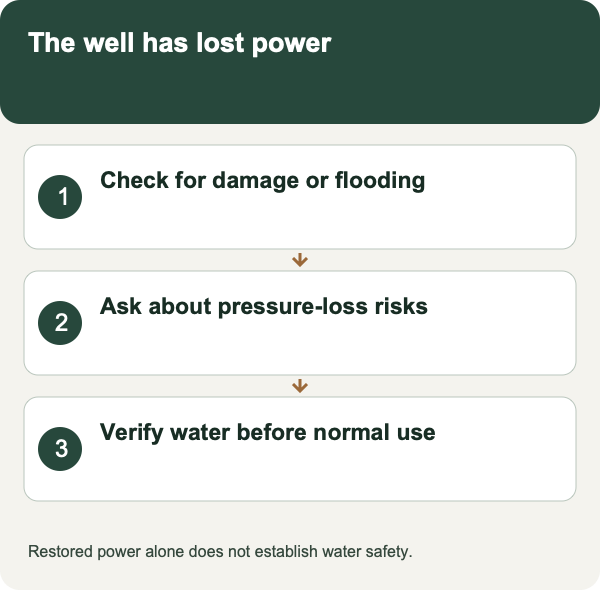
Start with the pressure history, not the taste
Iowa DNR recommends drinking-water testing after a power outage in which a private supply loses pressure, and a known-safe alternative while awaiting satisfactory results. Michigan's emergency guidance explains why: opening fixtures consumes the stored pressurized supply when the electric pump cannot replenish it. Leaks or other vulnerable connections can then provide a contamination pathway. Water may still look, taste, and smell ordinary.
Write down what you actually know: when electricity failed, whether someone used water, whether a gauge was observed, and whether any fixture stopped flowing. Mark an unobserved interval as unknown. A gauge reading taken after restoration cannot reconstruct the earlier event. If pressure apparently remained normal, tell your health department that too; do not turn that observation into a blanket safety certificate. This guide addresses a specific disruption, not the routine annual testing schedule.[1][2]
Set up a temporary safe-water routine
Use unopened commercially bottled water or another supply confirmed safe for drinking, food preparation, brushing teeth, and other uses covered by local instructions. Pause ice making and communicate the precaution to everyone in the home. A note at the kitchen sink is more useful than assuming visitors remember a conversation. Ask specifically about bathing, dishwashing, pets, and vulnerable household members if the local advice does not cover them.
CDC recommends at least one gallon per person per day for three days and, if possible, a two-week reserve; some households need more. This is an emergency planning baseline, not an allowance for normal household consumption. Do not assume boiling fixes every problem. CDC states that fuel or toxic chemical contamination cannot be made safe by boiling or disinfecting. Report a spill or fuel odor and request a different supply rather than choosing a home treatment recipe.[3][4]
Keep mechanical troubleshooting observational
Once power returns, note whether flow resumes, whether an accessible gauge changes, and whether the pump seems to cycle unusually often. From a safe, dry position, look for visible pipe leaks or damaged equipment. Give these observations to a well contractor. No flow could involve a pump, controls, the well itself, or plumbing; an outage does not identify the failed part.
Do not remove electrical covers, bridge pressure-switch contacts, repeatedly reset a tripping breaker, or attempt an unfamiliar pump-priming procedure. Stop if wiring, controls, or the surrounding area are wet or damaged. A contractor's visit becomes more efficient when you have the well completion record, pump information, treatment layout, and earlier service notes ready. Keep the report factual: 'water stopped at 7 a.m.' is better evidence than 'the pressure tank failed.' The site's short-cycling guide provides background, but electrical or pump repair remains professional work.[7][8][6]
Arrange event-specific testing before collecting a sample
Contact the county or state health department and a laboratory certified for drinking-water testing. Explain the pressure loss, storm conditions, repairs, and any nearby contamination concern. Ask which microbial analyses are needed and whether the event warrants chemical testing. A routine test ordered last month cannot answer what happened during this outage.
Ask the laboratory which tap to use, whether treatment changes sample location, what preparation is required, which bottle it supplies, and how quickly the sample must arrive. Do not improvise collection into a kitchen jar. Also ask how any proposed disinfection changes sampling timing. Record who will interpret the result and tell the household when normal use may resume. Our lab-report helper can organize reported values, but it cannot clear an affected water supply or replace the laboratory's collection instructions. Keep a dated copy of the result with the event record.[5][1]
Treat flood exposure as a different branch
A storm outage and a flooded well are not interchangeable events. If floodwater surrounded or overtopped the well, or damage created an entry path, stop treating this as a simple restart. EPA says to stay away from a flooded well pump because of shock risk and not to drink or wash with flooded-well water. A well or pump contractor and local health officials should guide inspection, cleaning, disinfection, and testing.
CDC recommends professional well disinfection after an emergency because this work can be hazardous. Do not add an estimated quantity of bleach because the water looks cloudy, and do not infer clearance because flushing makes it look clear. Tell the contractor about all connected equipment and any suspected sewage, fuel, or chemical exposure. Keep family members away from flooded equipment while you arrange assistance; taking a close-up photograph is not worth entering an unsafe area.[5][6]
Include treatment equipment in the restart conversation
Make a list of the equipment between the well and the drinking tap: sediment housings, softeners, filters, UV equipment, chemical-feed equipment, storage, and point-of-use units. For each, record the model, any displayed alarm, whether it lost power, and whether it was bypassed or exposed to floodwater. This is an information checklist, not permission to change valve positions or disable alarms.
Ask the installer for the exact restart and sanitation procedure applicable to that configuration. What does a normal status display mean? Was any water used while treatment was unavailable? Does a repair require additional sampling? Who verifies downstream plumbing is ready? Those questions prevent a narrow pump repair from being mistaken for a whole-system assessment. A generic filter label does not establish suitability for a newly identified contaminant; treatment decisions should follow the identified problem and professional advice.[5][7]
Prepare a small handoff packet for the next outage
Our suggested packet has four pages: household water needs; well and treatment identification; service and laboratory contacts; and an event log. Add a photograph of the normal equipment arrangement, without removing covers. Include the location of your bottled supply and the person responsible for replenishing it. Store an offline copy so a failed internet connection does not erase the plan.
During an outage, follow the prearranged system plan and limit unnecessary water withdrawal. If freezing also threatens the house, contact your plumber: conserving pressure and winterizing plumbing are different objectives and need a coordinated decision. After recovery, add the actual repair, sample results, and return-to-use advice to the packet. Note one improvement to complete before the next storm, such as refreshing contact numbers or making the supply accessible to a household member who cannot lift heavy containers.
For the service call, separate confirmed events from estimates. A useful message might say that electricity returned this morning, the last recorded pressure was yesterday afternoon, no one watched the gauge overnight, and a filter alarm remains visible. Then ask two separate questions: what is needed to restore reliable supply, and what is needed before drinking it? Keep the answers in separate boxes on the log. This prevents a successful mechanical repair from silently closing the outstanding water-quality question.[2][4][7]
| Observation | Next action | What it does not establish |
|---|---|---|
| Pressure lost or history unknown | Use known-safe water; arrange local advice and testing | Clear water is not microbiological clearance |
| Power restored but flow absent | Call a well contractor with the event and equipment record | A failed pump is not the only possible cause |
| Flooded well or wet electrical controls | Stay away; coordinate professional inspection and water precautions | Restored electricity does not make equipment safe |
| Flow and pressure appear normal | Complete the applicable sampling and treatment restart plan | Mechanical recovery and drinking-water safety are separate decisions |
Before you buy or hire
Related reading and tools
Choose the next step for your situation: measure, compare options, or maintain and verify.
- Explore the topicWell Water Treatment
- Measure the problemHow Often Should You Test Well Water? A Practical Schedule
- Measure the problemWell Pump Short Cycling: Pressure Tank Symptoms and Next Checks
- Measure with a toolWell Water Lab Report Decision Helper
How this guide was checked
Guides are built from official sources, product documentation, manufacturer manuals, and practical homeowner decision criteria. We do not claim hands-on product testing unless a page explicitly says a product was tested.
- Source-backed editorial review
- 8 cited source records
- Private well owners should test before buying treatment. Odor, stains, and taste are not complete safety assessments.
Ready Home Systems is educational and not a substitute for local code officials, licensed trades, medical providers, water labs, or mitigation professionals.
Read review methodologySources and manuals
- Private Well Program: Power Outages and WellsIowa Department of Natural Resources
- Protecting Your Private Water Supply in an EmergencyMichigan Department of Environment, Great Lakes, and Energy
- How to Make Water Safe in an EmergencyCenters for Disease Control and Prevention
- How to Create an Emergency Water SupplyCenters for Disease Control and Prevention
- Protect Your Home's WaterU.S. Environmental Protection Agency
- How to Disinfect Wells After an EmergencyCenters for Disease Control and Prevention
- Water Well Maintenance and RehabilitationPenn State Extension
- Well Water BasicsOklahoma State University Extension
FAQ
Can I drink the water as soon as the pump starts?
Not solely because the pump starts. If pressure was lost, contamination is suspected, or the history is unclear, continue the safe-water precaution while your health department and laboratory guide testing and return to use.
Should every outage be followed by shock chlorination?
Do not assume that. Describe the event to local health officials and a well professional. Inspection findings and testing guide the response; an improvised chlorine dose is not an appropriate substitute.
Who should I call first if there is no water?
For mechanical loss of supply, contact a well or pump contractor. Contact the health department about drinking-water precautions and testing. Flooding or electrical damage means staying clear of the equipment while arranging help.
Related guides
Best Iron Filter for Well Water: A Testing-First Buying Guide
Compare well-water iron filters by lab results, iron form, pH, manganese, service flow, backwash demand, maintenance, and verified media limits.
Best Sediment Filter Micron Size for Well Water
Choose a sediment filter micron size for well water by particle load, pressure loss, filter design, and water testing instead of relying on one universal rating.
Iron Filter vs Water Softener: Which One Does Well Water Need?
Compare iron filters and water softeners by mechanism, lab results, hardness, iron form, manganese, sulfur, treatment order, maintenance, and cost.