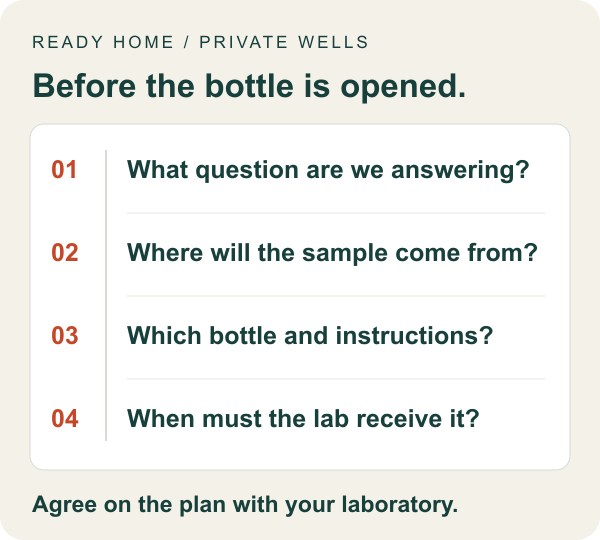
Start the order with a question the sample can answer
Are you checking routine drinking-water quality, investigating a new change, or asking whether installed treatment is doing its intended job? Tell the laboratory before ordering a package. CDC recommends a state-certified laboratory and local health-department advice on additional contaminants of concern. A broad-looking panel is not automatically the right panel for your location and purpose.
Write a one-sentence request in your own words: 'We want to investigate new staining at the kitchen cold tap' or 'We need the recommended follow-up after a well repair.' These are examples of questions, not diagnoses. Attach previous results and explain relevant events. If contamination is suspected, ask the health department about water use while waiting; collecting a sample is not itself evidence that the water is safe.[4][1]
Name the sampling point before naming the bottle
Penn State Extension distinguishes raw well water from water collected after treatment or household plumbing. A kitchen-tap result may be exactly what you need for drinking-water exposure, but it may not describe untreated water entering the equipment. Ask the lab which point matches the question; do not casually bypass treatment to create a different sample.
Our suggested naming convention combines location and condition: 'Kitchen cold tap—after treatment' is more informative than 'Sample 1.' If the lab recommends paired samples, confirm which tests go on each and how the collection should be coordinated. Photograph labels on visible treatment equipment if helpful, but do not dismantle plumbing or use an unsafe access point to complete the request.[2]
There is no single rinse-and-flush recipe
Obtain the containers and written directions from the chosen laboratory. Penn State warns against reused food or drink containers and explains that some bottles contain a fixing compound that rinsing or overflowing would remove. Consequently, 'rinse every bottle first' is not a safe generic instruction. Neither is 'never rinse any sample bottle': the correct rule belongs to the specific test and container.
Penn State's own kit illustrates the problem: its instructions distinguish a bacteria bottle, a first-draw lead bottle and another bottle for other tests, with different handling. That example does not establish the procedure for your laboratory. Match each bottle to its instruction sheet and ask about faucet preparation, first-draw versus flushed collection, fill level and preservative handling. Do not borrow a flushing time from another test or pour an unfamiliar substance out of the bottle.[2][3]
Book the delivery window before collection day
Confirm the receiving laboratory's opening days, sample cutoff, transport instructions and maximum time allowed for each requested test. Penn State's kit has its own bacteria-sample delivery deadline and warns about weekends and holidays. The general lesson is to work backward from laboratory receipt; it is not to apply that kit's deadline to every analyte or provider.
Make a simple appointment record: lab contact, planned collection time, courier or drop-off arrangement, required cooling instructions and latest accepted receipt. If the courier cannot meet the plan, change the collection appointment rather than hoping the sample remains acceptable. Ask the lab what to do with a late, leaking or mishandled sample; do not hide the deviation on the form. A replacement collection is frustrating, but an undocumented compromise can leave you with a result that does not answer the original question.[3]
Use a final read-back before opening the kit
The worksheet below is an editorial preparation aid, not a collection protocol. Read the completed answers back to the laboratory if anything remains ambiguous. Keep the actual instruction sheet beside the kit on collection day; a remembered summary is not a replacement. Ask whether your particular test needs a trained sampler or documented chain of custody, especially if the result is for a transaction, dispute or specialized investigation.
Consider an illustrative mismatch: the order says untreated well water, the bottle says a first-draw plumbing test, and the household plans to flush the kitchen tap. Those three labels do not yet describe a coherent sample. Stop and clarify with the lab. The right correction is not to choose the most familiar instruction; it is to align the question, location, test and method before collecting.[2]
- Purpose agreed: the result has a named question and recipient.
- Location agreed: raw, treated or a specified household fixture.
- Bottle matched: exact test, label and the lab's instructions together.
- Receipt planned: collection time and delivery acceptance confirmed.
| Write down | Ask the laboratory | Avoid this shortcut |
|---|---|---|
| Purpose and requested tests | Which panel and sample points answer this question? | Ordering only by the largest number of tests |
| Exact sampling location | Should this be raw, treated or fixture-specific water? | Calling every household tap 'the well sample' |
| Bottle and protocol | Which instructions belong to each container? | Applying the same rinse and flush rule to all bottles |
| Collection and receipt times | What transport conditions and deadline apply? | Collecting first and arranging shipping afterward |
| Unexpected event | What if the bottle leaks or delivery is delayed? | Omitting a deviation from the sample record |
Scroll sideways to read every column on smaller screens.
Keep the result attached to the sampling story
When the report arrives, check that its sample ID and collection information match your record. Ask about any laboratory qualification, rejected sample or requested recollection before using a number to buy treatment equipment. CDC recommends health-department help with interpretation and next steps when harmful germs or chemicals are found.
Save the request, instructions, sampling notes and report as one record. For a future comparison, you need to know whether the same location and treatment condition were used—not just whether two numbers share a unit. The lab-report helper can organize results, while the testing-schedule guide covers future testing questions. Neither replaces the lab's interpretation of sample validity or the health department's water-use advice.[4]
Related reading and tools
Choose the next step for your situation: measure, compare options, or maintain and verify.
- Explore the topicWell Water Treatment
- Measure the problemHow Often Should You Test Well Water? A Practical Schedule
- Measure with a toolWell Water Lab Report Decision Helper
- Compare your optionsWhole-House Well Water Filter Order: Sediment, Iron, Softener, UV, and RO
- Maintain and verifyWell Water After a Power Outage: Pressure, Testing, and Safe Restart
- Maintain and verifyWell Water Treatment Maintenance Costs: A Five-Year Worksheet
How this guide was checked
Guides are built from official sources, product documentation, manufacturer manuals, and practical homeowner decision criteria. We do not claim hands-on product testing unless a page explicitly says a product was tested.
- Source-backed editorial review
- 4 cited source records
- Private well owners should test before buying treatment. Odor, stains, and taste are not complete safety assessments.
Ready Home Systems is educational and not a substitute for local code officials, licensed trades, medical providers, water labs, or mitigation professionals.
Read review methodologySources and manuals
- Protect Your Home's WaterU.S. Environmental Protection Agency
- Testing Your Drinking WaterPenn State Extension
- How To Use the Penn State Drinking Water Test KitPenn State Extension
- Guidelines for Testing Well WaterCenters for Disease Control and Prevention
FAQ
Can I bring the lab water in a clean drinking-water bottle?
Arrange the correct containers with the laboratory first. Penn State explicitly warns against used food and drink containers. A bottle that looks clean is not a substitute for test-specific preparation and any required preservative.
How long should I run the tap before sampling?
Use the instructions for the particular test. First-draw and flushed samples answer different questions. Ask the lab before collection rather than adopting a universal number of minutes.
Should I switch off treatment before taking the sample?
Do not change the system just to follow generic advice. Explain the treatment arrangement and your question to the laboratory, then agree on the sampling point and conditions. Untreated supply water and treated drinking water are different evidence.