Choose the winter operating plan first
A continuously heated occupied house, a weekend cabin, and an empty house without dependable heat need different plans. Decide with your plumber or well contractor whether the system will remain operational throughout winter or undergo a planned shutdown. Opening a few faucets does not establish that every tank, appliance, and low point is drained.
Write the intended operating condition at the top of a checklist: heat maintained, someone available to respond, and a named response if power fails. If any of those conditions changes, revisit the plan. Purdue's winter-outage guidance covers pressure tanks, plumbing, treatment units, appliances, and heating systems, illustrating why a complete shutdown is more than a pipe-wrapping project. Its detailed draining procedures are not a universal homeowner recipe. Obtain instructions for your actual equipment and leave unfamiliar disassembly or winterization to qualified professionals.[5]
Trace the route from the well to the last vulnerable fixture
Use the well log, earlier installer drawings, and visible plumbing to identify the outdoor wellhead, underground service route, building entry, pressure equipment, treatment equipment, and branches to unheated spaces. Maryland Extension explains that a pitless adapter makes a sanitary connection below the frost line. That description is not proof that your service line has adequate local burial depth; confirm unknown construction details with the well professional.
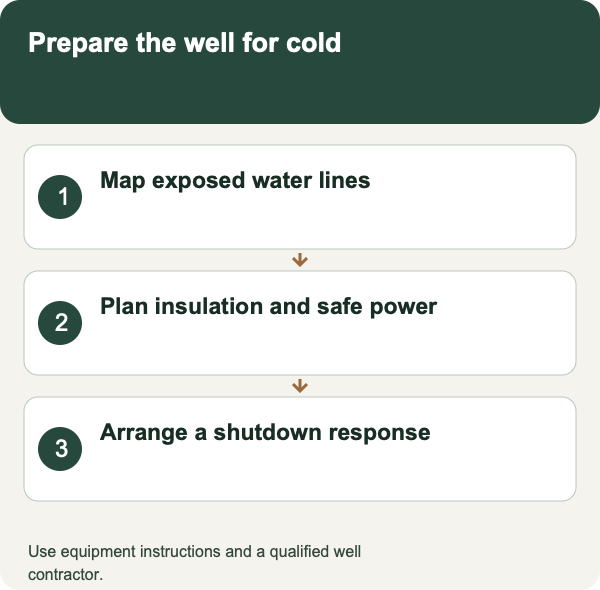
Our suggested map uses three labels: visible and protected, visible and exposed, or concealed and unverified. Mark pipe runs beside exterior walls, garage plumbing, crawl-space entries, and a separate pump house. Do not crawl into an unsafe space or remove a well cap to complete the map. Add the location of the household shutoff and the professional's instructions for using it, then make sure another adult can find the map without relying on your phone.[4][1]
Improve the building protection before the cold arrives
Oklahoma State Extension recommends looking for vulnerable supply pipes in unheated areas, insulating pipes, and sealing cold-air leaks where pipes enter the home. Keep the home's heating system in working order. If plumbing is in the garage, keeping the garage door closed helps preserve its existing protection. Cabinet doors can allow indoor warmth around enclosed pipes, provided household chemicals are moved out of children's reach.
Inspect insulation for missing sections and ask a contractor to correct recurring freeze-prone routing. Oregon State explains that insulation slows heat transfer; it does not create heat or guarantee protection through an indefinite outage. Avoid assigning a universal number of safe hours based on outdoor temperature alone. Record the conditions at the vulnerable location, not only the thermostat in a warmer room. For a pump house, have the heating arrangement and building enclosure reviewed together rather than improvising a lamp or portable heater beside equipment.[1][2]
Include tanks, filters, valves, and small connecting lines
A protected main pipe is only one part of a functioning supply. Add pressure equipment, filter housings, treatment valves, small tubing, outdoor branches, and water-using appliances to the inventory. For each item, note whether the manufacturer supplies winter-storage or freeze-protection instructions. Do not presume a water-filled component can stay in an unheated room because a nearby pipe has insulation.
Pentair's Pentek Big Blue housing specification specifically warns that freezing can crack the filter and cause leakage. That is a documented example, not a draining procedure for every filter. Ask the installer which components must remain heated and which can be safely winterized. If the system is being shut down, request a written restart sequence as well. Put equipment model numbers next to the tasks so a helper cannot confuse instructions for a filter housing, water heater, and heating-system loop.[6][5][9]
Treat heating cable as an electrical product, not generic tape
If a professional recommends heat cable, obtain the exact product instructions and verify the intended pipe material, dimensions, location, power arrangement, and permitted insulation. CPSC warns that damaged jackets, exposed conductors, or charring require attention; cable overlap and insulation rules depend on manufacturer instructions. Do not copy an installation photograph from a different product.
Record the cable model and who installed it. Ask how its operation should be checked without opening electrical equipment, what indicates a fault, and who responds if protection loses power. Do not assume a cable is working because its plug is present. Likewise, do not add blankets or extra insulation over it unless the instructions explicitly allow that arrangement. Existing cable with unclear identification or damaged wiring is a contractor question before winter, not something to energize experimentally during a cold night.[3]
Plan separately for an outage and for an unattended property
General advice to drip a vulnerable faucet assumes water can continue to be supplied. For a well without working backup power, withdrawing water consumes the available pressure reserve. Michigan's emergency guidance warns that depressurization increases contamination risk. Ask your plumber in advance how to handle both freezing exposure and pressure preservation; do not simply leave faucets running throughout an unpowered-well outage.
Create a response chain for absences: who receives a low-temperature or outage alert, who can reach the property safely, and which contractor already knows the system. Treat an alert as a request for assessment, not evidence that pipes are safe. If the plan requires professional shutdown before severe conditions develop, arrange access and contact details ahead of time. Never add automotive antifreeze to household water plumbing. Chemical use and winterization of specialized heating or drain systems require the applicable professional and manufacturer instructions.[8][5]
Know the stop conditions and document the recovery
A sudden loss of flow during cold weather, a cracked housing, visible leakage, or unusual pump behavior warrants a call to the plumber or well contractor. Do not force a valve, heat a pipe with flame, apply improvised electrical thawing equipment, or continue operating equipment that appears damaged. Keep clear of standing water and electrical equipment. Follow a prearranged safe isolation procedure only if you can do so without entering a hazardous area.
After repairs, ask whether pressure loss or opened plumbing calls for water testing and whether any treatment equipment needs its own restart procedure. Record exactly where the problem occurred so next year's preparation addresses that location. Preserve the wellhead's sanitary protection while improving weather protection: Oregon State advises leaving an intact seal undisturbed and checking vent screens. Do not bury the wellhead, block its vent, or pack a cover around it without professional review.
When comparing proposed preventive work, ask each contractor to identify the vulnerable component, the protection being added, the power dependency, and the response if that protection fails. A quote for pipe insulation and a quote for relocating plumbing solve different parts of the problem; comparing only the total price can obscure that difference. Keep the accepted scope with photographs and equipment instructions. At the next seasonal check, verify that the assumed conditions still exist rather than automatically repeating last year's shopping list.[1][2][7]
| Situation | Preparation priority | Escalation point |
|---|---|---|
| Occupied home with reliable heat | Map exposed sections and correct drafts and missing protection | Recurring cold spots or a history of freezing |
| Separate pump house | Review enclosure, equipment requirements, and approved heat arrangement | Unknown wiring, damaged cable, or unreliable heat |
| Power outage during severe cold | Use the agreed pressure and winterization response plan | Loss of flow, falling protection, or inability to keep the home safe |
| Seasonal vacancy without dependable heat | Schedule complete equipment-specific professional winterization | No written shutdown and restart plan |
Before you buy or hire
Related reading and tools
Choose the next step for your situation: measure, compare options, or maintain and verify.
- Explore the topicWell Water Treatment
- Measure the problemWell Pump Short Cycling: Pressure Tank Symptoms and Next Checks
- Measure with a toolWell Water Lab Report Decision Helper
- Compare your optionsWhole-House Well Water Filter Order: Sediment, Iron, Softener, UV, and RO
How this guide was checked
Guides are built from official sources, product documentation, manufacturer manuals, and practical homeowner decision criteria. We do not claim hands-on product testing unless a page explicitly says a product was tested.
- Source-backed editorial review
- 9 cited source records
- Private well owners should test before buying treatment. Odor, stains, and taste are not complete safety assessments.
Ready Home Systems is educational and not a substitute for local code officials, licensed trades, medical providers, water labs, or mitigation professionals.
Read review methodologySources and manuals
- Take Steps To Prevent Water Pipes From FreezingOklahoma State University Extension
- Winterizing your Water Well SystemOregon State University Extension
- Check Heat Tapes, Cables For Possible Fire HazardsU.S. Consumer Product Safety Commission
- Understanding and Maintaining Private WellsUniversity of Maryland Extension
- Protect Your Plumbing and Appliances during a Winter Power FailurePurdue University Extension
- Pentair Pentek Big Blue Filter Housings: SpecificationsPentair
- Twelve simple things you can do to protect your well waterOregon State University Extension
- Protecting Your Private Water Supply in an EmergencyMichigan Department of Environment, Great Lakes, and Energy
- Well Water BasicsOklahoma State University Extension
FAQ
Will pipe insulation prevent freezing all winter?
Not by itself in every situation. Insulation slows heat loss, while exposure, available heat, and outage duration still matter. Arrange a system-specific plan for vulnerable locations instead of treating insulation as a guarantee.
Should I leave a faucet dripping when the well has no power?
Do not apply that advice automatically. Water withdrawal can deplete pressure when the pump cannot run. Ask your plumber how to balance freeze protection and pressure preservation for your system before an outage occurs.
Is this the same as preventing a frozen sump discharge?
No. This checklist concerns the household drinking-water supply and its connected equipment. A sump discharge has a different purpose and layout; its winter precautions belong in a separate drainage-system plan.
Related guides
Best Iron Filter for Well Water: A Testing-First Buying Guide
Compare well-water iron filters by lab results, iron form, pH, manganese, service flow, backwash demand, maintenance, and verified media limits.
Best Sediment Filter Micron Size for Well Water
Choose a sediment filter micron size for well water by particle load, pressure loss, filter design, and water testing instead of relying on one universal rating.
How Often Should You Test Well Water? A Practical Schedule
Build a private-well testing schedule for annual checks, floods, repairs, household changes, and local contaminants—and learn what to do with the results.