Ask for a measured proposal, not a pressure promise
This worksheet is for the stage after the household has considered whether a continuing municipal water supply is a credible backup dependency. It does not repeat the battery-versus-water-powered comparison. Its deliverable is a record the installer can sign and explain: what was measured, where, under which conditions, and how it supports the proposed model.
Supply the existing pump identity, basin and discharge observations, previous flooding history and any known water-service restrictions. Ask who will obtain local plumbing and water-authority requirements. Do not create a live flood, obstruct a discharge, remove a cover with an unknown electrical hazard or handle an energized pump to gather information. Photographs from a safe position and existing service records are enough to begin the conversation.[1][4]
Write the gauge location beside every pressure
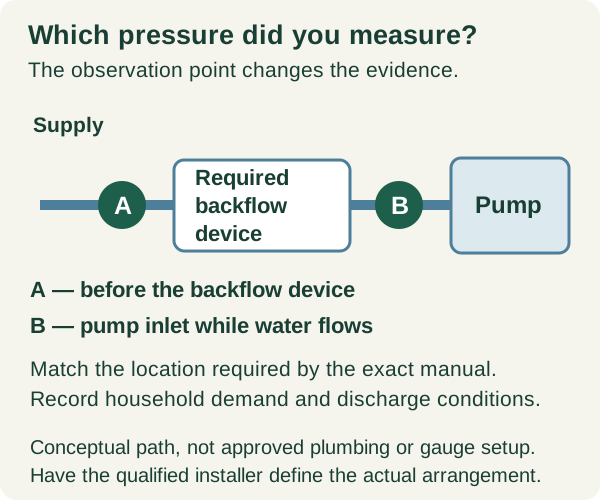
Liberty's current 5824000K manual separates closed-valve maximum supply pressure from operating conditions. Its performance table uses pressure at the SumpJet inlet while water flows; the table notes that an RP/RPZ backflow assembly can reduce operating pressure. The safety section also states a recommended minimum supply measurement ahead of the backflow device. Those locations must not be silently treated as the same measurement.
Ask the installer to label a simple sketch: municipal entry, proposed branch, required backflow protection, pressure observation points, backup inlet and discharge. The diagram on this page explains the distinction only; it is not a plumbing drawing or approved order of fittings. A number recorded at an outside faucet might be useful context, but it cannot by itself select the row of a pump-inlet performance table.
Record separate cases for no backup flow, backup operation alone, and an installer-selected representative household demand occurring at the same time. Note which fixtures were operating rather than labeling the last case 'worst case' without evidence. A brief visit cannot establish the utility's minimum pressure during every regional emergency; ask what supply uncertainty the proposal leaves unresolved.[1]
Use Guardian's 10-foot data as a conditional example
A.Y. McDonald's Guardian 747H20 submittal, dated 3/22, lists 390 gallons per hour removed at 30 psi inlet pressure and 906 gallons per hour at 60 psi, both at 10 feet of lift. Dividing by 60 converts those figures to 6.5 and 15.1 gallons per minute. These are manufacturer-published operating points, not measurements from our site or guaranteed performance at your house.
Liberty's current SJ10 manual gives 9 gpm at 30 psi and 8 feet of static head under its table conditions. The Guardian example is at 10 feet. Do not place those two figures into a winner column as if the test conditions matched. Have the installer relate the relevant manufacturer's data to the actual discharge arrangement and the property's assessed inflow; this worksheet cannot replace that hydraulic assessment.[2][1]
| Published inlet pressure | Published sump-water removal | Arithmetic unit conversion |
|---|---|---|
| 30 psi | 390 gph | 6.5 gpm |
| 60 psi | 906 gph | 15.1 gpm |
Scroll sideways to read every column on smaller screens.
Resolve the Guardian pressure-limit conflict before ordering
The Guardian submittal lists a 90 psi maximum, whereas the separately hosted 3210-352 installation sheet dated 12/21 states 150 psi. These official documents disagree. Do not treat the higher number as permission to operate between 90 and 150 psi, and do not assume that being below 90 psi resolves every installation condition. Ask A.Y. McDonald or the supplying installer for written confirmation of the current limit and instructions for the exact model supplied.
Keep that response with the quote and identify which document it supersedes. If a proposal cannot resolve the discrepancy, mark that candidate pending rather than smoothing the figures into a range. The same discipline applies to model suffixes: the submittal identifies 747H20-0001 as an RPZ-equipped option. A base model, an alarm option and a backflow-equipped version should not be interchangeable line items on a purchase order.[2][3]
Bring this worksheet to the site assessment
The following fields are an editorial handover structure, not a mandatory code form. Let the qualified installer decide the safe instruments and test procedure. If the installation is only proposed, distinguish measured existing conditions from calculated or assumed future conditions. A pressure measurement made before adding a required device is not evidence that the final assembled branch delivers the same pressure.
Hypothetical example: a proposal records 62 psi with no backup flow but 38 psi at the pump inlet during the agreed demand test. The static figure does not justify using a 60 psi performance point. The next question is which documented lower-pressure condition supports the required removal rate, or what further design information is needed. These invented readings illustrate record interpretation; they are not a Guardian or SJ10 test and do not establish a universal acceptance margin.
Keep the basis for inflow separate from the measurement of pump output. A dry-weather visit can document dimensions and supply behavior but may not reproduce storm inflow. Ask what the design case is, what evidence supports it, and what happens if that case is exceeded. The quote should make uncertainty visible instead of promising that a water-driven backup can run forever under every outage.[1][2]
| Field | Record | Unresolved condition to flag |
|---|---|---|
| Exact proposed equipment | Model, suffix, manual revision and pressure-limit confirmation | Conflicting manuals or unspecified variant |
| Supply and observation points | Sketch; gauge location; units; date/time | Static or remote faucet reading used as pump-inlet evidence |
| Flowing-pressure cases | Backup alone; agreed concurrent demand; fixtures named | Final branch/backflow device not represented |
| Removal requirement | Assessed inflow; discharge lift, route and pipe details | Only a maximum GPH label or dry-day assumption |
| Backflow and discharge approval | Authority, accepted arrangement and testing obligations | A supplied check valve assumed sufficient without approval |
| Commissioning and response | Permitted test result; alarm recipient; normal state restored | No observation record or no named responder |
Scroll sideways to read every column on smaller screens.
Backflow approval and a response plan are separate checks
The Guardian installation instructions require appropriate listed backflow protection for the installation under the applicable local requirements. Washington's health department illustrates that approved assemblies, qualified testing and retained records can be separate parts of a water-system program; its rules are not automatically the rules for every state. Ask the local water authority which assembly, permit, testing and future service obligations apply to this address.
For handover, ask the installer to demonstrate the manual's permitted operation and stopping sequence, verify the discharge route and unobstructed float motion, explain normal versus fault indications, and identify who receives any alarm. Keep the observation dates and the manufacturer's maintenance instructions. An alarm feature is not a response plan until its recipient and safe action are named.
Return the electrical primary pump and all controls to their intended normal state after professional testing. Store the final worksheet with the model/serial record, confirmed manual, backflow documentation and service contact. The result should let another qualified person understand the assumptions without repeating the whole sales conversation; it should not invite an owner to recreate dangerous failure conditions.[3][4]
Related reading and tools
Choose the next step for your situation: measure, compare options, or maintain and verify.
- Measure the problemHow to Size a Sump Pump: Flow, Lift, Pit Inflow, and Horsepower
- Compare your optionsWater-Powered vs Battery Sump Backup: Compare the Dependencies
- Maintain and verifySump Pump Replacement Quote Checklist: Compare the Complete Scope
- Maintain and verifySump Pump High-Water Alarm: Local, Wi-Fi, or Cellular?
- Maintain and verifyPrimary and Backup Sump Pump Maintenance Checklist
How this guide was checked 2026-10-23T00:00:00.000Z
Guides are built from official sources, product documentation, manufacturer manuals, and practical homeowner decision criteria. We do not claim hands-on product testing unless a page explicitly says a product was tested.
- Source-backed editorial review
- 4 cited source records
- Backup pump sizing depends on pit inflow, lift height, discharge path, battery age, and local flood risk. Check manufacturer instructions and local code.
Ready Home Systems is educational and not a substitute for local code officials, licensed trades, medical providers, water labs, or mitigation professionals.
Read review methodologySources and manuals
- SumpJet installation manual 5824000K (2026)Liberty Pumps
- Guardian 747H20 submittal data sheet (3/22)A. Y. McDonald
- Guardian installation instruction 3210-352 (12/21)A. Y. McDonald
- Cross-Connection Control and Backflow PreventionWashington State Department of Health
Keep a copy for reference or share the guide. Check the online version for later updates.
Ready Home Systems · https://readyhomesystems.com/water-powered-sump-backup-flowing-pressure/
Planning guidance, not a professional assessment. Check the online guide and cited sources for updates.